






😊👇🏼

🔔 We're delighted to share the Abstracts from the Serbian Group for Primary Immunodeficiencies (SGPI) 2nd symposium, which took place April 24-25 in Belgrade and Novi Sad, Serbia. Explore the latest advancements in #PID clinical practice and research! 👉 hubs.la/Q04tJF1c0

Latest from us. :)

Conor Gruber, @BogunovicLab @KidsAtColumbia et al. identify #STAT2 mutations in a family with severe early-onset pulmonary alveolar proteinosis (PAP), a rare lung disease marked by alveolar surfactant accumulation. hubs.la/Q04pM_cP0

An exquisite article in The Atlantic by @rkhamsi on how fatal genetic diagnosis need not be. Thank you for featuring @BogunovicLab. 👇🏼 nam02.safelinks.protection.o…

Latest from us. :) Led by amazing Pat O’Connell. We, more often than not, see variants of unknown significance (VUSs), and by definition don’t know if they are causative of disease. The only way to exclude them as causative is to test them experimentally. doi.org/10.70962/jhi.2026005…


Latest from us. Led by amazing Azzeddine Tahiat. Novel forms of CD55 deficiency. Importantly, C5 inhibition restores B cell homeostasis #CHAPLE disease @KidsAtColumbia @ColumbiaPS @Columbia rupress.org/jhi/article/2/4/…
Latest from us. @MelissaGansMD et al. lead the way in detailing how best to care for immune dysregulation in individuals with Down syndrome. @jhumimmunity doi.org/10.70962/jhi.2025016…

Latest from us. Led by @he_randolph. What goes rogue in #MISC? 1) Although clinically silent, inflammation persists for months! 2) This is in part due to expansion of T cells that recognize SARS-CoV2 antigens but also cross-react to self antigens. 👇🏼 nam02.safelinks.protection.o…
This is funny and true. :)

1/ Spotlight on our former trainee Dusan Bogunovic (@BogunovicLab), a postdoctoral fellow in our NY lab from 2010-13 and now Professor of Pediatrics, Vice Chair for Basic Research, and Director of the Center for Genetic Errors of Immunity at @Columbia.

A must read!
In this Perspective, Casanova @casanova_lab discusses the 30-year history and future implications of emerging science showing that monogenetic lesions, and #autoimmune disorders targeting the same components of host defense, can underlie the same infection hubs.la/Q048F5Zz0

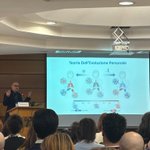
Latest thoughts. Today in @JExpMed. We are disomic individuals genetically. Transcriptionally we need not be. Here I discuss what we know about this and propose Theory of Personal Evolution. @KidsAtColumbia @ColumbiaMed hubs.la/Q047WZQZ0

Join our study using next generation Jak inhibitors in skin diseases in individuals with #DownSyndome with @EmmaGuttman @MSHSDerm and @BogunovicLab @KidsAtColumbia. We are actively recruiting. ds-connect.org/now-recruitin…

With his greatness. Honoring his greatness. Thank you @Cornell for invitation to Carl Nathan Lectureship. It was wonderful.

When in Rome… Thank you ImmunITA for hosting me. And thank you for listening to my theory. @KidsAtColumbia @ColumbiaMed

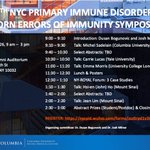
My favorite meeting is back in NYC. Come join us!!!
1/ The 33rd Annual Henry Kunkel Society Meeting will be held April 16–18, 2026, at @RockefellerUniv in New York. The theme is “Autoantibodies Against Cytokines.”

Sazeides et al. @BogunovicLab show that human ISG15 deficiency is a monogenic syndrome that poises individuals to a proapoptotic and profibrotic state that can lead to lung and skin damage with scarring and impaired function via chronic inflammation. hubs.la/Q044Ds9W0

Latest from us. @columbiaMed @KidsAtColumbia Dr Akalu et al. report on novel variants leading to TBK1 deficiency , resulting in autoinflammation but also in some cases viral diseases. doi.org/10.70962/jhi.2025024…

BogunovicLab retweeted

We’re very close, and when we reach 2000 signatures, petition will be sent to @GovKathyHochul ahead of her Executive Budget announcement and revision period throughout January! So share with friends & family! c.org/hwy54dWJDb

9th NYC IEI Symposium. Tomorrow at Alumni Auditorium on 168th street in NYC. Join us!!! nycpid.wufoo.com/forms/zsz0r…

BogunovicLab retweeted

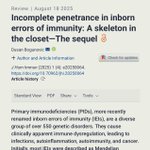
4️⃣ Dusan Bogunovic @BogunovicLab reviews how incomplete penetrance in genetic disorders can be influenced by genetic variant quality, genetic and epigenetic modification, environment, and mosaicism. rupress.org/jhi/article/1/4/…
