

Co-Founder and CEO at Soda Labs @sodabubblelabs I mostly write about cryptography and Web3. Schedule a call https://xitter.cf/t.co/wf3jt0LJaw
Joined April 2012
- Tweets1.8K
- Following2.3K
- Followers1.6K
- Likes3.4K
Luckily, from what we know, this was only a data leak and not a secret key leak. But even a data leak is really bad. Names and emails are enough for targeted phishing, and once they're out, they're out for good. xitter.cf/coinbureau/status/2125…


Factoring in P would break RSA. Bitcoin signatures rest on elliptic curve discrete log, a different problem, so I'd wait for an actual announcement before moving any coins. xitter.cf/Cointelegraph/status/2…

⚡️ NOW: AI labs likely hold undisclosed cryptography breakthroughs that could threaten the encryption behind crypto wallets, says computer scientist Scott Aaronson.
cointelegraph.com/news/ai-la…
1
5
437
Computing on encrypted data doesn't have to mean GPUs or ASICs. Why do so many stacks assume it does?
We chose garbled circuits: real-time speed, NIST-standardized AES and SHA-256 inside circuits, and AES-NI already in Intel CPUs.
Clip from my talk at @CryptoCanal Common S3nse in Amsterdam: youtube.com/shorts/cOWtleNHa…
Full talk: youtu.be/HE0hq_Arv4Q

1
3
69
Two schemes built to survive quantum computers were broken in 2022 [1][2]. A laptop and a weekend was enough.
Rainbow and SIKE had spent years in the NIST competition. Then someone found a theorem that fit the math, and the math gave way. No quantum computer required.
Every cryptosystem is a bet that some math problem stays hard. Eli's chart ranks the bets.
Elliptic curves, which protect much of the internet, are rich in structure. That is why they are fast and compact, and exactly what Shor's algorithm exploits. A large enough quantum computer ends them.
Lattices are next in line. No efficient quantum attack is known, which is real progress. But they are young and still carry plenty of structure. In 2024 a claimed quantum break of lattices lasted about a week before a bug was found. [3]
At the top sit AES and SHA-256, closer to pure (and clever) scrambling than to algebra. Nobody has found an algebraic shortcut, and after 25 years of public attacks the best results on full AES shave about two bits off brute force. [4] Grover's algorithm, the best known quantum attack, only takes a square root off the search, so doubling key sizes is believed to absorb it (and we already have AES-256 standardized).
With AI -faster mathematics means more theorems and theorems like structure. The fewer and older the assumptions under a system, the less a faster mathematician can do to it.
[1] eprint.iacr.org/2022/214
[2] eprint.iacr.org/2022/975
[3] eprint.iacr.org/2024/555
[4] eprint.iacr.org/2011/449

Our digital world is secured by math.
This isn't just about blockchain. It's banks, messaging apps, online shopping, personal info, you name it.
If AI is advancing math faster than ever, we need to stay ahead of the curve.
The way to do that is with stronger cryptography 🙂

5
5
545
Avishay Yanai retweeted

The Binance hack reportedly began with a job interview. How did one laptop get so far?
On the STG-3 panel, Verdict Machine: malware in a "home assignment," then lateral movement through internal AI tooling.
How far could one laptop get in your org?
@keinan_ziv @Verdict_Machine
North Korea's hackers reportedly run like a company. What happens when they get AI?
zeroShadow on the STG-3 Binance hack panel: AI lets them scale, and helps them chain small security gaps into "big problems."
Which gap would they chain first?
@keinan_ziv @zeroshadow_io @Verdict_Machine
Everyone wants a better vault for the key. Is the vault the problem?
My answer on the STG-3 Binance hack panel: "implement policy checkers along the path of approvals." At every point in the flow, not only one.
Where does your flow check policy?
@keinan_ziv @Verdict_Machine @zeroshadow_io
Avishay Yanai retweeted
Want to explain privacy to developers? Soda Labs builds privacy software. Join our Growth Partners program for Telegram, X, LinkedIn and developer communities. You propose your rate.
Applications close in two days, Sat Nov 21.
Apply to join: sodalabs.xyz/apply

ALT Card: Join the Growth Partners program. Telegram, X, LinkedIn, developer community. You propose your rate. Apply to join. Applications close Sat, Nov 21. sodalabs.xyz/apply
A hardware wallet is one chip you trust blindly. Tamper with the supply chain and the seed was never yours.
The fix isn't a better box. Split the key so no single device ever holds all of it.
Why is self-custody still sold as a single point of failure? xitter.cf/Cointelegraph/status/2…
🇦🇪 LATEST: Ledger’s hardware tampering saga has spread to Dubai, where two owners report losing $604,000 in crypto from wallets they say they bought at an authorized Virgin Megastore.
ct.com/news/ledger-hardware-…

Is crypto's transparency why it keeps getting hacked?
My answer on the STG-3 Binance hack panel: no. The attacker needed access to a service that signs what it's asked.
Transparency helps defenders follow the funds in real time.
@keinan_ziv @Verdict_Machine @zeroshadow_io
Privacy is a pre-requisite to regulated finance

Monad just announced Monad Private Settlement. Co-founder Keone Hon on who it’s for:
“Maybe a bank or an exchange or some other entity that has a bunch of customer-specific details.”
“They need to keep private.”
“But they need to allow those users to still interact atomically with all the liquidity of the layer one.”
@keoneHD @monad
3
209

Avishay Yanai retweeted
She gets it

One thing I’ve always found interesting about blockchain is how much information we’re expected to make public just to use it.
Your transactions, wallet balances and financial activities can be visible to anyone. That’s great for transparency, but not everyone wants their entire financial life open for public inspection.
Imagine running a business where everyone can see your payments, balances and financial strategies.
This is a problem @sodabubblelabs is working to solve.
And I think their approach deserves more attention. 🧵

Avishay Yanai retweeted
MPC is the only way to achieve:
✅ Privacy
✅ Resistance to crashes and compromised machines
✅ Availability
✅ Operational resilience
✅ Compliance compatibility
✅ Complex business logic

More TEEs don't make you more private.
They make you less.
Securing one TEE may be possible. But availability needs replicas, and resilience needs them spread out. Securing TEEs in that setup is close to impossible, and breaking into one can mean a privacy disaster.
MPC gives you redundancy without growing the attack surface.
And ZK alone can't do it either: even a simple token transfer needs computing on data from different participants, let alone more complex logic like auctions and DEXs.
That's why we chose MPC at Soda Labs.
Clip from my talk at @CryptoCanal Common S3nse in Amsterdam.
Avishay Yanai retweeted
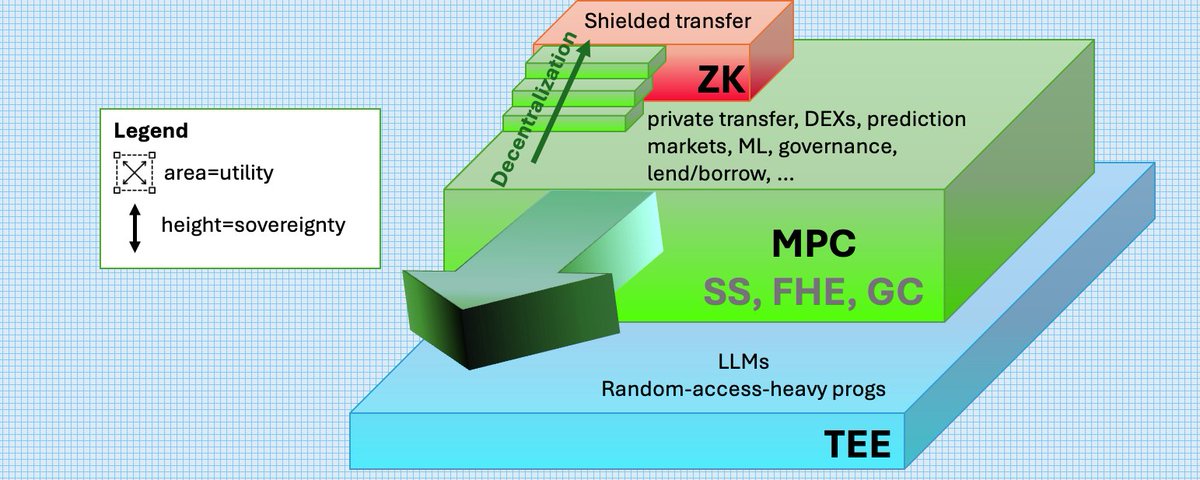
MPC is the answer to the utility vs sovereignty question.
ZK isn't the only road to sovereignty. Can MPC get close?
TEEs: run almost anything, trust the hardware.
ZK: "in math we trust".
MPC: more parties and a higher threshold make collusion much harder.
From my @CryptoCanal Common S3nse talk.
ZK isn't the only road to sovereignty. Can MPC get close?
TEEs: run almost anything, trust the hardware.
ZK: "in math we trust".
MPC: more parties and a higher threshold make collusion much harder.
From my @CryptoCanal Common S3nse talk.

