

Fostering a vibrant, inclusive, and global community dedicated to science and society. Join us: https://xitter.cf/t.co/Jvs055fiDM
- Tweets18.9K
- Following254
- Followers256K
- Likes10K






ALT A keynote speaker shares their research at a large session.

ALT A 3D rendering showing many black holes with orange accretion disks against a black background.

ALT Title slide reading "A Snapshot of PRL's Nobel Legacy" with a swirling blue and green particle image inside an oval frame, and "Swipe for discoveries through the years" below it with a forward-arrow icon. Two entries are shown: “2026, High-Energy Astrophysical Neutrinos,” illustrated with a vibrant 3D visualization showing colorful vertical columns made of stacked spheres glowing in yellow, orange, red, and green against a white background, citing PRL 111 021103 (2013) and PRL 113 101101 (2014). “2025, Macroscopic Quantum Tunneling,” illustrated with a schematic of an apparatus with a Pt-195 NMR thermometer, citing PRL 53 1260 (1984), PRL 55 1543 (1985), and PRL 55 1908 (1985).

ALT Four Nobel-linked discoveries: “2023, Attosecond Pulses,” illustrated with a diagram of a wave packet and two green V-shaped curves, one straight and one tilted, with pink spheres above, citing PRL 42 1127 (1979), PRL 48 1814 (1982), PRL 73 2180 (1994), PRL 77 1234 (1996), and PRL 81 297 (1998). “2022, Quantum Nonlocality,” illustrated with a schematic of a photon entanglement experiment using polarizing beam splitters and detectors, citing PRL 23 880 (1969), PRL 28 938 (1972), PRL 47 460 (1981), PRL 49 91 & 1804 (1982), PRL 71 4287 (1993), PRL 80 3891 (1998), and PRL 81 1345 (1999). “2021, Complex Systems,” illustrated with a grid of green dots with arrows showing a disordered spin system, citing PRL 43 1754 (1979), PRL 50 1946 (1983), PRL 52 1156 (1984), PRL 109 205501 (2012), and PRL 127 038001 (2021). “2020, Black Hole Formation,” illustrated with an artist's rendering of warped spacetime around a glowing blue sphere, citing PRL 10 66 (1963) and PRL 14 57 (1965).

ALT Four Nobel-linked discoveries: “2019, Cosmology,” illustrated with a split image of a smooth sphere transitioning into a starry, clustered universe, citing PRL 16 410 (1966). “2018, Optical Tweezers,” illustrated with a laser beam trapping a chain of green spheres, citing PRL 24 156 (1970), PRL 40 729 (1978), and PRL 57 314 (1986). “2017, Gravitational Waves,” illustrated with an artist's rendering of two orbiting compact objects warping a grid of spacetime, citing PRL 116 061102 & 241103 (2016) and PRL 118 221101 (2017). “2016, Topological Phases of Matter,” illustrated with a thermometer-style diagram showing matter transitioning through plasma, gas, liquid, solid, and quantum condensate states, citing PRL 39 1201 (1977), PRL 49 405 (1982), PRL 50 1153 (1983), and PRL 61 2015 (1988).

ALT Four Nobel-linked discoveries: “2015, Neutrino Oscillations,” illustrated with a photo of workers inside a large spherical particle detector, citing PRL 81 1562 (1998), PRL 87 071301 (2001), and PRL 89 011301 (2002). “2014, Super Resolved Fluorescence Microscopy,” illustrated with a fluorescence microscopy image of a cell with red and green glowing branching structures, citing PRL 62 2535 (1989). “2013, Higgs Boson,” illustrated with a starburst labeled "Big Bang" connecting to a ball-in-a-bowl diagram labeled "10⁻¹¹ seconds," citing PRL 13 321 & 508 (1964). “2012, Manipulation of Individual Quantum States,” illustrated with a Schrödinger's-cat-style silhouette of a black cat and its shadow, citing PRL 76 1796 & 1800 (1996).


ALT A detailed image of the Milky Way galaxy, showcasing a bright, luminous center and a dense band of stars and cosmic dust stretched across the dark expanse of space. The surrounding area is dotted with numerous stars and faint celestial bodies.

ALT Graphic with text reading “APS Honors, Fellows Announced.” It is on a blue background with a gold seal in the upper right corner reading “APS Fellow.”


ALT A line-art portrait illustration of Francis Halzen with gold accents, created by Niklas Elmehed. Below the illustration, a dark red banner displays his name, "Francis Halzen," along with the award citation: "for decisive contributions to the IceCube Neutrino Observatory and the discovery of high-energy neutrinos of astrophysical origin". At the bottom, text attributes the award to the Royal Swedish Academy of Sciences.

ALT Front cover of the journal Physical Review Letters, Volume 111, Number 2, published July 12, 2013 by the American Physical Society. The top portion features green geometric stripes framing the issue number "111" and the journal title. The center displays a scientific visualization composed of vertical wave-like patterns made of colorful, semi-transparent spheres and spindle-like columns in shades of green, yellow, orange, and blue set against a light cream background.

ALT Illustrated portrait of Francis Halzen, the 2026 Nobel Prize in Physics laureate, drawn in gold and black ink. On the right corner is a small artists’ insignia reading N E. Illustration credit: Niklas Elmehed, Nobel Prize Outreach.


ALT Stanislav Petrov is seated at a table in his home.

ALT At left, a full-scale model of the Molniya-1 satellite hangs from a ceiling in the Tsiolkovsky State Museum of the History of Cosmonautics. The model features a central component from which six rectangular panels extend. At right, a diagram showing the trajectory of the highly eccentric Molniya orbit.

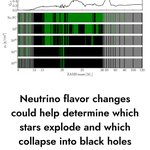
ALT A graph shows successful (green) and failed (black) stellar collapse outcomes across stars with zero-age main-sequence masses from nine9 to 120 times the mass of the sSun. Results are shown for simulations without neutrino flavor conversion and with conversion occurring at three different core densities. The patterns of successful and failed outcomes vary substantially across stellar masses and conversion assumptions. Text at the bottom reads, “Neutrino flavor changes could help determine which stars explode and which collapse into black holes.”

ALT A graph shows successful (green) and failed (black) stellar collapse outcomes across stars with zero-age main-sequence masses from nine to 120 times the mass of the sun. Results are shown for simulations without neutrino flavor conversion and with conversion occurring at three different core densities. The patterns of successful and failed outcomes vary substantially across stellar masses and conversion assumptions.

ALT Two people sitting and talking together, while one has their laptop open on their lap.

ALT Two people are placing pins on a large, colorful map of the world. One person is focusing on a specific area of the map. They are both wearing coats and holding what appear to be travel documents or guides. The setting looks like a public event or a museum.

ALT A group of individuals stand in front of a large map backdrop with the APS logo. The map highlights a welcoming global community of APS members, with the text "Where is your home?" People are engaged in conversation and examining the map, some carrying backpacks.

ALT A series of three side-by-side photos capture Kelvin wave turbulence along an air-water vortex filament. A 40-centimeter-long vortex set against a black backdrop is bounded on the bottom by a red tube and on the top by an immersed gray annulus, where the vortex is forced by gentle random horizontal oscillations — generating interacting Kelvin waves that transport energy along the filament.

ALT A headshot of Amir with greenery in the background.

ALT Amir stands at a blackboard covered with equations.