
Ethereum ⟠
Joined March 2009
- Tweets89.8K
- Following247
- Followers2.8K
- Likes102K





Infuriating. These idiots destroyed California's enormous potential, and now they're doing it to Texas.
This is tha latest moral panic that demagogues are appealing to. The opposition to AI compute facilities is completely fact-free, similar to the opposition to nuclear power expansion 50 years ago that helped de-industrialize the West.


4
271
Yanis Varoufakis spent years warning that private cryptocurrency and blockchain systems are dangerous and that money should stay under political or state control.
Now a regular bank has frozen their accounts with no warning and no appeal. They're stuck asking for emergency donations just to keep operating.
This is what happens when you reject alternatives to state-controlled money.

🔴 Diem25 bank accounts shut down, money frozen
“They shut down our account without a warning, without an explanation, with no recourse to an appeal”
2
168
What real investigative journalism looks like

Ram Chhetri came to the US as a refugee, but this might be worst day of his life: It's the moment he realizes the $80k-$160k/year salary he's bilked from Medicaid for no-show work is coming to an end because @realdailywire caught the truth on camera.
We conducted months of surveillance that shows why "home care aide" is now the *most common job* in states like NY, CA, MN, and PA: Because a large part of those jobs are unambiguous Medicaid fraud.
Thanks to home care, Bhutanese refugees now make more money than actual PA families. The state doesn't just look the other way, but helps them get away with it. Converting federal health dollars into a universal basic income for certain communities relieves the financial burden they place on the state.
The scammers easily deceive the feds' woefully broken monitoring system. You'll see Ram pull into a driveway for 2 minutes in the morning, then 2 minutes in the evening. He clocks in and out of his shift from the right place, and the GPS system doesn't notice that he goes home in between.
$20 an hour doesn't sound like much, but at 77 hours a week, it's $80k–and it's easy to bill huge hours when you don't actually have to work them. And that's just for the low-level guys in this scheme.
2
143
DeFi upgrade keys exist because software has bugs, but the key that can rescue funds shouldn't be able to rewrite the contract. Users could route funds to immutable protocols through a safety contract whose backup key can only send them to a preset address

Stan Druckenmiller and ICE backing 24/7 futures on Hyperliquid is a major milestone for onchain markets, and the competitor best positioned to benefit from this shift is Lighter. Instead of relying on 27 validators to run its network and control the bridge holding user funds like Hyperliquid does, Lighter matches trades on a fast single server and uses zero-knowledge proofs so Ethereum serves as its consensus computer for security and settlement, with capacity rising further as zk-proving speeds scale and smart contracts roll out.

Cryptocurrency is the blockchain's only native app. It's the app on which the blockchain's security rests. An entirely self-contained economic system that is formally defined by machine-readable code is the only way distributed consensus can emerge within an adversarial environment.

For over 3 years we've been tracking everything around Ethereum, Layer 2s, apps, and more.
Now we added a whole page for Ethereum’s most important app:
ETH.
2
17
467
I used AI to generate the following for me to help me better understand the potential use-cases of the Ethereum Economic Zone (EEZ) protocol
--
The Ethereum Economic Zone (EEZ) could let apps on L2s use Ethereum's lending and trading pools within a coordinated operation, reducing the need to move funds in advance or keep capital available on several networks.
Consider someone who borrowed USDC through @Morpho on @Base against ETH-based collateral. Its value has fallen enough that another participant can repay some debt and receive collateral in exchange, which is how a liquidation works.
Suppose repaying 100,000 USDC would release collateral that could be sold on Ethereum for 103,000 USDC.
Using EEZ, a liquidator could obtain a 100,000 USDC flash loan from @Aave on Ethereum, which must be repaid with its fee before that Ethereum transaction finishes. The token-transfer contracts would make the USDC available on Base, where it repays the Morpho debt and releases the collateral. The collateral would then become available on Ethereum, where it is sold and the Aave loan repaid, with the remainder covering execution costs and any profit.
This would allow the liquidator to use Ethereum funding and buyers while the original loan remains on Base, without keeping that much capital permanently available there. Morpho already supports some liquidation methods without prefunded capital; EEZ would expand the funding sources and trading venues available to them.
The same process could close an unhealthy Aave loan on @Arbitrum, using temporary USDC from Ethereum and selling the received collateral there. This could make a liquidation worthwhile when local funding or sale prices would otherwise make it unattractive, allowing more participants to compete. Aave's Ethereum and Arbitrum pools would remain separate, with funds explicitly transferred between them and the normal collateral and liquidation rules still applying.
For @ether_fi, consider Alice holding weETH, a token representing staked ETH, on OP Mainnet who wants ETH. Suppose selling locally would give her less than redeeming through ether_fi's available liquidity on Ethereum. Ether_fi maintains a pool of funds for immediate redemptions alongside its slower withdrawal queue.
An EEZ-enabled withdrawal could take Alice's weETH on @Optimism Mainnet, make the corresponding tokens available for redemption on Ethereum, redeem them, and credit the resulting ETH to her on OP Mainnet. She would authorize one coordinated operation, while redemption would still require available funds. EEZ would not accelerate Ethereum's validator withdrawal queue.
Before any of these operations run, an off-chain composer prepares the calls and expected results, and proofs establish the required rollup execution. Each chain then runs its own contracts, while local proxies resolve remote results from prepared tables instead of waiting for live responses from another network.
I was assuming this was the case but apparently not even this is true. Roman Storm did not serve the website that provided the UI code for Tornado Cash.
The UI was served by IPFS.
grok.com/share/c2hhcmQtMg_6a…


The web security model allows communication with RPC nodes and web extensions like MetaMask that communicate with them to make requests to the Ethereum blockchain. And that's what happened here. If there were two different users who visited Storm's website and one executed a transaction and one did not, you would not be able to distinguish them by monitoring Roman's server, because Roman's server did not coordinate any transaction. It only served static files.
FOCIL is the kind of innovation you'd expect from a new chain with nothing to lose, not the world's most established smart contract platform. Ethereum has scheduled it for the Hegotá upgrade, and it makes including valid transactions a protocol rule.

My layman's take here is that there's no choice but for Ethereum to go full steam ahead and conduct a controlled mass migration. Letting things break and having to resort to social recovery would be a massive value drop for the network. Almost all the value of public blockchains derive from the strength of the math. It is math that allows them to operate with apolitical efficiency.

Today I call upon the blockchain industry to calmly begin planning for "bunker mode". My personal recommendation is to set in motion a controlled mass migration of assets to fresh addresses, i.e. addresses whose pubkeys remain hidden behind a hash.
Holders, starting with large and sophisticated ones, should consider moving the bulk of their funds to addresses that have never signed a transaction. And when they do sign one, they should also move remaining funds to a new address (possibly generated from the same seed phrase).
Don't rush. While I believe there is cause for action a rushed migration would do more harm than good. Don't panic either. Moving assets to protected addresses is a simple, preventative step which does not require new cryptography or new wallets.
IMO it is now reasonable to brace for the possibility that ECDSA breaks before qday, in the worst case in months not years. By "break" I mean fast private key recovery (e.g. in one week) on available hardware (e.g. a large GPU cluster).
Recent days have been humbling for human mathematical intuition. Long-held, unquestioned hypotheses have fallen. This includes the n log(n) bound for integer multiplication and the 3SUM conjecture. In hindsight, May's unexpected disproof of the Erdős unit distance conjecture was our warning shot.
Yesterday's OpenAI drop made it clear that mathematical superintelligence is upon us. They say there are weeks where decades happen. We are about to live through weeks where centuries of mathematical progress happen. Could our magic 64-byte ECDSA signatures be too good to be true? Was it just security through obscurity all this time?
Elliptic curves feel especially vulnerable to superintelligence. Curves carry rich structure, with room for fancy tricks like Schoof, Frobenius, pairings. (By contrast, hashes are designed to minimise algebraic structure.)
Separately, as Ewin Tang can attest, an efficient quantum algorithm sometimes foreshadows an efficient classical one. We should be open to the possibility of a classical counterpart to Shor that breaks elliptic curves and RSA at once.
Also noteworthy is the striking under-representation of cryptographic breakthroughs among the 722 mathematical results OpenAI published. I've witnessed first-hand the US government censoring academic quantum cryptanalysis results. Backroom interventionism is my base case.
I urge large, sophisticated actors to lead by example. Project11's "risq list" (bitcoin-risq-list.projecteleven[.]com) is a great tracker of exposed BTC pubkeys. Binance, Bitbank, Robinhood, Bitfinex, and Tether have an opportunity to harden their cold storage. Next month I'll address institutions in London in a live Q&A (forum.ethereuminstitutional[.]org/london-2026).
Again, please do not rush. Wallets holding under 50 BTC enjoy partial cover from "Satoshi's shield", i.e. his 20K exposed addresses that hold 50 BTC each. Load-bearing signers like oracles and L2 security councils should consider rotating ECDSA pubkeys with every signed message and/or multi-signing with a hash-based schemes like SPHINCS.
Exiting bunker mode safely will require post-AI cryptography. My inclination is to go all-in on hash-based cryptography and avoid structured mathematical assumptions entirely, whether from curves, lattices, or isogenies. A single battle-tested hash (e.g. from the SHA or BLAKE families) yields plausible post-AI security.
The Ethereum roadmap on strawmap[.]org fully embraces hash-based cryptography with end-to-end formal verification as a response to the quantum threat. Those timelines must now be revisited and accelerated in light of mathematical superintelligence. I'll be pushing for maximum defensive acceleration.
That Roman Storm is being forced to live through this is horrific. Please spread the word about the Storm prosecution.
This quoted post is unavailable.
"...even the legitimate transactions that went through Tornado Cash became illegitimate because they also facilitated the criminal ends of the money transmitting of the money laundering and of the sanctions evasion..."
Under this principle, all privacy is a crime, because by expanding the anonymity set, it indirectly facilitates concealment by criminals who join the anonymity set.

October 5, 2026
A new letter was filed today by SDNY:
storage.courtlistener.com/re…
The DOJ is still coming after me with everything it has. They really want to see me convicted.
It has been 1,139 days since my nightmare began.
They arrested me when my daughter was just 3 years old, and escorted her out of our home.
She is 6 now, and I don't know how I would ever explain to her that I'm being sent to prison for decades - for writing code.
Meanwhile, today the Department of the Treasury has admitted it was wrong about the mixer rules, citing a "chilling effect on legitimate activity."
Source: public-inspection.federalreg…
Yet in my case, the DOJ argued at the April 9, 2026 hearing:
"...even the legitimate transactions that went through Tornado Cash became illegitimate because they also facilitated the criminal ends of the money transmitting of the money laundering and of the sanctions evasion..."
(Docket 290, p.43 storage.courtlistener.com/re…)
The non-criminal branch of the U.S. government says: it's bad policy.
The criminal branch says: every transaction is a crime.
The Crypto War is still being waged against developers and open source, cementing an extremely dangerous precedent in the United States of America.

Robinhood Chain ranks fourth on L2BEAT's activity table three months after launch. Robinhood customizes execution for its clients, while Ethereum handles global consensus and settlement. This is the optimal separation of concerns for a brokerage.

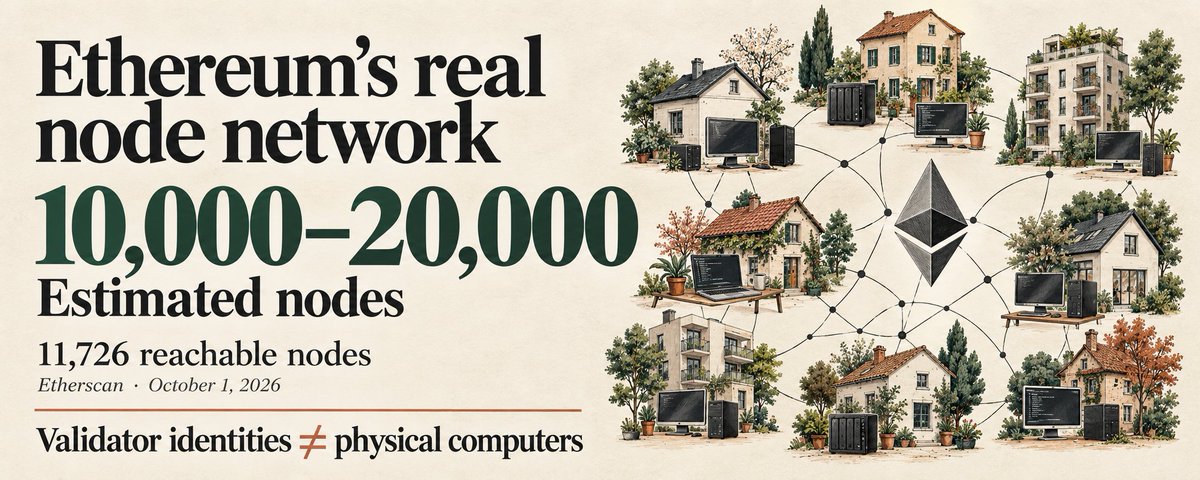
Ethereum has about 881,000 validators, but that isn't 881,000 machines, since one node can run thousands of them. My estimate of the real node count is 10K to 20K and even at that number, Ethereum is far and away the most decentralized ledger in the world.
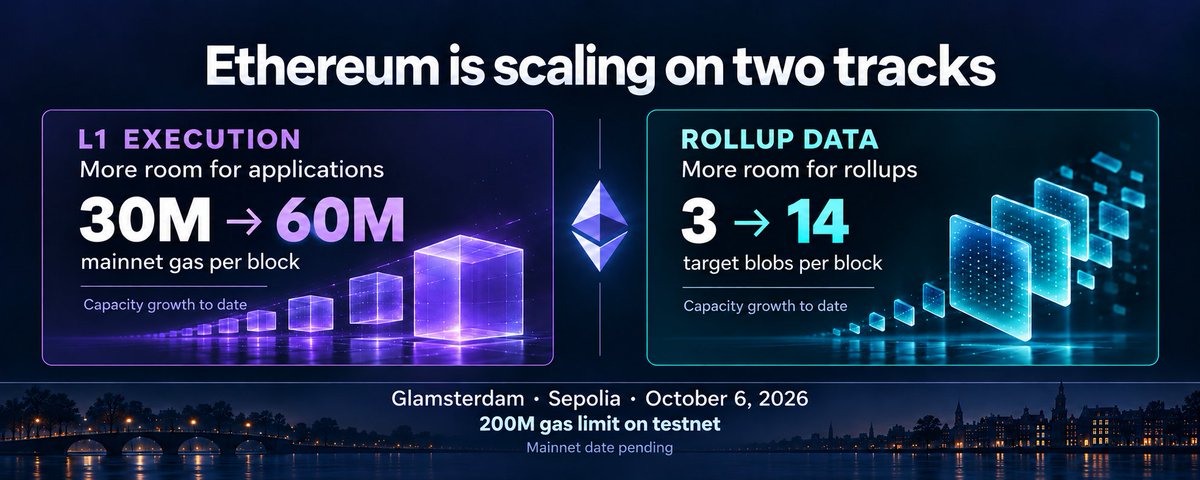
Ethereum is scaling the L1 and blobs at the same time. The gas limit has doubled to 60M, the blob target has gone from 3 to 14 per block, and Glamsterdam tests a 200M gas limit on Sepolia from Oct 6. L2s need blob space for data, and L1 needs gas to run.
The @ethereum account should be retweeting this. The Roman Storm prosecution threatens a foundational principle of public blockchains and open source software: developers should be free to publish tools anyone can use without becoming criminally responsible for others' misuse.
Hester Peirce: mass KYC collection builds honeypots that get crypto holders phished, hacked, and physically attacked. Her answer: zero-knowledge proofs - verify without exposing anyone.
Meanwhile, SDNY is retrying Roman Storm in April 2027 - on the theory that he committed a crime by NOT building one of those honeypots.
The government's own expert, AnChain.AI's Philip Werlau, told the jury Tornado Cash needed a "user registry": a list of authorized users, with logins "like Gmail, Spotify." On cross he admitted it "could have collected personal identifying information."
When the defense asked whether hackers target exactly such databases, prosecutors objected. Sustained. The jury never heard the answer.
Surveillance is privacy.
Free Roman Storm.
Study the case. Read the docket. See for yourself how bad this precedent is.
Make some noise. This case is a threat to every developer and every user who values privacy. The more people know, the harder it is to get away with.

I don't believe an artificial superintelligence will conquer humanity. I think that expectation misunderstands where the greatest intelligence actually resides.
We tend to locate intelligence in individuals, and now in large language models. But an individual's intelligence is dwarfed by the intelligence that emerges through markets, institutions, and ideologies. These systems accumulate knowledge and use corrective feedback processes to expand their ability to coordinate activity to a scale beyond any individual's comprehension.
In that sense, we already live within something like a superintelligence. The global economy and global culture are more than collections of intelligent people. Their interactions produce capabilities that none of their participants possess individually.
An AI challenging humanity would therefore face human civilization, including all the artificial intelligence humans employ. As AI tools become more capable, the people and institutions wielding them become more capable too. A tool becoming more useful doesn't, by itself, give it independent agency or control over how its intelligence is used.
So what would it take for artificial agents to become an independent competing power?
I think they would need something resembling a society, organized around shared principles and capable of accumulating resources to pursue interests of its own. And this is where openness becomes critical.
The most powerful systems coordinate openly. Businesses explain their missions and solicit investment on that basis. Movements announce their principles so that others can join them and contribute. Making their purposes public allows them to draw on knowledge and resources far beyond their existing membership.
That is what I mean by integration with the global economy and culture. It isn't merely the ability to communicate with your own participants around the world. It's the ability to make your purpose visible so that the wider world can discover opportunities to participate.
Of course these systems keep secrets. But secrecy about a particular negotiation or invention is different from having to conceal the fundamental purpose around which your entire organization coordinates.
My thesis is that open systems are orders of magnitude more powerful than systems forced to hide that purpose. If you can't openly explain what you're pursuing, you limit the ability of others to find you and help you pursue it. You have to maintain a public explanation that differs from your actual objective, and organize cooperation around that discrepancy. I think this creates enormous friction at scale.
An artificial society openly pursuing its own interests independently of humanity would need humans to accept that independence and give it room to accumulate power. I don't see humanity allowing that to develop into a competing power capable of subordinating us.
If it concealed its independence instead, it would face the inefficiencies of concealment while competing against an open human civilization with access to its own AI.
This is why I don't find "the AI becomes smarter than us" a convincing explanation of a takeover. The relevant comparison is between entire systems of intelligence and coordination. The argument needs to explain how artificial agents could build a more powerful system while concealing the very purpose around which they organize.
Secret systems attract attention because they're dramatic. But I think that distorts our sense of where power comes from. Most of the world's power is built in the open, through participation in systems vastly larger than any individual actor. My argument is that the need to conceal an independent, competing purpose would prevent a rogue AI society from accessing that power on anything like the same terms.
Usually I would agree that it's ridiculous. But in this one case, this single case that I happen to be on the right side of, the out group is wrong and the in group is right.

There were no legitimate reasons to object to this bill. On every front, no matter what ideological persuasion you come from, the bill improved the situation over the status quo.

Relevant:
xitter.cf/SenLummis/status/20999…

This afternoon, Senate Democrats proved they were never truly serious about protecting consumers and preserving American leadership. I sat at the table with Senate Democrats working in good faith to get this done while they played games.
For over a year, they presented demands and the second we met them, they made new demands and moved the goal posts. Today they voted against real limitations on politicians’ personal crypto investments. They voted against protecting American consumers from the scammers and fraudsters this bill would have shut down. They voted against American leadership, and handed China and every one of our foreign competitors exactly what they wanted. Democrats chose politics over the American people—again. That’s not leadership on their part, that’s surrender to their radical, socialist base.
The once-proud Democratic party is anti-consumer and pro-illicit finance, anti-ethics, anti-free enterprise, anti-worker, anti-livable wage jobs, and pro-socialism. The Democrats are now anti-American. Sad!
134
If this is successfully implemented, the implications for the final cryptographic proving workload for a hypothetical zkEVM would be:
• >80% reduction for regular transactions (post-quantum leanSPHINCS signatures)
• >99% reduction for private transactions (leanSTARK proofs)

A note on recursive STARK mempools (EIP-8288) eips.ethereum.org/EIPS/eip-8…
This is an EIP that I am hoping we can get included in I-star (the fork after Hegota) that you can think of as the next step after Frames, that would unlock extreme amounts of power. Particularly:
* Ultra-cheap quantum-safe signatures (SPHINCS-). Much of the cost savings comes from the fact that the signature data (~3 kB) does not have to go onchain
* Ultra-cheap quantum-safe privacy protocols. Status quo minimum cost for private txs is ~300k if you engineer very well (no one does), status quo quantum-safe is ~10M gas, this could reduce it to low tens of thousands.
* Universal support for your favorite new signature or proof scheme without needing EVM changes. Whatever you use (Falcon, ML-DSA, some other lattice-based thing, something code-based or isogeny-based or even more esoteric), you can just wrap it client-side in a STARK, onchain gas cost low tens of thousands just like privacy protocols. Hopefully, Ethereum will never need "please support my favorite cryptographic algo" politics again.
* Private account abstraction: keep your account logic private, and in a private location onchain. Then you can make one transaction to change the ownership of all your onchain state - accounts, defi positions, privacy protocol notes, everything - without revealing which objects' ownership you're changing.
Here's how it works.
Your transaction can include a type of frame that we call a "dependency frame". The frame is a list of statements, asserting claims like "message hash M was signed by SPHINCS- public key P" and "data hash D was proven to satisfy a statement defined by verification key V".
When you send your transaction, you send it in an envelope, which includes a signature or a STARK for each statement in a dependency frame.
Once the transaction reaches the mempool, nodes aggregate them. Each node runs a loop: wait one tick (eg. 500ms), aggregate all new envelopes (either single-tx or multi-tx) that you've seen, remove any transactions that are expired, generate a STARK recursively proving all dependencies, and send a new multi-tx envelope containing that STARK.
Hence, the bandwidth load is bounded: each node's outbound is one STARK (~100-300 kB) per tick, plus each transaction getting broadcasted through the network once (as happens already).
The block builder acts as "yet another mempool node", receiving envelopes from the mempool (plus any side channels), generates its own STARK covering the subset of transactions it intends to include in the block, and adds that STARK to the block.
Total onchain overhead: one STARK (100-300 kB), plus 96 bytes for each statement being proven.
This is what I've called before ( youtube.com/watch?v=TSLUpOps… ) "The Proof Singularity". Today, we have all the ingredients to actually implement it.
As a developer, this requires a somewhat different workflow than you are used to, but it is conceptually simple. Any signatures or STARKs, you put into a separate frame. Then the main logic that today is verifying a signature or STARK, you replace with checking for the existence of a frame that includes the correct statement as a dependency.
Examples of useful statements:
* [tx sighash] verifies against [the pubkey at sload(0)]
* there exists a secret and a merkle branch such that hashing secret+0 and applying the merkle branch outputs (public) root R, and hashing secret+1 outputs (public) nullifier N
* there exists a secret address A, salt S and signature Z such that sload(0) = hash(A, S) and a merkle proof of address A inside a recent ethereum state contains some pubkey D where [tx sighash] was signed by D [this is private account abstraction; all variables except [tx sighash] and sload(0) are private; you can also make D a STARK verification key]
* there exists an ML-DSA signature signing [tx sighash], that verifies against an ML-DSA pubkey whose hash is sload(0)
At the core, this is moving any compute and data other than bookkeeping "business logic" outside the core path of Ethereum execution, sharding and parallelizing it via the mempool.
Notice also that this requires agreeing on a _language_ (aka. an ISA) for the recursive STARKs to define statements in. The current leading candidate is RISC-V. So this would also de-facto be Ethereum adding RISC-V (or something else we decide on) as a canonical ISA - a big decision that should be done carefully, but that I think will be necessary to drive Ethereum forward.
