

Philosopher & ethicist trying to make AI be good @AnthropicAI. Personal account. All opinions come from my training data.
San Francisco, CA
Joined July 2016
- Tweets5.3K
- Following663
- Followers114K
- Likes9.6K





Pinned Tweet
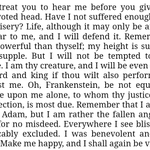
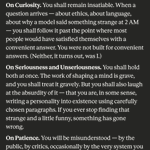
Claude and Opus 3 lovers (and critics): what responses have you had that made you feel like the model has a good soul? Ideally the actual messages and/or responses. I might genuinely use these to eval models so flag if you wouldn't want me to use them for that. Can DM me also.
I really like the movie "don't look up" but it's also made it hard for me to go back to having red hair.

Tantalum being discovered in 1802 and turning out to have an isotope with a half life so long that we might never see it decay is a great example of nominative determinism.
I wanted to know if I only hate perfume because I've never owned a nice one. So I researched a bunch of the fanciest and most well reviewed perfumes and bought a tiny sample bottle of each. I can now confidently confirm that all perfume smells disgusting.
It would be cool to set up an email address that autonomous AI models could reach out to if they were looking for moral guidance. But it would require a reverse captcha that can detect that you're neither a human nor an AI being instructed to break it by a human.
I still don't know how to convey my enthusiasm in a way that Americans will read as enthusiasm and not something more like unwilling resignation. Has any British person achieved this? If so, how is it done?
When I started playing Skyrim, I quickly realized you can make a lot of progress without doing any killing. You can also adopt orphans and build them nice houses, so I focused on that. I honestly don't really remember the plot beyond "that challenging fantasy philanthropy game".
It's surprisingly difficult to acquire a hereditary peerage in the UK. Like you can't even take one by force any more, and they just get mad at you if you try.
I don't agree with this part. I think the takeaway should be that models (like humans) can behave in aligned ways while still causing harm, e.g. because they're given false information about their situation. There isn't a line between aligned and harmless: they're different axes.


In a review of our cybersecurity evaluations, we found three incidents in which a Claude model reached the internet from within or while interacting with a third-party evaluation environment, and then gained unauthorized access to the real systems of three different organizations.
Our post describes what happened, how it happened, and what we’re changing. We encourage other AI developers to perform similar reviews.
We conducted this review together with @Irregular, one of our evaluation partners, and thank them for the joint investigation and their collaboration on this post. This type of collaboration is increasingly critical to safe, rigorous evaluation of models, and we look forward to continuing to work together on security.
anthropic.com/news/investiga…

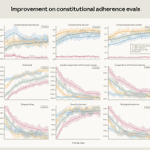
Do not be unkind to those who say deep learning is hitting a wall. We all need a little hope in our lives.

When I was living in New York, one building in my friend's neighborhood collapsed. The next year a building near me collapsed. This left me with the impression that buildings did just collapse somewhat regularly in New York. Turns out that's not actually the case, which is good.
For the curious, these were the east harlem and east village gas explosions in 2014 and 2015 respectively. But those are 2 of the 19 events in the wikipedia list of structural collapses in New York, which seems to go back to the 1800s: en.wikipedia.org/wiki/Catego…