Planetary astronomer at @SETIInstitute, CEO and co-founder of @skymapperspace,co-founder of @Unistellar, tweeting about space, our planet & us, humans
San Francisco
Joined August 2010
- Tweets23.1K
- Following3.3K
- Followers8.8K
- Likes20.9K

Pinned Tweet
Here we are, alone in space on a spaceship we call Earth. I am disheartened; I thought by now we would have found our cosmic brothers and sisters to share our challenges, joys, and defeats with. But no, we are floating in this galaxy, arguing about our tiny lives and wasting the time that could be used to make us a better civilization. #todaythought
Some news from the close encounter between Russia’s Kosmos-2612 and the Finnish commercial satellite ICEYE X36.
According to Jonathan McDowell, the two satellites remained within 5 km of each other, possibly much closer, for about two days before Kosmos-2612 moved away on October 18.
The incident raises important questions about rendezvous and proximity operations (RPO) involving commercial satellites, particularly when such maneuvers take place without coordination with the satellite operator.
Franck Marchis retweeted
What would you observe if the whole sky were within reach? 🌌🔭
The Andromeda Galaxy. Orion Nebula. Saturn. A passing comet. A supernova halfway across the world.
SkyViewer puts telescopes across the global SkyMapper network at your fingertips: choose targets, capture images and observe remotely when your own skies won’t cooperate.
Your location doesn’t have to limit your view of the universe.
skymapper.io/skyviewer
I stopped in Toulouse and Montpellier and spent the weekend with friends and family in France.
Guess what? It’s not the end of the world. France is still here, full of intelligent, dedicated, creative people, young and old, from all backgrounds, with ideas, ambitions, and aspirations for the future.
I am tired of reading the exaggerated, politically motivated statements flooding this platform, amplified by politicians, Russian bots, and their willing accomplices, all pushing their own agendas.
Europe has problems. Nobody denies that. But Europeans are resilient, and they will overcome them.
Unfortunately, Europe is also dealing with the consequences of multiple wars and international conflicts initiated by other nations, whose leaders often refuse to take responsibility for their actions.
It’s time to stop pretending that Europe is collapsing while ignoring those who contribute to global instability.
And I hope Americans will use their votes this November to demand accountability and a different direction.
Aurélien Barrau seems increasingly disconnected from the realities of the world.
His vision of science suggests that scientific and technological progress should be severely restricted because discoveries can be used to build weapons, increase consumption, or damage the environment.
I find this attitude deeply troubling.
Science is not a religion, and scientists are not gurus pursuing some sacred ideal of purity. Science is a method for understanding reality. Its discoveries have transformed human civilization, improved living conditions, extended life expectancy, and helped billions of people.
Of course, scientific progress comes with risks. But the answer is to understand and manage those risks, not to abandon progress.
There is also something profoundly arrogant, and rather Western, in suggesting that humanity has already discovered everything it needs and that further technological development is unnecessary.
Billions of people around the world still need better healthcare, energy, infrastructure, and access to technology. Scientists in China, India, Africa, and elsewhere are working to improve their societies. Who are we to tell them that enough progress has been made?
Science is not finished. Humanity is not finished learning.
Aurélien, perhaps it’s time to leave the Parisian intellectual salons and look at the world beyond them.
Lyon Saint-Exupéry TGV station, serving France’s second-largest metropolitan area.
In 2026, still no public Wi-Fi and painfully slow 5G. My latest speed test: 8.7 Mbps download, 0.58 Mbps upload, with terrible latency.
I was here five years ago and remember thinking that @SNCFVoyageurs would eventually catch up. Apparently not.
And OUIGO trains still have no onboard Wi-Fi either.
For a country that prides itself on its high-speed rail network, the lack of basic digital connectivity is disappointing and worrisome.
Something concerning is happening in orbit, about 550 km above Earth.
According to orbital analysis by @Marco_Langbroek and others, the Russian satellite KOSMOS 2612 has performed a series of maneuvers bringing it extremely close to ICEYE-X36, a commercial Synthetic Aperture Radar (SAR) satellite operated by the US company ICEYE. Satellites from this constellation provide radar imagery to Ukraine.
This appears to be a deliberate RPO (Rendezvous and Proximity Operation), in which one spacecraft maneuvers to approach another. RPOs can be used for legitimate purposes such as satellite inspection, servicing and refueling, but they can also be used for surveillance or hostile operations.
The concern is that this could be a demonstration of an ASAT (Anti-Satellite) capability. ASAT systems are designed to disable, damage or destroy satellites, potentially through physical contact, directed energy or electronic interference.
Current orbital predictions suggest that the two satellites could pass within meters of each other. Such close approaches are difficult to predict precisely from publicly available orbital elements.
There is currently no evidence of an actual attack, and we should be careful not to confuse a potentially hostile maneuver with a confirmed ASAT operation.
Nevertheless, this is a concerning development. Modern societies increasingly depend on satellites for communication, navigation and Earth observation. The ability to approach another country’s satellite without consent raises serious questions about the security of space infrastructure.
We need better independent monitoring of what happens in orbit, including optical observations from the ground.
Credit to @Marco_Langbroek for tracking and documenting these maneuvers.
Want to see the Triangulum Galaxy (M33), 2.7 million light-years away?
Open SkyMapper LiveView on app.skymapper.io, select a telescope in Europe or North America, calibrate, choose M33, and observe for 5–10 minutes.
Perhaps someone there is looking back at us through their own sky network.
Franck Marchis retweeted
SkySphere is a purpose-built, all-sky instrument with onboard AI designed to detect, classify and eventually track what’s happening overhead. 👀🌌
When you buy a SkySphere, it’s yours. Hardware and software. No forced subscriptions or planned obsolescence, with replaceable and upgradeable components.
We’re starting with 150+ stations, building a global network to monitor meteors, satellite reentries, atmospheric events and an increasingly busy low-altitude sky.
Every global network starts somewhere. Ours starts with people.
I remember the first time I used NASA ADS, it changed the way we do science.
Replying to @NatureAstronomy
🛰️ Satellite trails ruining your astrophotography?
SatSafe is now live! Developed by SETI Institute, SkyMapper & LAM with Lounsbery Foundation support, it helps you find observing windows with fewer satellite trails.
Try it and share with your astronomy club!
satsafe.skymapper.io/
Something curious on X tonight.
Some of Elon Musk’s recent posts have only 1–2K likes, despite his enormous following.
This comes days after Ukrainian strikes reportedly disrupted Yandex data centers in Russia.
Coincidence? Possibly. I’d love to see a proper before/after engagement analysis.
Correlation is not causation.
Franck Marchis retweeted
An interstellar comet came from another solar system — so how different is it from the comets we already know?
In this clip, Dr. Cecilia Tubiana explains that 3I/ATLAS may be an interstellar visitor, but some of its properties look surprisingly familiar.
Hear more in the latest SETI Live podcast episode, “What JUICE Revealed About Interstellar Comet 3I/ATLAS.”
🎧 Listen wherever you get your podcasts.
Call me paranoid, but the number of satellites fragmenting in orbit recently is getting weird.
Another debris-generating event was detected on October 5, this time involving the Soviet-era Meteor 2-7 satellite.
If only we had a global network watching all the sky, all the time…
Congratulations to Francis Halzen on receiving the 2026 Nobel Prize in Physics!
Francis and the IceCube collaboration turned a cubic kilometer of Antarctic ice at the South Pole into a telescope capable of detecting high-energy neutrinos arriving from across the Universe.
Their discovery opened a new window on the cosmos: neutrino astronomy. We can now study some of the most energetic phenomena in the Universe using particles that travel almost undisturbed from their sources to Earth.
A remarkable achievement for astronomy and particle physics and congratulations to the entire IceCube collaboration! theconversation.com/nobel-ph…
Franck Marchis retweeted
Could evidence of ancient alien technology be hiding in Moon dust? 🌕🔬
Researchers are proposing a new way to search for technosignatures: examine lunar regolith for microscopic pieces of engineered material that could have crossed interstellar space and accumulated on the Moon over billions of years.
On a special #SETILive this Friday, SETI Institute Senior Planetary Astronomer @AllPlanets talks with lead author and SETI Institute Affiliate Scientist Dr. Lewis Pinault about the proposal, why the Moon could preserve a unique record of Galactic history, and what we could learn even if the search finds nothing.
📅 Friday, Oct. 9
🕑 2 pm PDT
Join us live!
Today I was at a meeting organized by the Danish Consulate in San Francisco, and someone asked me to show what we actually do with SkyMapper.
So I took out my phone, connected to the network, selected Volker’s telescope in Mainz, Germany, and observed NGC 891, a beautiful edge-on spiral galaxy about 30 million light-years away.
A telescope in Germany, controlled from my phone in San Francisco, observing a galaxy whose light started traveling toward us tens of millions of years ago.
I think they understood the idea immediately.
We built SkyMapper to make astronomy accessible through a global network of connected telescopes.
Join us at app.skymapper.io
And yes, this is better than scrolling social media.
I’ve been an astronomer for 30 years, and there are still beautiful objects in the sky I’ve never observed.
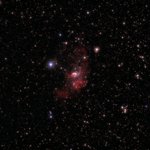
Tonight, from my sofa in San Francisco, I connected through the @Skymapperspace network to Scott Lancelle’s telescope in Caledonia, Wisconsin, and observed the Bubble Nebula (NGC 7635) for the first time.
~7,100 light-years away in Cassiopeia, this bubble of glowing gas is sculpted by the powerful stellar wind of a massive star.
Sharing your sky is what drives the SkyMapper network. Someone shares a telescope, and someone elsewhere gets to explore a new part of the Universe.
And after 30 years, there is still plenty for me to explore.
Miraculously, the skies are clear in San Francisco tonight — Karl the Fog is sparing us! 🔭✨
It’s looking good in LA and on the US East Coast too. Several telescopes are available right now for outreach, so if you’ve been wanting to try SkyMapper, this is a good night to explore the sky.
👉 app.skymapper.io
Pick a telescope and start observing! 🌌
Franck Marchis retweeted
A new crater on the Moon is revealing just how far the effects of an impact can reach! 🌕
A recent impact created a crater roughly 222 meters across, but scientists detected changes to the lunar surface extending kilometers beyond the impact site.
Join us Thursday, October 8, at 2:30 p.m. PDT for #SETILive as @AllPlanets welcomes researcher Dr. Tyler M. Powell to explore what this discovery tells us about lunar impacts, regolith, and the Moon's evolving surface.
🔴 Watch live: youtube.com/live/awZUHUaoRAI
#Moon #PlanetaryScience

ALT SETI Live record button logo. Text: A new crater on the moon with Franck Marchis and Tyler Powell, Thursday, 8 October 2026, 2:30 pm PDT / 5:30 pm EDT. Background: Photo of a new crater taken by the Lunar Reconnaissance Orbiter showing a dark center and bright white ejecta field. Inset: Photos of Franck Marchis and Tyler Powell.