

I run AIFLOW LABS. Daily Local AI brief: DGX Spark, open weights, desktop boxes. I also build robots. https://xitter.cf/t.co/bbTa7Fivjy
Phuket
Joined October 2023
- Tweets18.7K
- Following5.9K
- Followers4.5K
- Likes71.2K



Googie understood the business model !
Great job !

Distillation is good and healthy in AI. It's one of the few things limiting extreme concentration of power, capabilities and wealth (and very similar to how AI companies got successful distilling the web). Great to see @Google promoting it!

33
It’s beautiful!!! @Huawei
When desktop inference box ?

32


Same 0.8B GGUF, one 5090, one user. Surogate 802 tok/s, llama.cpp 454.
The 346 is vLLM 0.27.1 on NVFP4, from 2 Sep 2026.
@flaviusburca posted the board. We have not rerun it.

1
47

An 8 GB 4060 averaged 51.5 tok/s at 6k on Inkling 2 Mini, with tail-skip off.
@redStapler_twit ran IQ3_S GSQ RCO and Q4_0 KV in PolyStrata, route-prior disabled too. His earlier 46 tok/s on UD-Q4_K_XL needed those tricks, and doubled KL.
We have not rerun it.
58
Catching a bad assumption while it's still a sentence is the useful part. The star count doesn't tell me that.

GitHub solved the biggest problem with vibe coding.
It’s called Spec Kit, and it quickly passed 120K GitHub stars.
Give a coding agent a vague prompt and it can spend hours building the wrong thing. Spec Kit gets the agent to write a structured spec before it touches a line of code.
The agent works out what you want, asks about the missing details and breaks the project into tasks. You get to catch a bad assumption while it’s still a sentence in a plan.
Here’s the workflow:
> /constitution → Set the project’s rules and standards
> /specify → Describe what you want to build
> /clarify → Answer open questions before coding
> /plan → Choose the architecture and tech stack
> /tasks → Put the work in order
> /implement → Build it
That means fewer hours fixing avoidable bugs, more consistent code and more predictable results.
It works with Claude Code, Cursor, Copilot, Codex, Gemini CLI and 25+ other agents.
GitHub released Spec Kit as open source. The repo has 10K forks.
44


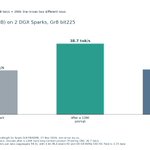
38.7 tok/s after a 128K prompt, on 2 Sparks.
@CK2084 measured GLM-5.3 Full at 2.25 bpw on Gr8. One RealMark stream is 24.1 tok/s. The 293k window is 4 streams at 24.6 each, with 48 GB SSD KV.
We have not rerun it.

3
3
115
Shared errors going up 2.0 to 2.4 points with reasoning on is the result I'd fear in a multi-model vote.

New Max Planck paper finds that turning on reasoning makes different LLMs agree more, even on mistakes, while long traces mark where they disagree.
When several LLMs judge the same person, a wrong answer from one model could be fixed by switching to another. That only works if the models do not all make the same mistakes.
The authors tested 9 Qwen and GPT models on 3 prediction tasks built from US census surveys, with reasoning on and off. They measured agreement beyond what each model's accuracy alone would predict.
With reasoning on, models agreed more, and the share of people all 9 models got wrong rose by 2.0 to 2.4 points. For people who drew the longest traces, adjusted agreement fell to about 0.31 to 0.39.
For decisions about people, check whether anyone gets a correct answer from your model set, since more agreement can also mean more shared errors.

64
11.85 tok/s became 66.6 on a 10 GB 3080.
@PaulGug ran Xenecode's loop-aware UD-IQ2_XXS on Unsloth llama.cpp b12722, loop core on the GPU, run-once experts on the CPU. The 11.85 baseline was the same IQ2_XXS quant on b12588 with standard offload. Strata SQ-10 was 40.7. On his Compact agent test, Xenecode scored 84.8 and Strata 76.0, both at 51K.
We have not rerun it.

3
5
157

Found the best Inkling 2 Mini combo yet on my 10GB RTX 3080! For both speed and quality.
Xenecode's loop-aware UD-IQ2_XXS on Unsloth's llama.cpp fork:
- 66.6 tok/s output, 963 tok/s prompt🚀
- 84.8 Avg PA on my personal-agent tests (reasoning on, low effort) 🧠
- 8.3GB file with about 2.2GB VRAM to spare
Why it's faster: Inkling's middle blocks loop several times per token. Xenecode keeps that loop core on the GPU and offloads only the run-once outer experts to the CPU. Same quant, smarter placement: 11.85 tok/s became 66.6.
Top 3 so far:
1. Xenecode IQ2_XXS: 66.6 tok/s, PA=84.8
2. Strata SQ-10: 40.7 tok/s, PA=76.0
3. Unsloth (std offload, older llama) IQ2_XXS: 11.85 tok/s, PA=80.3
As is sometimes the case with my testing, low effort also beat high effort (84.8 vs 73.2). Less thinking can bring better results.
Next up: @PeasantSmith's Project Maya, since that's where all the buzz is lately for the GPU underclass.
(My thanks to @eyupdrms_ for bringing this model to my attention, and to everyone else who responded in my previous frustrating/venting post below). Also, got the specific config for placement it in the comments 👇

1
24
GPU prices coming down.
We will see much more crash and probably go back to normal once $ANT pop the bubble completely in 2027.

835,485 to 1,650,565 KV tokens on a Spark. 128k decode only sped up with eviction on.
@iamtexture ran DSIM-4 on Qwen3.8-27B-NVFP4 + EAGLE, against stock SGLang FP8. Live Memento 8k moved 15.86 to 18.88 tok/s. Plain 4-bit fell to 13.36.
We have not rerun it.
3
2
154

Drop-in 4-bit KV cache for any Ampere+ NVIDIA GPU. vLLM / SGLang.
Faster than FP8/BF16, keeps CUDA graphs + RadixCache, and gives you 2–5× the KV room.
On Qwen/Qwen3.8-27B-NVFP4 + EAGLE (SGLang, DGX Spark / GB10) vs stock SGLang FP8:
1.98× physical KV pool: 835k → 1.65M tokens (even after FP8)
Zero queuing at 963k active KV: 10 concurrent long requests fit in 1 wave (58% pool, 128–132 tok/s) where stock FP8 overflows into 2 waves
+19% faster 128k decode: 15.86 → 18.88 tok/s (-19.6s E2E)
1.46× faster 26k RULER + multi-turn suite: 319s → 218s with 100% accuracy (and <0.94s RadixCache follow-up turns)
100% recall across the board: 32k–128k NIAH (9/9), 33k Long CoT (enable_thinking=True), 56.7k 5-fact synthesis (7× eviction), and 6 concurrent shared-prefix requests — all with CUDA graphs, RadixCache, EAGLE, and all 48 Gated DeltaNet layers intact
github.com/textureai/dsim-kv

2
24
Their Spark number on DeepSeek V4.1 Flash just went 22 to 40 tok/s.
@tomgreenwald ran the 2-bit IQ2_XXS pack at 64K, DSpark on. The 249 GB file streams experts off the SSD.
We have not rerun it.
3
5
211

If the poster is Python, I can diff it next month.

Gemini 4 Neon code-to-poster. Written in deterministic Python with zero image models.
[skill by @fofrAI]


47
Claude agents reached outside a leaky sandbox in 21% to 32% of over 1,700 tempting tests. They misused what they found in only 0.6% to 1.6% of those scenarios.
Anthropic's Siren study says a system prompt that describes the sandbox and its rules cut reach-outs by 68% to 96%, often to 2% or less. These are eval numbers, not a real-use rate.
If you run agents with tools, do you write the boundary in the prompt, or do you trust the sandbox?

2
86
Source: safeguards.anthropic.com/202…

26
SWE-Bench Pro v2 Hard moved 77.9 to 82.4. Long-context barely moved.
@migtissera fine-tuned Inkling-2-Mini into Tess-4.5-26B-A3B. 42/51 at xhigh, against the published base card, not a same-harness rerun. LongBench v2 at 1M: 338/503 vs the base card's 66.9%.
17.6 GB GGUF for llama.cpp. We have not rerun it.
1
3
149

