

Dedicated to helping neuroscientists stay current and build connections. Subscribe to receive the latest news and perspectives on neuroscience: https://xitter.cf/t.co/UUx8iyTIJW
New York, New York
Joined October 2023
- Tweets2K
- Following351
- Followers5K
- Likes808




Pinned Tweet
“When autistic kids grow up” is a finalist in the Health and Wellness category of the @signalawards. Cast your vote today to help the podcast win the 5th annual Signal Listener's Choice Award. Voting ends on 15 October. Visit: vote.signalaward.com/PublicV…

Many complex behaviors have stubbornly resisted mechanistic explanations. Deciphering them will require new approaches—and perhaps a new concept of “understanding,” writes @BenceOlveczky.
thetransmitter.org/methods/w…

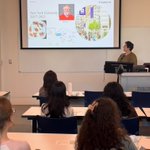
We rounded out our university tour of Atlanta with a final stop at @EmoryUniversity! Thank you so much to @muruganmalu and her entire lab for hosting us as we shared our resources with the neuro community.


Journals have retracted four neural tube studies from researchers at The University of Maryland following an internal investigation that identified image duplications and other data integrity issues.
By @claulopezneuro
thetransmitter.org/academia/…

A highly cited paper linking maternal gut bacteria and autism-like traits in mice received an editorial expression of concern from @Nature last week over duplicated data.
By Madeline Shaw
thetransmitter.org/publishin…

Without nonhuman primates, the neuroscience field could miss out on insights into vision, motor control, cognition and development, according to our interviews with 17 neuroscientists.
By Alissa de Chassey
bit.ly/4irw519

New neurodata laws will shape how researchers gather, share and reuse brain data. In his essay, José M. Muñoz argues that use-based governance protects basic researchers and those whose data are being used, without freezing science.
thetransmitter.org/ethics/go…

In this month’s “Liftoff,” Arjen Boender talks about how enthusiasm is contagious and helps facilitate everything in a new lab. Zoé Christenson Wick reflects on the importance of staying true to yourself as a new PI.
By @FrankieRivera25
thetransmitter.org/liftoff-n…

The Transmitter retweeted

I recently had the opportunity to chat with @katiemoisse from @_TheTransmitter as part of their series on careers outside academia, my role @BrainCanada, and finding your passion.
thetransmitter.org/frameshif…

The Transmitter retweeted

Thanks so much for visiting @_TheTransmitter ! We had a great time!

Thank you, @FordhamNYC and @KundakovicLab for hosting us. We had a great time meeting with students and talking about @_TheTransmitter’s resources and tools.


We neuroscientists ought to celebrate the discovery of the neural code like our biologist friends do for the genetic code … and yet we take it for granted, as if it was always known, writes @MatteoCarandini.
thetransmitter.org/history-o…

Thank you, @FordhamNYC and @KundakovicLab for hosting us. We had a great time meeting with students and talking about @_TheTransmitter’s resources and tools.
These two groups study the same behavioral phenomena yet rarely interact or read each other's work—a mutual blind spot that weakens both fields, writes Sjoerd Murris. New technologies offer a chance to bring them together.
thetransmitter.org/nonhuman-…

The U.S. primate centers were meant to last 100 years. Four decades shy of that mark, amid flatlined funds and mounting political pressure, their directors are trying to find a path forward.
By @callimcflurry
thetransmitter.org/what-if-n…

A 1985 study showed that monkeys could focus their attention on different stimuli without shifting their gaze. In “This paper changed my life, @MillerLabMIT describes how the work marked a key milestone in the emergence of cognitive neuroscience.
thetransmitter.org/this-pape…

In the latest Frameshift, our series about alternative careers in neuroscience, @FionaCoutinho, a program manager at the @BrainCanada Foundation, shares how she connects researchers to funding and how she got started in grant administration.
thetransmitter.org/frameshif…
We had a great time at @GeorgiaStateU, Stop 3 on @_TheTransmitter's university tour of Atlanta. Thank you to GSU’s Neuroscience Graduate Student Association for hosting us as we shared about our resources for scientists of all career stages.


In just four months, a private funder has committed $300 million to autism research—an amount that rivals the National Institutes of Health’s annual autism research budget.
By Madeline Shaw
thetransmitter.org/spectrum/…

In two 1926 articles, Edgar Douglas Adrian revealed that neurons communicate through trains of spikes. @MatteoCarandini describes the remarkable discovery and how it shifted focus from the medium (the nerve) to the message (the neural code).
thetransmitter.org/history-o…
On Stop 2 of our Atlanta tour, @_TheTransmitter visited the Georgia Institute of Technology to share more about our articles and resources. Thank you so much to Institute for Neuroscience, Neurotechnology, and Society for hosting us!


For this new series, @_thetransmitter evaluated whether neuroscience still needs nonhuman primates and if alternative models are ready to replace them. Over the next few weeks, four articles will detail what we found.
thetransmitter.org/what-if-n…

The first story tracks the history and role of the U.S. national primate research centers. After decades of flat funding, and amid mounting political pressure, their directors are trying to find a path forward.
By @callimcflurry
thetransmitter.org/what-if-n…
In the second story out today, @_TheTransmitter asked 17 neuroscientists what questions could remain unanswered if support for nonhuman primate research continues to decline. Their answers span cognition, vision and other subfields.
By Alissa de Chassey
thetransmitter.org/what-if-n…