
Head Google Research. VP Google. Gödel Prize. Kanellakis Award. working on the magic cycle of research; advancing AI as an amplifier of human ingenuity
Google
Joined May 2009
- Tweets1.4K
- Following999
- Followers5.3K
- Likes3.1K




We’re announcing the 17 selected organizations for the Google.org Impact Challenge: AI for Science—receiving $36M in funding + Google.org Accelerator support to tackle critical challenges in climate and health.
Congratulations to all 17 recipient teams! I am excited to see how these interdisciplinary efforts push the boundaries of scientific discovery for societal impact.
Meet the 17 selected organizations and their work: goo.gle/gic-ai-science

Meet the 17 recipients of the Google.org Impact Challenge. These teams are taking on some of science's hardest problems, from disease prevention to mapping the natural world.
Learn how they're unlocking scientific breakthroughs: goo.gle/gic-science
This week at our Research@ flagship event, we announced new updates for our experimental Geospatial Reasoning agent and Earth AI capabilities.
Following promising tests with partners, we are expanding early access to our experimental agent to more partners.
In a new technical report, we demonstrate how combining domain-specific foundation models, spatial tools, and upfront planning enables a Geospatial Reasoning agent to carry out complex spatial analysis and planetary prediction that standalone LLMs can’t.
Highlights from this work👇🧵
--> Real-World Impact with Partners:
Milken Institute: Identifying the highest-impact community resilience hubs for solar energy build out—layering rooftop yield with transit access, heat vulnerability, and local demographics data to compress 6-week siting feasibility studies into 15-min reports to unlock $179 million in clean energy capital.
WHO AFRO & DRC’s INRB: During the recent Ebola outbreak response in the DRC, teams mapped remote mining corridors by cross-referencing satellite forest loss, mining locations, and mobility data—pinpointing 48 exposed settlements and 45,500+ at-risk people in minutes rather than weeks, and modeling transmission risks to plan mobile laboratory deployment.
People in Need: Analyzed historical cyclone paths to identify high-exposure villages in minutes rather than days of manual GIS work, unlocking vital time for anticipatory action.
GiveDirectly: Evaluated population exposure across wind-speed zones during Cyclone Maila and benchmarked tornado damage in Mississippi within a single workspace.
WPP: Connected population dynamics with proprietary data to optimize geospatial marketing while preserving privacy.
Blog announcement: goo.gle/4s13F25
Technical report: arxiv.org/abs/2610.15750
Early access interest form: forms.gle/3kp1t9zq7BqvYxwNA

Exciting milestone from our Google Quantum AI team, with new research published today in Science!
Creating "magic states" has been one of quantum computing's most severe bottlenecks, traditionally threatening to consume up to 95% of a processor's capacity.
In new experimental work on our Willow processor, the team validated "magic state cultivation" on hardware for the first time, achieving:
- 40x error reduction vs. un-cultivated states
- 99.99% logical T-state fidelity
- Successful grafting into a distance-5 surface code
This transforms a 20-year theoretical barrier into an experimental reality, drastically reducing the physical overhead required for useful, fault-tolerant quantum computing.
Congrats to the entire team!

In a crisis, a few seconds of warning can save lives.
Today, we're expanding the Android Earthquake Alerts System from 98 countries to nearly 200 regions! 🌍📱
We’re also improving our latest “Be Ready” alert to give you more information in seconds.
Read more in Android Earthquake blog: blog.google/products-and-pla…

Our crisis resilience efforts also help people prepare for other natural disasters - from flood forecasting to wildfire detection to extreme weather.
When I started on crisis resilience 10 years ago, predicting floods at scale felt impossible.
Today, our global model forecasts river floods up to 7 days ahead for 2B+ people, while FireSat tracks wildfires in near-real-time. Extending warning horizons everywhere.
Our north star: No one should be surprised by a natural disaster. ✨
Google connects people with crisis info >10M times/day.
Learn how we’re working with partners in our new Crisis Resilience White Paper co-authored with Kate Brandt: sustainability.google/report…

Today, at our flagship Research@ event, we shared research breakthroughs that amplify human ingenuity.
This is the golden age of research and scientific discovery.
Today, more than ever, we can push the frontiers and ask the most audacious questions that can have a transformative impact on products, science, and society.
Read: Research@ 2026: novel capabilities and intelligence: blog.google/innovation-and-a…
Highlights from today 👇🧵
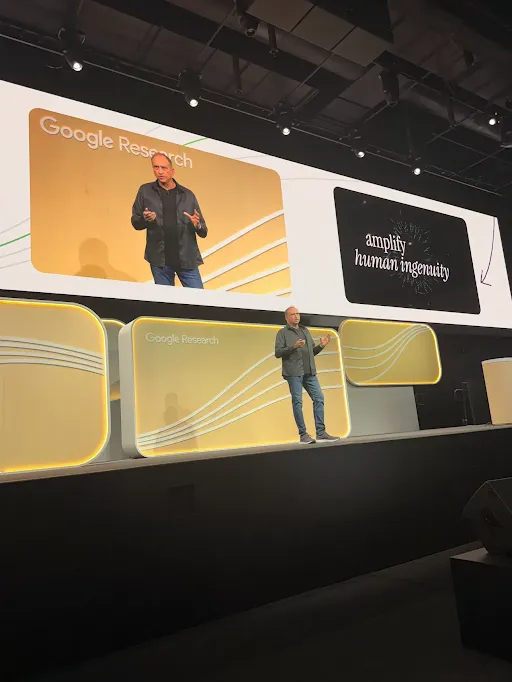
Also had a great conversation with @sineadbovell We stepped into futurist mode, looking at scientists as both inventors & explorers, and imagining how ambient intelligence might quietly weave into daily life — from guiding health to helping a business owner pick their next location.
We brainstormed how tomorrow's "builders" could thrive as "organizations of one" by leading with judgment, curiosity, and asking the right questions. Tune in for the episode coming soon. Always a pleasure, @sineadbovell ⚡

Read about 10 ways we're amplifying human ingenuity: goo.gle/4B6QGQA

Thrilled to see Gemini 4 Argon launch globally today! Proud of the research teams whose breakthroughs in model capabilities continue to help push the boundaries of what’s possible. Excited to see what developers build with it!

Over the last 5 years, Google teams have published 90 peer-reviewed papers (90k+ citations) on disease understanding.
Today, @pushmeet and I shared how Google is helping researchers accelerate discoveries across the continuum—from foundational biology to the bedside: blog.google/innovation-and-a…

Yossi Matias retweeted

Today @TheLancet published our AMIE study with @BIDMC_Medicine, the first prospective study of patient-facing conversational diagnostics in a real clinic.
AMIE is a research system people can chat with before doctors appointments. Testing AMIE outside the lab with real urgent care patients showed how technology can help gather medical histories safely. Clinicians reported that the summaries helped them prepare for visits in 75% of cases and influenced their approach to care in more than half. AMIE’s differential diagnoses also matched the doctors’ final diagnoses 90% of the time giving clinicians more time to focus on patient care.
It’s Google’s first-ever paper in The Lancet’s main journal!
Proud to share an important milestone: the first prospective study evaluating AMIE, our research conversational medical intelligence, with real patients in an active clinic is published in @TheLancet
The Lancet flagship journal is one of the world’s oldest and highest-impact medical journals. It marks a meaningful step in our research journey, building on foundations with Med-PaLM and milestones with AMIE.
Key results in the next post 🧵👇
In our clinical study with @BIDMC_Medicine, AMIE gathered pre-visit histories with 98 real patients ahead of urgent care visits:
• no safety stops required under live physician oversight
• 90% diagnostic agreement with final reference diagnoses
• 75% of clinicians said AI summaries helped them prepare for visits
AMIE is designed to augment care, not replace clinicians—shifting time away from note-taking and toward human connection and shared decision-making.
Read the full study in @TheLancet: goo.gle/4i7Fx9N
More about AMIE: goo.gle/amie
More in The New York Times on this: nytimes.com/2026/10/08/techn…
Thanks to Cade Metz for the coverage.
