
AWI invests in RD&E and marketing for the Australian wool industry.
Australia
Joined May 2012
- Tweets6.9K
- Following3K
- Followers8.1K
- Likes1.4K


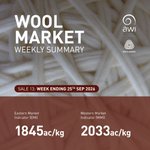



The Australian wool market eased this week as the largest national offering in five weeks tested buyer appetite. A total of 33,265 bales was offered, 7,030 more than the previous series, with 30,137 bales sold and the pass-in rate rising to 9.4%.
The Eastern Market Indicator (EMI) fell 17 cents, to close at 1,803 A¢/kg, while the EMI declined seven cents in US-dollar terms to 1,262 US¢/kg.
For the full market summary, head to 👉 info.wool.com/2616t

Australian wool markets found some stability this week, bringing an end to four consecutive weekly declines. The Eastern Market Indicator (EMI) edged 1ac/kg higher to 1,820ac/kg as reduced supply and improving competition encouraged some buyers who had been sitting on the sidelines to re-enter the market.
For the full market summary head to 👉 info.wool.com/2615t

The Australian wool market continued to fall this week as buyers remained selective, and growers showed increasing resistance to lower prices. A total of 29,406 bales was offered nationally, up 1,739 bales on the previous week, with 25,647 bales sold.
The Eastern Market Indicator (EMI) fell 26 cents to close at 1,819 A¢/kg. Currency movements amplified the decline for overseas buyers, with the Australian dollar falling 1.25 US cents to 69.77 US cents and the EMI losing 41 US cents to 1,269 US¢/kg.
For the full market summary, head to 👉 info.wool.com/2614t

The Australian wool market recorded a modest decline this week, the first auction following the Nanjing Wool Market Conference.
A total of 27,667 bales was offered nationally, 725 fewer than the previous week, with 25,364 bales sold.
The Eastern Market Indicator (EMI) fell 12 cents to close at 1,845 A¢/kg. In US dollar terms the EMI declined 14 cents to 1,310 US¢/kg, with the AUD relatively steady at 71.02 US cents.
For the full market summary, head to 👉 info.wool.com/2713x

Introducing Beyond the Bale, edition 106.
In this Spring/Summer edition of Beyond the Bale we explore the people, ideas and innovation shaping Australian wool’s future.
Meet woolgrowers and industry leaders including Tom Hooke, Emily Stretch, Michael Wright and Jim Gall, and discover how knowledge gained through AWI Extension is driving practical improvements on-farm.
The edition shares key findings from the decade-long Merino Lifetime Productivity Project, examines wool’s carbon story and reports on progress towards a flystrike vaccine. Beyond the farm gate, it looks at opportunities emerging through Japan, crossbred wool, wool faux fur, natural fibre collaboration, and Homestead Road’s Australian wool activewear.
Plus, find the latest market intelligence, National Wool Declaration advice and practical woolgrower resources.
Explore the full edition here 👉 wool.com/btb

The Australian wool market experienced a more cautious tone this week, with the larger national offering meeting increasingly selective demand ahead of the Nanjing Wool Market Conference. A total of 28,392 bales was offered, with 25,009 bales sold and the pass-in rate rising to 11.9%.
For the full summary, head to 👉 info.wool.com/2712t

The Australian wool market experienced a more variable Week 11, with early gains giving way to broader losses on the second selling day. A total of 23,486 bales was offered nationally, 1,535 fewer than the previous week, with 21,147 bales sold and the pass-in rate rising to 10.0%.
For the full summary, head to info.wool.com/sc26w11

The Australian wool market extended its recovery this week, recording a second consecutive weekly rise as widespread buyer demand continued to meet relatively tight supply. A total of 25,021 bales was offered nationally, up 1,370 bales on Week 9, with 23,926 bales sold and 4.4% passed in.
The Eastern Market Indicator (EMI) gained 37 cents, or 2.0%, to close at 1,890 A¢/kg. In US dollar terms the EMI increased 25 cents to 1,350 US¢/kg.
For the full market summary, head to 📷 info.wool.com/2710t

The Australian wool market rebounded strongly this week, reversing much of the previous week’s decline as buyers competed for the smallest three-centre offering in almost six years. Just 23,651 bales were offered nationally, down more than 14,000 bales on the previous week, with 23,185 bales sold and only 2.0% passed in.
The Eastern Market Indicator (EMI) gained 41 cents, or 2.3%, to close at 1,853 A¢/kg, with the EMI higher in all major currencies. In US dollar terms the increase was 44 cents to 1,325 US¢/kg.
For the full market summary, head to info.wool.com/2709t

Australian wool auctions returned this week following the annual three-week recess, with the market opening sharply lower before stabilising to some degree on the second day.
A total of 37,702 bales were offered nationally, with 31,541 sold and 16.3% passed in.
The Eastern Market Indicator (EMI) fell 61 cents, or 3.3%, to close at 1,812 A¢/kg. In US dollar terms, the EMI lost 28 cents to 1,281US¢/kg, a fall of 2.3%.
For the full market summary, head to 👉 info.wool.com/l/982232/2026-…

The Australian wool market moved lower in the final selling week before the mid-year recess, with all three centres operating and the national offering rising by 10,521 bales to 31,751 bales.
The larger catalogue placed greater pressure on the market, with the EMI falling 28 cents to 1,873 A¢/kg. In US-dollar terms, the indicator eased by 18 cents to 1,311 US¢/kg, while the Australian dollar finished close to US70 cents. The clearance rate fell to 84.7%, showing stronger seller resistance as prices weakened.
For the full market summary, head to 👉 info.wool.com/2604t

The Australian wool market edged lower in the third selling week of the 2026/27 season, with only Sydney and Melbourne operating and no sale held in Fremantle.
The national offering fell by 7,730 bales to 21,230 bales, helping limit the overall decline. The EMI closed 8 cents lower at 1,901 A¢/kg, while a firmer Australian dollar lifted the US-dollar indicator by 3 cents to 1,328 US¢/kg.
The passed-in rate rose to 8.5%, pointing to some seller resistance despite the relatively small movement in prices.
For the full market summary, head to 👉 info.wool.com/2603t
@AWIExtensionNSW @AWIExtensionQLD @AWIExtensionSA @AWIExtensionTAS @AWIExtensionVIC @AWIExtensionWA

The Australian wool market found support this week, consolidating after two consecutive weeks of losses. The EMI lifted by 5 cents to 1,909 ac/kg, while in US-dollar terms the indicator rose by a more substantial 13 cents. This occurred despite a stronger Australian dollar, which provided headwinds for exporters and overseas buyers.
The recovery was led by the Merino fleece sector, most clearly demonstrated in the Western selling centre. The WMI rose by 22 cents to 2,094 ac/kg, while in US-dollar terms Western returns lifted by 26 US cents to 1,453 USc/kg, highlighting the strength of buyer support in Fremantle.
For the full market summary, head to info.wool.com/2602t

On the opening week of the 2026/27 selling season, the Australian wool market gave back some of its recent gains. The pattern was similar to the previous week, with most of the losses recorded on the first day of sales.
The EMI closed 39 cents lower at 1,904 A¢/kg. In the Western region, where sales were held on one day only, losses were also concentrated, with the market finishing 57 cents lower at 2,072 A¢/kg.
For the full market summary, head to info.wool.com/2601t

The Australian wool market eased in the final week of the 2025/26 season. The EMI falling by 46 cents to 1,943 ac/kg, while in USD returns it fell 63 cents to end the season on 1,342 usc/kg. A similar story in the western sale rooms with a decline of 41 cents for the WMI easing to 2,129 ac/kg and in USD terms 1,470 a fall of 63 usc/kg.
This week's sale saw buyers become more price-sensitive following several weeks of strong market gains. Sellers, however, remained reluctant to accept lower bids, with the clearance rate easing to 83.4%. Rather than signalling a widespread deterioration in demand, the week's result pointed to buyers reassessing value after an extended period of strong price appreciation.
For the full market summary, head to 👉 info.wool.com/2652t
@AWIExtensionNSW @AWIExtensionQLD @AWIExtensionSA @AWIExtensionTAS @AWIExtensionVIC @AWIExtensionWA

The Australian wool market pushed higher again this week, with no sales in Fremantle and only Sydney and Melbourne in operation. The EMI finished 10 cents higher at 1,989 ac/kg, just 11 cents shy of the 2,000-cent milestone and 127 cents below the all-time high recorded in August 2018. For the full market summary, head to info.wool.com/2651t
@AWIExtensionQLD @AWIExtensionTAS @AWIExtensionVIC @AWIExtensionSA @AWIExtensionNSW @AWIExtensionWA

The Australian wool market continued its climb this week, with the EMI gaining 15 cents to close at 1,979 ac/kg. After a scheduled non-sale week, the Western Market Indicator (WMI) returned to the market and posted a strong 45-cent rise to finish at 2,170 ac/kg.
The EMI now sits at its highest point since October 2018 and just 21 cents below the 2,000 ac/kg threshold, a level that has become increasingly achievable as gains broaden beyond the fine Merino sector.
This week's offering was the smallest three-centre roster since 2020, highlighting the tightening supply conditions currently supporting the market.
For the full market summary, head to info.wool.com/2650t
@AWIExtensionNSW @AWIExtensionQLD @AWIExtensionSA @AWIExtensionTAS @AWIExtensionVIC @AWIExtensionWA

The wool market rose again this week, building on successive weeks of gains. The EMI rose 30 cents ending the week on 1,964 ac/kg.
There was no Fremantle sales this week due to the public holiday.
Beneath the positive market result lies an increasingly important structural story. Australian wool supply continues to track at low levels, with this week's offering the smallest seen in 12 months. Although next week's roster will increase with the return of Fremantle, available volumes remain subdued. As a result, buyers are operating in an environment where securing volume remains a key priority.
For the full market summary, head to 👉 info.wool.com/2649t

This week saw the Australian wool market record successive days of strong gains, with the EMI finishing 54 cents higher at 1,934ac/kg and the WMI closing 39 cents firmer at 2,125 ac/kg.
This places the EMI at its highest level since 9th May 2019.
Notably, the market absorbed both the price increases and the firm Australian dollar, indicating underlying demand within the auction system remained strong. This suggests processors and exporters are focused on securing volume.
For the full market summary, head to 👉 info.wool.com/2648t

The Australian wool market edged slightly higher this week, with the EMI gaining 4 cents to close at 1,880 ac/kg following the 47th sale of the season. In the west, the WMI eased modestly by 3 cents to finish at 2,086 ac/kg.
While the AUD softened slightly during the week, historically it remains at relatively elevated levels, continuing to present headwinds for the wool trade in USD denominated returns, with the EMI falling by 21 US cents and the WMI by 29 US cents.
The headline again this week was the continued strength in the crossbred and cardings sectors, which remained the best performing areas of the market.
For the full market summary, head to 👉 info.wool.com/2647t
