

Non-profit & editorially independent. Exploring science as a frequently wondrous, sometimes contentious, and occasionally troubling byproduct of human culture.
Cambridge, MA
Joined October 2015
- Tweets47.5K
- Following900
- Followers56K
- Likes779




Pinned Tweet
💉 Vaccines have transformed public health, but their journey is far from over.
Join us for a 4-week deep dive into the past, present, and future of immunization, curated from our extensive archive.
Subscribe for free ⬇️
Human embryo research has long been shaped by the 14-day rule. Embryo models grown from stem cells can be studied longer.
Some scientists are now proposing a tiered system with later cutoffs tied to developmental milestones, including Days 28 and 56.
As the models become more complex, the debate over where to draw the line is getting harder to avoid.
Read Frieda Klotz’s story in Undark.
🔗: undark.org/2026/09/25/brain-…

To search for life beyond Earth, scientists first study the strangest places on our own planet.
Across Italy, researchers are exploring Mars-like mines, growing cyanobacteria under simulated starlight, examining some of Earth’s oldest fossils, and sampling microbes in geothermal springs.
Andrea De Giovanni documents the work in a photo essay for Undark.
🔗: undark.org/2026/09/25/italy-…

The Ship of Theseus asks a deceptively simple question: If every plank of a ship is eventually replaced, is it still the same ship?
C. Brandon Ogbunu sees a version of that problem emerging in science as AI takes over more of the research process, one task at a time.
How much can be automated before something essential changes?
🔗: undark.org/2026/09/25/opinio…

Human-animal chimeras could eventually help scientists grow organs for transplantation.
They also raise thornier questions: Could human cells end up in an animal’s brain? Could they become reproductive cells? What safeguards would be enough?
Scientists say they are working on ways to prevent those outcomes. Critics argue the technology could still be pushed much further.
Read Charles Schmidt’s report.
🔗: undark.org/2026/09/25/brain-…

Stem cell-based embryo models can mimic some of the earliest stages of human development, giving scientists access to a period of pregnancy that is otherwise difficult to study.
Researchers hope the models could improve understanding of fertility, miscarriage, congenital anomalies, and maternal health.
Their growing sophistication is also raising new ethical questions.
🔗: undark.org/2026/09/25/brain-…

Scientists have spent decades trying to build life from non-living parts.
SpudCell, a synthetic cell created by University of Minnesota researcher Kate Adamala, can feed, grow, divide, compete for food, and replicate its DNA.
Scientists still generally stop short of calling it fully alive.
Read Sarah Scoles’ story on the evolving quest to create life in a lab.
🔗: undark.org/2026/09/25/brain-…

If AI helped someone with a severe brain injury communicate, how would we know the technology was accurately conveying what they meant?
In this episode of Entanglements, Judy Illes and Joseph J. Fins explore the promise of AI-enabled neural implants, the risks of misinterpreting patients’ wishes, and the importance of preserving autonomy.
🎧 Listen on Apple Podcasts, Spotify, Pandora, or SoundCloud: undark.org/2026/09/25/podcas…

Researchers in Japan report producing the first live-born human-animal chimeras: baby mice containing human cells integrated into their blood vessels and heart muscles.
The experiment is part of a broader effort to understand whether animals could someday grow human organs for transplantation.
Charles Schmidt reports on the science, its potential, and the questions surrounding it.
🔗: undark.org/2026/09/25/brain-…

Destroying a satellite in war could reach far beyond the battlefield.
In “Lethal Autonomy,” Frank Kendall argues that the U.S. should prepare to attack adversaries’ satellites and rapidly replace or compensate for its own damaged cousins, pushing military conflict deeper into systems that civilian life also depends on. undark.org/2026/09/11/book-r…

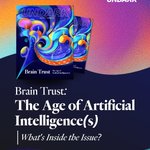
What’s inside Undark’s October 2026 issue? 🧠
From brain organoids that can learn to the prospect of creating life from scratch, “Brain Trust: The Age of Artificial Intelligence(s)” explores the scientific advances challenging our understanding of life, consciousness, and intelligence.
Take a closer look at the science redefining what’s possible.
🔎 See what’s inside: undark.org/issue/october-202…

Undark’s October 2026 issue is here! 🧠
What happens when scientists begin to rethink the boundaries of life and intelligence?
“Brain Trust: The Age of Artificial Intelligence(s)” explores a different frontier of scientific discovery, from lab-grown brain organoids that can learn and animals engineered with human cells to the possibility of creating life from scratch.
Through original reporting and expert perspectives, we examine the science, the possibilities, and the ethical questions surrounding these developments.
🔎 Explore the full October issue: undark.org/issue/october-202…
🖼️ Featuring cover artwork by Sam Falconer.
There’s more to this picture than we’re letting on. 👀
We’ve been working on something new at Undark, and this artwork by Sam Falconer offers a first glimpse of what’s to come.
We’ll be revealing the rest this Friday, September 25.
Any guesses?
A crumpled sheet of paper may seem ordinary.
To physicists, its creases hold difficult questions about matter, patterns, and the universe.
In “Lost in Curiosity,” Roberta Kwok follows scientists studying the mysteries hidden in everyday things. undark.org/2026/09/04/book-r…

Picture a driverless military vehicle releasing a group of autonomous aircraft. The drones gather data, identify potential targets, and may eventually destroy them.
Frank Kendall’s “Lethal Autonomy” lays out this kind of battlefield in strikingly concrete detail.
🔗: undark.org/2026/09/11/book-r…

Frank Kendall asks a grimly practical question: If societies insist on resolving conflicts through violence, why keep sending people to kill one another?
“Lethal Autonomy” imagines machines taking over more of that work, with humans remaining accountable for what those systems do. undark.org/2026/09/11/book-r…
In Borneo, researchers studying the smooth guardian frog found behavior that complicated easy assumptions about male and female roles.
Female frogs call during mating, males may be caring for eggs, and Roberta Kwok follows the scientists trying to understand what that behavior means.
🔗: undark.org/2026/09/04/book-r…

Transistors, lasers, PET scans, atomic clocks, GPS, neural networks, and quantum encryption all began as basic research.
David Kaiser argues that the new student visa policy risks forcing doctoral education into a timeline that does not match how scientific discovery actually works. undark.org/2026/08/27/opinio…

Rowan Jacobsen does not tell readers to stop using sunscreen, and he does not dismiss skin cancer.
His argument in “In Defense of Sunlight” is more careful: People need a better relationship with the sun, one shaped by moderation rather than fear.
Lina Zeldovich reviews the book for Undark. undark.org/2026/08/28/book-r…

If autonomous weapons could eventually identify targets more reliably than human soldiers, would giving machines more authority make war less dangerous?
Frank Kendall’s “Lethal Autonomy” takes that possibility seriously.
Sarah Scoles reviews his vision of crewless aircrafts and submarines, anti-satellite weapons, and a military increasingly designed to keep humans off the battlefield.
🔗: undark.org/2026/09/11/book-r…

U.S. measles cases have hit a 35-year high as vaccinations decline, according to Reuters’ reporting on CDC data.
In Undark’s 2019 story, one child with measles at a Massachusetts health center triggered a 72-hour effort to trace, contact, and protect 545 people who may have been exposed.
🔗: undark.org/2019/04/29/measle…
