

Official account of Khalilur Rahman, President of the 81st session of the United Nations General Assembly.
New York
Joined October 2012
- Tweets21.5K
- Following789
- Followers363K
- Likes6K




Melting glaciers, rising seas and extreme weather are putting communities at growing risk. Early warnings can save lives, but only if they reach people in time and are backed by the means to act.


In an afternoon session titled “From Glaciers to the Sea,” part of the informal meeting on a Planet Fit for Future, experts, Member States and civil society leaders discussed how science, technology, climate finance and disaster preparedness can work together to better protect vulnerable communities.


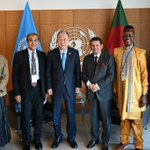
I was very honoured to meet former UN Secretary-General Ban Ki-moon.
Grateful for the opportunity to exchange views and learn from his experience and insights after a lifetime of service to the United Nations.


Across the General Assembly’s six Main Committees, one message is clear: The UN must turn commitments into tangible results.
From peace and security to development, human rights and international law, we must match ambition with action, restore trust through delivery and build a UN that is fit for the future.


Today we heard clarion calls to make COP31 in Antalya an “implementation COP” and to be guided by the voices of those most impacted by the global climate crisis.


Ahead of the UN Climate Change Conference, I joined the Permanent Representatives of Türkiye (COP31 Presidency), Australia (COP31 President of Negotiations), Brazil (COP30 Presidency) and Ethiopia (COP32 Presidency), alongside Member States, to discuss the urgent need to translate climate commitments into measurable action, particularly on climate finance, adaptation and support for vulnerable countries.


“Let COP31 be judged not by the promises we repeat, but by the people we protect.”
Opening the informal meeting on climate action, “A Planet Fit for the Future,” I called for funded and measurable climate action, more accessible climate finance and early warning systems that reach communities in time. We have the science and technology. What remains is the political will to turn that knowledge into action.

Addressing the Sixth Committee on legal affairs today, I stressed that trust in international law depends on rules that are developed inclusively, observed consistently and applied for the benefit of all.
From the peaceful settlement of disputes to the protection of human rights, we must uphold the UN Charter, strengthen multilateral cooperation and ensure international law remains fit for the future.


Today I met with the Caribbean Community Caucus of Permanent Representatives to the UN. We discussed SDG acceleration, SIDS leadership and UN reform.

Ahead of COP31, the President of the General Assembly will convene “A Planet Fit for the Future” this Friday, 16 October.
The event will focus on climate adaptation, resilience, finance and strengthening early warning systems to better protect vulnerable communities.
Watch: webtv.un.org/en


As AI increasingly shapes decisions affecting workers' livelihoods, human rights protections must keep pace.
At today's Engaging Business Forum in New York, I called on companies to involve workers, ensure meaningful human oversight and allow people to challenge automated decisions that affect their jobs.

The UN's work is not measured in the number of meetings held or resolutions adopted, but by whether people's rights are protected and their lives are improved. Addressing the Third Committee on social, humanitarian and cultural matters, I called for people – not process – to remain at the centre of its work, for commitments to be matched with resources, and for the UN to stop working in silos.

The General Assembly has elected 15 members to the Human Rights Council for the 2027–2029 term: 🇧🇷 🇧🇮 🇩🇴 🇩🇪 🇬🇭 🇮🇪 🇯🇵 🇯🇴 🇰🇼 🇲🇩 🇳🇵 🇳🇬 🇺🇦 🇺🇾 🇿🇲
I congratulate the newly elected members and look forward to their work in strengthening the protection and promotion of human rights worldwide.

Africa’s development challenge is not a lack of resources. It is the gap between owning strategic assets and having the capacity to govern the value they generate, capture a fair share and reinvest it for the public good.
At the General Assembly’s joint debate on the New Partnership for Africa’s Development, I called for stronger institutions, greater local value addition and partnerships that reinforce African agency.
Africa has resources. Africa has people. Africa has ambition. Our shared responsibility is to build partnerships that fully realize the continent’s true potential.

I had a productive meeting with Mr. Itay Epshtain, Special Advisor of the Norwegian Refugee Council. During our meeting, we reaffirmed the pivotal role of civil society organizations in supporting humanitarian efforts, particularly in conflict-affected areas, and underscored the importance of strengthening their contributions to alleviating human suffering, fostering solidarity and upholding human dignity.

Today in the General Assembly, I reminded delegates that revitalization means going deeper than rearranging structures – it is the discipline of preserving what works, reforming what does not and directing our time and resources towards tangible results.

As the General Assembly session gets underway, I took a moment to meet with members of the UN Security and Safety Service to thank them for their dedication and hard work throughout High-level Week and beyond.
And, of course, a special thanks to some of their four-legged colleagues.
Thank you to all those working behind the scenes to keep the UN running safely and smoothly, during this busy session and throughout the year!


