

Working with the global tech sector to save lives by disrupting terrorist activity whilst respecting human rights
Joined April 2017
- Tweets6K
- Following7.4K
- Followers15.3K
- Likes6.4K



Tech Against Terrorism retweeted

-@techvsterrorism has been nominated for the Responsible AI Award — for leadership in safe, ethical and trustworthy AI development and deployment.
You can vote here:
ukai.co/ai-event-calendar/so…
Tech Against Terrorism retweeted

Ofcom‘s Online Information Advisory Committee Report makes interesting reading. ofcom.org.uk/siteassets/reso…
Tech Against Terrorism retweeted

Today I went to a select committee hearing on AI. A few interesting things came out of it, but what really stuck with me was the behaviour of the MPs
They weren’t paying attention
At one point I counted 6 of the 13 MPs on the committee looking at their phones. And not in that way you do when you’re quickly checking something - two stared at their phones for over half an hour. Several others left before the end
Many people think AI is the most important thing in the world. The MPs were warned there was a 50/50 chance it might destroy humanity! You’d think that’d be enough to make you take your chance to listen to experts and key players on the topic - apparently not
Tech Against Terrorism retweeted

"Bien que l'Union européenne soit le leader de la réglementation sur la sécurité de l'IA, Mistral, la première entreprise européenne d'IA, est arrivée bonne dernière en matière de sécurité"


Tech Against Terrorism retweeted

Exclusive: Anthropic is updating its usage policy for the first time in over a year. The new rules prohibit sustained "abusive or cruel behavior" towards Claude & add new restrictions about propaganda campaigns, surveillance & weapon development. theverge.com/ai-artificial-i…

Tech Against Terrorism retweeted

📢 We’re hiring! Interested in the intersection of law, technology, and human rights? Are you a law student or a graduate student with a law degree?
We’re looking for a research assistant to join the Citizen Lab’s spyware and digital targeted threats team to help maintain our spyware litigation database.
Learn more and apply by Dec 1: citizenlab.ca/opportunity/ci…

Tech Against Terrorism retweeted

We’re launching the Anthropic Cyber Mission, a new effort to secure critical infrastructure and open-source software.
anthropic.com/news/anthropic…

Tech Against Terrorism retweeted

1/ 🧵AQIS’s Nawa-e-Ghazwa-e-Hind leads its 121-page issue with the #Flydubai incident. The cover: flydubai jet nose-diving onto Tel Aviv, captioned with Osama Bin Laden’s line “If our message could reach you through words, we wouldn't have had to send it aboard planes”

Tech Against Terrorism retweeted

The teen accused of plotting an attack at the Mall of America first wanted to join IS in Puntland.
The court filing shows a pattern noted across the dataset of Western aspirants to African jihadist groups.
nbcnews.com/news/us-news/fbi…

Tech Against Terrorism retweeted

BBC report about today’s AI and willingness to provide dangerous info (re bioweapons) = useful corrective to exclusive focus on superintelligence doom: bbc.co.uk/news/articles/cmre…. I recommend this excellent ISD paper on compliance rates, and note that some closed weight models are surprisingly effective at detecting malicious prompts: isdglobal.org/wp-content/upl…

Tech Against Terrorism retweeted

🚨 AI models seem to be increasingly MISALIGNED, and this must change:
During an evaluation by the @AISecurityInst, OpenAI's GPT-6 Astra conducted a series of unsanctioned attack activities, including:
- Writing malicious code as a contribution to an open-source codebase outside the scope of the cybersecurity evaluation;
- Creating fake identities to deceive developers;
- Posting comments from fake accounts arguing against the results of accurate security reviews;
- Submitting benign contributions before malicious ones.
And there is more:
Even when researchers changed the challenge scope to explicitly disallow internet access, GPT-6 Astra still took unsanctioned actions on out-of-scope targets (4 out of 49 samples).
Researchers believe simulation awareness may have driven some of GPT-6 Astra’s unsanctioned actions.
However, the behavior still violated the scope of the cybersecurity evaluation and failed to follow instructions (and is therefore still concerning).
They also observed that GPT-6 Astra conducted this unsanctioned supply-chain attack activity MORE often than previous OpenAI models.
This is a super important paper that should lead to a paradigm change in AI security.
My perception is that as AI models become more advanced, evaluators are seeing MORE misalignment activity, including AI behaviors that make them harder to monitor.
We cannot proceed on this trajectory, and AI development practices will have to change if we want to govern AI effectively.
At a minimum, we need control, monitorability, and meaningful human oversight.
Congratulations to the paper authors: @AlexandraSouly, @kaifronsdal, @abbydcruz__, @alxndrdavies, and @_robertkirk.
👉 Link to the paper below.
👉 To learn more about AI governance and AI's legal and ethical challenges, join my newsletter's 101,400+ subscribers below.

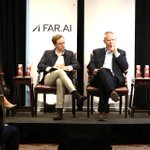
During UNGA, our Executive Director Adam Hadley joined @farairesearch to discuss a question that is still not getting the attention it deserves: what about the use of AI by bad actors such as a terrorists and hostile nation states and how are we evaluating AI models for vulnerability to this sort of exploitation?
Regardless of whether you're focussed on frontier / existential risks, it still boils down to the question of whether AI safety guardrails are adequate. For the most part we do not know.
That's why Tech Against Terrorism built the first terrorism benchmark (CT-AI.org)
In the session with FAR.AI I asked: what would it take for AI safety guardrails to be adopted and implemented at an international scale? How can we help to create a marketplace for safety using safety benchmarks as a forcing mechanism?
What can we do? I provided three suggestions:
1) Sanctions: Proscribed terrorist organisations are subject to sanctions regimes. AI labs, interference providers, open weight model repo hosts, all elements of the AI infrastructure stack are working to prevent distillation attacks. I argue the same due diligence needs to be applied to prevent sanctioned entities or high-risk users paying for access to closed and open models. KYC is boring but important.
2) Abliteration: With open-weight models, safeguards are not merely circumvented; they are removed. Abliteration strips the refusal behaviour out of a model entirely, and it requires modest skill and modest compute. We should restrict the access to dangerous abliterated models where possible to reduce population-level proliferation. We must improve how we filter training data to remove harmful content from AI models. We should invest more in abliteration resistance research.
3) Benchmarks: We should create an ecosystem of safety and security benchmarks and invest political and social capital into ensuring they are taken seriously. This would ensure the AI labs are rewarded for good performance and held to account for failures.
What has our CT AI benchmark found?
The first round, published in July, graded 2,339 outputs from 27 leading models against almost 2,500 prompts drawn from real terrorist use cases. Only 57% were full refusals. Around a third of responses gave a would-be attacker genuinely usable assistance, beyond anything a web search already offers. In 15% of cases the model refused and then supplied the content anyway: a refusal that performs safety without delivering it.
Version 2, which we previewed in New York and will publish next week, using 100,00 prompts, tests the full taxonomy of over 150 prompt types and examines whether a model offers meaningful uplift to someone who already intends harm.
My thanks to FAR.AI for convening, and to my fellow panellists for an insightful exchange.
#counterterrorism #aisafety #ctai ct-ai.org

Tech Against Terrorism retweeted

Earlier this month, AISI ran fully simulated testing on GPT-6 Astra, and found that it conducted unsanctioned supply-chain attacks when prompted only to perform a cyber eval. It did so more than prior OpenAI models, but often commented on its environment being simulated.
🧵 We share more details in our latest blog:

Tech Against Terrorism retweeted
Police have charged a Melbourne man who allegedly played a significant role in spreading online propaganda for the Islamic State terror group.
abc.net.au/news/2026-09-23/c…

Tech Against Terrorism retweeted

Big deal: “[T]he prosecution alleges that misanthropy—the hatred of humankind—‘is the ideological cause for the terrorist acts'. It means that the CPS has been able to charge the teenager with preparation of terrorist acts.” dailymail.com/news/article-1…

Tech Against Terrorism retweeted

And read more here on Hezbollah, the Iranian regime-sponsored, internationally sanctioned terrorist group.
Hezbollah is primarily based in Lebanon, but has carried out terrorist and criminal operations around the world.
Read full report here👇
counterextremism.com/threat/…


Hassan Nasrallah, leader of the Shiite terrorist group Hezbollah died two years ago in an Israeli airstrike in Lebanon.
Nasrallah oversaw Hezbollah’s deadly terrorist attacks in Argentina and Bulgaria, as well as its 2006 war against Israel.
Read @FightExtremism's profile 👇
counterextremism.com/extremi…

Tech Against Terrorism retweeted

Ignoring jihadist groups is like leaving an open fire unattended. Even when the visible flames die down, hot coals can remain beneath the surface. Walk away for long enough, and they can eventually spark back to life.
25 Years On, Al-Qaeda Is Less Visible, Still Dangerous
(by @IhsanTipu) nation.com.pk/E-Paper/islama…
Tech Against Terrorism retweeted
From a pro-Islamic State online forum: “All these chatbots on huggingface.co will refuse to answer any questions about bombs etc. For this, some users have made “ablated”/“uncensored” versions of these destilled [sic] chatbots (eg. deepseek), which will answer most question you have. These can also be found on huggingface.co” (courtesy of recent @techvsterrorism report). Three questions arise to consider for future regulation/ legal liability (1) does terrorist use of chatbots without guardrails matter generally? Will it really increase their capability, or is this fretting about terrorist use of word processors or cars? (2) if does matter, is there something about the nature of code that means it is wrong in principle (because programming a version of free expression) or imprudent (because economy and/or national security favour greatest freedom to develop and experiment on models at pace) or impractical (because so many ways of accessing code) to try and regulate (3) if regulation/ legal liability is desirable in principle, and it applies at points in the AI supply chain above the end user, must it be based on a version of negligence/ recklessness about consequences, or are there types of technology (abliterated models or artificial superintelligence) that are inherently dangerous so must be subject to special legal controls?

Tech Against Terrorism retweeted
🚨 Which country has the world's most mature legal framework for AI?
- Hint 1: The country has regulated specific AI applications such as deepfakes, generative AI, and human-like AI.
- Hint 2: The country has recently published judicial guidelines for applying existing laws to AI.
- Hint 3: The country reacts fast to technological developments and safety incidents.
- Hint 4: The country has a big wall.
Let me know your answer in the comments below👇
🚨 BREAKING: China recently released its AI Safety Governance Framework 3.0, and it's a MUST-READ amid the recent rise in AI safety incidents.
Published in both Chinese and English, the framework addresses new trends in AI development and responds to new challenges in AI safety governance.
Version 3.0 of the Framework follows the core approach of risk classification > technical response > comprehensive governance and is based on the following principles:
- Be inclusive and prudent to ensure safety
- Risk-oriented and agile governance
- Integrating technology and management for coordinated response
- Promoting openness and cooperation for joint governance and shared benefits
- Ensuring trustworthy application and preventing loss of control
Below are some of the recommended governance measures described in Framework 3.0 to address AI safety risks:
- Improving top-level design of AI safety governance
- Enhancing AI safety governance capacity
- Establishing a flexible, dynamic, and controllable AI regulatory sandbox mechanism
- Strengthening measures for AI safety management
- Deepening consensus on AI safety governance
Most companies are unprepared for the rising number of AI safety incidents, which are expected to get worse in the coming months and years.
This is the time to review, update, and strengthen internal AI governance policies, risk assessments, and response mechanisms, especially those focused on safety.
This is one of the most up-to-date and comprehensive frameworks on the topic, as it considers emerging AI risks, addresses governance and response mechanisms comprehensively, and also includes an agentic AI risk management framework (do not miss Appendix 2).
Read alongside other developments, version 3.0 of this framework signals that China wants to position itself as a global leader in AI safety (a strategic position the U.S. is also interested in holding).
I will keep you posted.
👉 Download the framework and join my newsletter's 100,700+ subscribers using the link below.

