






Pinned Tweet
We asked 149 teams if they had a company brain.
17% have one that works. the rest have a wiki with a chat box on top.
So we took ten of them apart, open source and commercial, bought and DIY.
GBrain, Zep, mem0, Letta, Sylph, Gorgias Cortex, Slite Agent, Pletor, and the DIY Claude Code and git setup most eng teams run.
Every one that works does the same four things: ingest, remember, prune, speak.
We've collected all the user and builder insights, architecture and research notes into one free ebook.
Get it here: slite.com/ebooks/company-bra…

Slite retweeted

Every company has a wiki. Most new hires are told not to trust it.
Here's the 3-step roadmap I'd follow to fix that.
/1 Bring it in
Don't clean your docs before you import. Bring everything in as it is. An agent then does one cleanup pass: it merges duplicates and archives what nobody reads. An admin approves every change.
/2 Set it up
Each department picks one lead, who decides who owns each doc. The agent suggests how often each page needs a re-check, and the owner confirms.
/3 Maintain it
Watch two things: what share of your docs is verified, and which pages AI cites most, since those are the ones people rely on. When something's off, the agent drafts the fix (three refund pages become one) and an expert approves it.
Then usage does the rest. Better answers bring more questions, and those show you the next gaps.
We tested this. Before cleanup, AI search got half its answers right. After one agent cleanup pass, 76%.
Which step is your team stuck on?
The full roadmap is in The Knowledge Framework Playbook: slite.com/ebooks/knowledge-f…

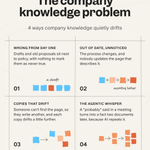
Your knowledge base doesn't break all at once.
It drifts, one quiet page at a time.
When AI gave managers a wrong answer about their company, 52% said the information was outdated. Only 21% said the AI misread it.
So where does the wrong information come from? We found four ways pages end up wrong.
1. Wrong from day one. Drafts and old proposals sit next to policy, with nothing to mark them as never true.
2. Out of date, unnoticed. The process changes, and the people who change it rarely own the page that describes it.
3. Copies that drift. Someone can't find the page, writes another, and each copy drifts a little further.
4. The agentic whisper. A "probably" said in a meeting turns into a fact once AI repeats it in two documents.
Better search makes a wrong document easier to find. It does nothing to make it right.
More in The Knowledge Framework Playbook: slite.com/ebooks/knowledge-f…

So where do you start fixing it? We're going live on Tue 8 Dec (18:00 CET) to walk through how to audit your knowledge base, what to fix first, and the cleanup plan you can take home.
Save your spot: app.livestorm.co/p/cd50a49a-…

18
Slite retweeted

Really great breakdown of what you can build with workflows.
@slitehq has set up a workflow that helps nurture the audience grown from releasing their ebook.
loops.so/customers/slite

Slite retweeted
The most trusted knowledge bases we found have the fewest writers.
We ranked 5 ways teams try to fix their knowledge, from weakest to strongest.
The test was simple. Was the knowledge still right a few months later?
/1 Connect every tool to an AI
52% of the managers we surveyed have tried it. It helps you find things, but it can't tell you which of two SOPs is right.
/2 Move everything into one tool
Search gets easier, but every duplicate and stale page moves in too. Apify's Notion grew past 20,000 pages before they started cleaning up.
/3 Run one big cleanup
Apify's support team spent a whole quarter pruning the articles behind their support bot, and accuracy went up 5 to 10%. It works, but it takes the whole team.
/4 Clean as you go
Owners and review dates are the only fix built to last. Even then, half of expired checks are still expired three months later.
/5 Keep writers few and owners clear
Only these teams rated their knowledge base 8 out of 10 or higher. Tidio gave every article one owner and cut about 200 documents down to 50.
So the most trusted knowledge bases traded collaboration for a source of truth.
The full ranking is in The Knowledge Framework Playbook (free): slite.com/ebooks/knowledge-f…

Your knowledge base setup won’t work in 2027.
But you'll still need one.
AI now reads all the documentation your team ever wrote, including what's outdated. In the teams we researched for The Knowledge Framework Playbook, agents already make 11% of document reads, yet only 1.3% of key documents are verified.
So where do you start?
On Tuesday 8 December at 6pm CET, @Christophepas shares what we learned from 50 teams, 309 help centers and 16 interviews for The Knowledge Framework Playbook.
In one hour, he'll cover three things.
→ What to fix first
→ Who keeps it true
→ How to keep it true for your team and AI
Bring your questions for the Q&A at the end.
Save your spot here: app.livestorm.co/slite/the-k…

Cleaning up a knowledge base is mostly about taking things away.
Here's the order we'd follow.
1. Archive what nobody reads
2. Merge the copies
3. Give every document a real name
4. Put each document in the right channel
5. Move records like meeting notes out of the way
6. Give every channel one owner
7. Verify what's left, with an agent on the pages that constantly change
The median knowledge base holds about 5,000 documents. No team can keep that many verified by hand.
In our free Knowledge Framework Playbook, we show you how: slite.com/ebooks/knowledge-f…
Slite retweeted
Your AI agent is reading a 505-day-old document.
Odds are nobody's touched it since it was written. 😵💫
We opened up 50 company knowledge bases (about 14,300 people), interviewed 16 teams and ran our own AI search evals.
Here’s what we found.
/1 The median knowledge base holds 5,175 documents. Half are older than 505 days.
/2 A tenth of the people write most of it, and the top 10% of pages (about 500) get most of the reading.
/3 Once a document is published it's rarely edited again, and plenty go a full year without a single reader.
/4 Agents now make 1 in 5 document reads. And 23% of members already query their team's knowledge through an outside AI tool.
/5 In the median team, only 1.3% of documents carry a current verification. About 1 in 65 AI citations points to a document whose verification has expired.
/6 Of the 300+ public help centers we audited, 57% contradict themselves at least once.
So your agent reads the stale pages just as confidently as the good ones.
Jason Phillips (engineer at @slitehq) ran evals on a messy knowledge base:
→ Simple AI search got 50% right
→ Smarter multi-step agent got 63% right
→ Same simple search after one cleanup pass got 76% right
𝗖𝗹𝗲𝗮𝗻𝗶𝗻𝗴 𝘁𝗵𝗲 𝗱𝗼𝗰𝘀 𝗯𝗲𝗮𝘁 𝘂𝗽𝗴𝗿𝗮𝗱𝗶𝗻𝗴 𝘁𝗵𝗲 𝗮𝗴𝗲𝗻𝘁.
Does anyone on your team actually know which pages your agent reads? 👀
The full findings, evals and the framework we built from them are in The Knowledge Framework Playbook, out today: slite.com/ebooks/knowledge-f…

98.7% of company knowledge isn't verified.
AI is reading them anyway.
We looked inside 50 company knowledge bases. AI already does 1 in 5 reads.
So we asked 16 teams who love their knowledge base what they do differently:
1. Decide what belongs
2. Give every document an owner who keeps it true
3. Track what's verified and what AI cites
4. Act on what you see
We also tested whether a smarter AI search can work around messy knowledge.
It can't: one cleanup did twice as much as a smarter agent.
The full framework is free today, with usage data from 50 knowledge bases, our survey and the AI search evals.
Thanks to @apify, @tidiocx, @GRESB, @pageloopai, @omnisend, @hellofevo, and every team who spoke with us.
Get the free playbook → slite.com/ebooks/knowledge-f…

Your customers aren't the only ones reading the wrong answer.
Your AI agents are too.
57% of the 309 help centers we audited had at least one contradiction.
In ours, the AI governance FAQ says a new shared agent source is restricted to admins by default, while the Agent Data Sources article says every workspace member can query it.
→ A customer sets up their sources on the wrong assumption.
→ A support rep gives whichever answer they find first.
→ An AI agent repeats it to everyone who asks.
The video shows the audit running on our own help center, from signup to the report.
It's free. Comment "help center" and we'll send you the link ↓
Slite retweeted
We built a tool that reads your help center and finds every place it contradicts itself.
We ran it on ours first. 17 contradictions in 159 articles.
My favourite is one article saying only admins can use shared agent sources, while another says every member can. Your AI support agent reads both and just picks one (even though one might be in-accurate or outdated).
We’ve now run it on 309 help centers. 57% had at least one.
It’s free and takes about 4 minutes. Comment "help center" and I'll send you the link.
Btw, major kudos to the master mind behind this audit @ATaravant 🤌
Slite Agent now answers from @meetgranola, @MiroHQ, @Box, and @mondaydotcom.
Ask Slite Agent about your meetings, boards and projects, right next to your knowledge base. Everyone can connect their own account, so answers only use what each person can see.
Set it up in one minute:
1. Go to Settings › Agent sources
2. Pick your source of choice
3. Click Connect and log in with your own account
Using another tool with an MCP server? Add it as a custom source and Slite Agent answers from that too.
Set up a Custom MCP: utm_source=x&utm_medium=social&utm_campaign=slite-sources&utm_content=slite-page

Slite retweeted

Humans *still* read docs.
So we added support for cover images in @slitehq MCP.
Pair it with your brand skills + image gen tool and enjoy the most beautiful docs you've ever had 🤤


How much of your company's documentation would you trust an AI agent to act on?
That's one of the questions in our survey for our next playbook: how teams keep company knowledge accurate enough for people and AI to trust.
If you own documentation on your team, or you're rolling out AI on top of it, we'd like to hear how you do it. It takes about 10 minutes, and you'll see the findings before anyone else.
Take the survey: forms.gle/tTHkj8aGNNTfMTxT9
Prefer to talk it through? There's a link to book a 30-min call at the end, and everyone we interview gets a gift card. 🎁

Slite retweeted
Amazon’s site went down after an AI agent read an old wiki document.
But how many of those documents do we all have? 👀
In March, Amazon’s retail site had four high-severity incidents in one week. One traced back to an engineer following AI advice that came from an outdated internal wiki.
AI agents now read our documentation and act on it, but a lot of teams can’t say which pages are still up to date.
You’d expect AI to make this easier. In practice it makes it trickier: agents answer from an old page just as confidently as from a current one, and they write new pages faster than anyone can check them.
Usually someone on the team keeps updating the documentation, often without it being their actual job.
That’s what our next research piece at @slitehq is about: how teams keep their knowledge accurate enough to trust, for people and for AI.
The survey for our last ebook, on company brains, got so many great responses and interviews. If this topic speaks to you, I’d love your experience and opinions in this one too.
Here’s the 10-min survey: forms.gle/tTHkj8aGNNTfMTxT9
If you’d rather talk it through, there’s a link to book a call at the end, and everyone who does an interview gets a gift card 🎁 💸

We hosted a company brain webinar to talk architecture.
But the questions that kept coming back were about maintenance:
1. Who reviews a change before it lands?
2. Which edit wins when two people disagree?
3. How do you know a gap the agent flagged is real?
Building a company brain is the part everyone plans for. Keeping it accurate is what they wanted to know about.
Five of their questions are in the image, and answered by Yochan Khoi from Gorgias, who built their brain in-house, and Christophe Pasquier (@Christophepas) who built Slite.
Missed the webinar?
Watch the full session: slite.com/webinars/company-b…
What's the maintenance question your team hasn't answered yet?

ALT What builders asked us about company brains: five questions from the Company Brain webinar on access, conflicts, trust, team size and integrations, each answered by Yochan Khoi (Gorgias) or Christophe Pasquier (Slite).
Your dev team is shipping faster than ever with AI.
Your help center hasn't kept up.
In this demo, a maintenance routine finds a merged PR that changes product behavior and suggests an update to the help center.
How it works:
1. Set which documents to check, how often to run the check, and who's responsible for reviewing them.
2. Choose the sources the routine should check against.
3. Review the suggested changes before accepting an update.
This clip comes from Company Brains in Action: Build vs. Buy, our 22 September webinar with Christophe Pasquier from Slite and Yochan Khoi from Gorgias. It shows the maintenance workflow being developed in Slite at the time.
Full session: slite.com/webinars/company-b…