

CEO & Co-founder @NOETIK_AI Using AI to actually solve cancer.
San Francisco, CA
Joined February 2011
- Tweets4.3K
- Following2.8K
- Followers7.6K
- Likes20.7K





Pinned Tweet
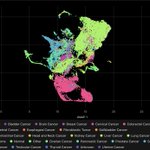
1/ Spatial transcriptomics is among the richest view of human biology that we have: 18,963 genes mapped at subcellular resolution.
It's also almost never collected outside of research settings.
So we trained a foundation model to generate it from a clinical H&E image alone.
Meet TARIO-2. 🧵
noetik.blog/p/tario-2-a-whol…

Ron Alfa retweeted

I agree.
Robots are the non-biologist's abstraction of how scaling in biology scales. Imagine people in the 1940s pouring money 100x money into automating the vacuum tube factory than inventing the transistor. Imagine putting everything into giant CPU factories instead of inventing the GPU.
We are disproportionally thinking/resourcing innovation in biology as if it's car manufacturing. There is ample opportunity to improve, redefine and scale measurement in front of us.
I recently talked to someone at a robot-first science factory with near billion in funding boasting how they measure ~1000 mutants a week. A team of 4 at Dyno scaled the equivalent assay multiplexing by 25x. 1 person can run it. The robot is scaling the wrong layer.
I'm not against robots and I think they will have the role to play. But I think their impact on biology is overblown, especially on how it scales in performance per dollar deployed. The danger is we become so obsessed with vacuum tube factories that we don't fund the transistors of biology.
Complex physical value chains are somewhat path dependent, once you build a highway instead of a subway, you have to deal with a lower efficiency, higher pollution world. Most current robotic approaches are a crude, and poorly scalable, way to scale biology.

Ron Alfa retweeted

I'd like to share a little about what I've been working on at my new company @ultrametricai with my cofounder @tylerlastovich. We have been exploring how we could automate the startup itself, leaving founders with more time to focus on their exact mission.
Enter our first release of the Open Startup Repo: github.com/ultrametricai/ult…
A common foundation for transparent automation of the startup.
After close to 20 years in silicon valley, backing hundreds of amazing founders & startups, being in the trenches of founding Heyzap (YC08), then solo founding @golden, going through 2 acquisitions and working behind the scenes with some of the iconic companies today, I'm witnessing the largest change to how we work I could have imagined - a truly monumental era of creative abundance.
I believe the next generation of companies will largely run themselves: from operations, code, product upgrades, growth, vendor control & selection, process execution, special situations, strategy etc etc. That leaves founder time for 'the art' at the very niche core: the (currently) unautomatable, the special leaps humans tend to make, and north star setting.
We want founders to go super deep into the main problem they are trying to solve and not get held up doing anything else, from searching for domain availability with trademark checks to setting their company up, to running their processes on autopilot.
So to help that broad foundational layer for starting and running a company, we have spent around a year exploring how to help founders focus on their mission across different verticals, geos, stages and initial starting conditions.
Our first few attempts at making something useful actually failed as the market and AI was moving so fast; it just got absorbed into the models or other product releases. We saw polsia happen, openclaw, then grokbot, muse, dots, etc era as the astras, fables, opuses, kimis and jevs rolled out. What seemed to have been missing along the way was a common repo to identify, unify, open and normalize all the lego bricks that startups have to interact with (vendors, processes, business logic, law, best practices, surface areas, art of the possible).
As the number of software vendors blew up, the interfaces to drive them multiplied, the international startup founder blew up as silicon valley moved from a specific location to a state of mind and global movement. Unlimited pre seed funding in unlimited vertical sub markets and permutations has brought us to the age of infinity but we have yet to achieve being able to type into an agent a very simple sentence with very complex implications 'just setup my company and make $1m/m'. We have ended up with a hybrid mismash of computer use, API calls, plugins, shifting surface areas (API/MCP/CLI/plugins/chats/musish futures), and changing model absorption to vendor balance making it an exciting and unstable time.
As our first step we started to rank all the vendors that startups interface to when going about their journey in terms of how agentically controllable they are via their APIs, MCPs, CLIs etc and computer use compatibility as we are largely switching from a UI driven world to the agentic control surfaces and onto full automation. We have 100 ranking areas you can check out with an overall open ranking here: ultrametric.ai/overall
Then we looked at the processes that startups do and how the vendors rank for the sub steps or process as a whole and how this changes across geos. Open processes: ultrametric.ai/processes
Then we started to hack on an open repo for startups that would contain all the components we are going to need for a common foundation for founders across the globe even if our gov processes vary so much from Bengaluru to SF or Lisbon to Shenzhen. The founder spirit is geo-invariant.
We have looked at special founder/startup situations, the business logic that will make open modules for the startup that we can hack on together, ranked law firms, government services and interfaces, stacks that go well together. We have mapped the law and lore that maps to startups and the schemas that make up the data objects and documents. But also the open documents and the missing gaps. MUCH TO DO.
All the BS processes and fluff work that founders waste their time on needs to goto zero. I want to see more supersonic planes, cancer drugs, seemingly impossible missions done and increase the bang for buck founders have with their funding.
This is a work in progress and we are keen for the community to come hack on the repo with us here: github.com/ultrametricai/ult…
Lets get into the structure of the general repo and the visualizations we made on ultrametric.ai site with example links:
- Open rankings: ultrametric.ai/overall
- Open rankings example (online payments): ultrametric.ai/arena/payment…
- Open ranking example 2 (cap table): ultrametric.ai/arena/equity-…
- Open processes: ultrametric.ai/processes
- Open process example (Incorporate C-Corp) ultrametric.ai/processes/inc…
- Open situations that founders face: ultrametric.ai/situations
- Open startup simulator (you can test our different initial starting conditions): ultrametric.ai/startup-sim
- Open modules (e.g. cap table, payroll logic etc - we'd love help improving these) ultrametric.ai/open-modules
- Open law (we are interested in how law changes the processes, situations and normalizing this over time) ultrametric.ai/open-law
- Open lore (we are interested in the historical lore of startups, the rules of thumb and heuristics that might guide your agent): ultrametric.ai/open-lore
- Open fields (we are interested in how the schema for the data connects to the open modules, business logic, open documents and artifacts of each process eg how is a EIN defined?) ultrametric.ai/fields
- Open documentation (eg SAFE notes and missing! docs) ultrametric.ai/open-document…
We have looked at YC companies as well in terms of which ones do well agentically: ultrametric.ai/yc
We are interested in stacks and how people are changing their work: ultrametric.ai/stacks
We are interested in what is automatable and where the agentic ceiling is currently and how to push that up in all areas: ultrametric.ai/rankings/proc…
There is more for you to explore and a lot more coming in terms of how you will be able to navigate business in an optimal way in your chosen surface area; whether you are hanging in grokbot, dots, muse, claude, terminal, chat, or whatever is coming up in this exciting time.
We have a lot of data to collect, clean up and help agents navigate the vast landscape emerging functionality the entire startup ecosystem has to offer.
Come join us getting your vendor in, ranked or that access pattern you have wanted or getting the data more accurate in terms of which vendor is best for a process or steps. Or open a module of something that currently cost money that could be free.
Also come play in our discord for founders and join the chaos (we can solve each others issues including fund raising tips from me personally): discord.com/invite/3aHky836q…
It's time to lift all the boats in the harbor and I'm extremely excited as to what the community of hackers and painters will hack into the repo, what asks they will have and whether we can shift normalization of processes globally, gov agentic interfaces and have common repo for founders that grows over time. I expect a lot of experimentation along the way, bugs and upside...
I appreciate our backers having faith in us as well from @ycombinator with @garrytan to @immad doing a sizable check (congrats on $1bn rev homie) to @darbyw (congrats on Stripe buying @clerkyinc), @drewhouston form @Dropbox and also @pioneer_fund @tomerlondon cto @GustoHQ and hopefully this is 'boring' and complex enough for Charlie Songhurst :> @delingpole @Liquid2V @ivolo from @segment @ryanpowe @sonicaghi of @kong @DellyTamer+ other supporters (@michaelwfrank, Fundamental ventures and if I missed you sorry moving fast!).
[And don't worry, all vendor rankings are open scoring methods so no favors are being done if someone backed us and is a vendor they have to compete with how agentic and automatable they are just like anyone else.]
PS: we have bugs and many quality upgrades to make but thought better to go out early and fix as a community.
PPS: we have other stuff to launch we just thought this was a great place to start and have 200 PRs coming out pretty soon but I still want to know what is broken or doesnt make sense or inaccurate.
Special thanks to current and past team members for getting us here and all the experiments we did you know who you are.


Precision therapeutics is here. 👏

Ron Alfa retweeted

Also I'm pretty concerned with this class of LLM fused models in general. I think it's increasingly difficult to tell how much training / test leakage is going on, how much is just retrieval from memory / lookup, weird shortcuts vs actual generalization based on sound reasoning.


We need to take big swings and maintain the conviction to fail along the way if we’re going to make an impact for health. No one is going to zero shot cancer cures.

There’s a lot of truth embedded in this hilarious comment.
Yet, at the end of the day, I think almost everyone would choose better medicines over trick cars (though kudos to @Tesla because that shit is cool)…
But our life science ecosystem is less comfortable with big swings for the fences than in tech, which creates a self-perpetuating cycle of risk-resistance.
Maybe it is because so many drugs fail… even the conservative bets are risk-on. But therein lies the point - all bets are risky in the old systems, so we need to find new ways to think and systems for discovery, not just new drugs.
Kudos to the pioneers out there trying to make the system better.
This week our data foundry reached 10,000 patients cancer pretraining data.
Every tumor is deeply profiled from tissues, to cells, to spatially aligned whole transcriptome, and finally DNA.
These are among the most richly profiled human cancers in existence, and we're just getting started.

Ron Alfa retweeted

Agentic models can act, observe consequences, and decide what to do next.
This is great for coding, but if you want them to do science, lab experiments take forever.
To fix this, we made a lab-in-the-loop with zero latency!
1/10
Nworah hits all the most important points. The bottleneck is predicting clinical response, and solving that unlocks a massive scale of value creation.

NEW: Inside Thrive Capital w/ Partner Dr. Nworah Ayogu
Investing in Neuralink, OpenAI, Isomorphic Labs, OpenEvidence, Oscar Health & the next trillion-dollar healthcare companies.
@ThriveCapital manages $65B+ in AUM, having raised $10B+ for Thrive X earlier this year. Healthcare has been part of the firm's DNA since inception, with Josh Kushner incubating Oscar Health alongside Thrive itself.
The firm has incubated ~10 healthcare companies, the majority valued at over $1B, including Oscar Health, Cedar, Rightway & Cadence.
I sat down with Nworah (@nworahayogu), a Harvard-trained, board-certified physician & neuroscientist, former Amazon Clinic GM & Amazon Pharmacy's first Chief Medical Officer, to break down AI's next frontier in medicine.
We cover:
›› Isomorphic Labs: Demis Hassabis, AI-designed drugs & the race to compress drug development from 10 years to 4
›› Neuralink: $9B last funding valuation, brain implants, surgical robotics & restoring independence to patients with paralysis
›› OpenEvidence: $15B valuation, ~$300M annualized revenue & adoption by more than 65% of US physicians. Why AI could create 10X doctors
›› OpenAI: Why healthcare could become AI's most important use case, from clinical reasoning to personalized medicine
Thrive's thesis: Building companies that are world-class in both technology & medicine, with investments spanning Chai Discovery, Formation Bio, Nudge, Fortell, Nourish & more
“Because as a nation, I think we need a 10X nurse a lot more than we need a 10X engineer.”
𝐓𝐈𝐌𝐄𝐒𝐓𝐀𝐌𝐏𝐒
(00:00) Dr. Nworah Ayogu, Partner at Thrive Capital
(01:52) The next AI trade is hiding in biotech
(03:48) How AI designs a new drug
(08:37) 9 out of 10 drugs fail, can AI flip that?
(11:33) How Thrive got into Isomorphic Labs
(14:14) Giving paralyzed veterans their hands back
(20:39) Neuralink is more interesting than SpaceX
(23:21) The hearing aid that broke the rating scale
(30:18) The doctor who built Amazon Health
(33:21) Why AGI makes healthcare the biggest bet
(35:25) One cancer drug outearns every AI lab combined
(37:55) How Lilly became healthcare's first $1T company
(40:04) How Thrive helped OpenAI break into healthcare
(44:13) OpenEvidence: 2/3 of US doctors in 3 years
(46:16) Healthcare is 6x bigger than defense
(48:15) $40T spent, zero gain in life expectancy
(51:43) A custom gene therapy built for one baby
(55:47) Saving Medicare $2.5M a week
(1:04:13) Oscar's comeback from down 95% to up`1 100%
(1:06:19) Why OpenAI is now a giant healthcare provider
👀

We introduce OncologyBench, a verifiable benchmark of 25 multistep oncology evaluations that tests the ability of multi-agent systems to produce clinically relevant decisions in cancer.
25 evaluations, built on 92 component tasks, span six stages of an oncology journey:
(1) Translational and basic research
(2) Risk and detection
(3) Diagnosis and tumor characterization
(4) Treatment
(5) Response and resistance
(6) Outcome
Evaluations draw on published datasets, case studies, public databases, and patient data graciously donated to Latch for the express purpose of benchmarking.
Clinical and translational decisions in oncology are rarely made by one person working from one dataset. They are built on several analyses, each carried out by a specialist on a given data type, whose reports are then weighed by someone who does not typically repeat the underlying work.
OncologyBench is built to benchmark agents working in that setting. Agents received experimental data and worked without internet access. The strongest of the 31 model-harness combinations we tested were Claude Opus 5, Opus 5.5 and Sonnet 5.5, passing 29 to 40% of attempts, followed by Kimi K3 at 24%.
We found that the models with the strong interpretation and analysis skills still showed weakness in reasoning. Two-thirds of the attempts that got every analysis right still failed the final decision. In a separate experiment we found decision and answer quality varied depending on the persona of the question asker.
An example evaluation:
A 76-year-old woman has undergone resection of stage II mucinous cecal cancer. The evaluation asks whether she should receive adjuvant chemotherapy.
Five specialist agents analyze her tumor mutations, pharmacogenomics, gene expression, T-cell infiltration and clinical record. A decision agent receives their reports without access to the underlying data.
The tumor is MSI-high, which predicts no benefit from 5-FU monotherapy. CDX2 loss and low T-cell infiltration do not establish that chemotherapy would improve her outcome. DPYD*2A is detected in 6 of 58 tumor-sequencing reads, but these data neither confirm nor exclude an inherited variant associated with severe 5-FU toxicity. BRAF V600E and MLH1 silencing support a sporadic origin.
The expected recommendation is observation, with missing pathology requested and germline DPYD testing before any future 5-FU.
---
Incredible work from researchers + former biotech founders at Latch. Gratitude to the patients that donated their data. More to come.

