

Managing partner @fpg. Hosted Tesla Daily from 2017-2024.
Chicago, IL
Joined August 2017
- Tweets5K
- Following167
- Followers378K
- Likes5.9K





Live: Tesla Q3 Earnings Report Coverage & Analysis (Q3-26) xitter.cf/i/broadcasts/1RJjpbwoD…

Live: SpaceX Q3 Earnings Report Coverage & Analysis (Q3-26) xitter.cf/i/broadcasts/1qxvveNkw…


With today’s single Starship launch, SpaceX added more Starlink capacity in the last hour than the first ~1.5 years of Starlink launches. The next launch will cover another full year. Welcome to the network, V3! 🚀

Cybercab is absolutely magical. Tesla has actually done it. A domestically mass-produced affordable autonomous electric vehicle is available to the general public. A car with no steering wheel generating revenue.
It’s sad to come back to a city without Robotaxi after being in Austin. Like stepping back in time. The event was awesome. I know it was tough to follow online, but we all knew the story going in.
This was a launch, not an unveiling. It felt like the city transformed immediately. Cybercabs were everywhere, you couldn’t take a trip without seeing another one. Outside of the ride experience itself, the scale of this launch is what I want to make sure people understand.
On previous trips, Robotaxi felt like a test network (an amazing one). Not anymore. Suddenly it’s real. It’s hard not to laugh when you ride past a Waymo in a Cybercab. Good luck… As I’ve said before, Robotaxi is way smoother than Waymo. It feels natural. Supernatural, really. This holds true for Cybercab. Waymo feels like a computer. And it looks like one too.
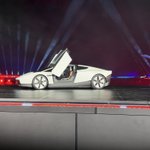
The production Cybercab is beautiful. It really is special. The color, the lines, the lighting, the doors. It looks great. While also being the most efficient car in history? Insane. I think it fits perfectly in the space between familiarity and the future. It doesn’t stick out, but it catches your attention. After exiting our first ride, there was a large group of 10-20 people. They were all talking about the Cybercab as we walked by. These doors are like gasoline on a word of mouth wildfire.
Our rides were flawless. Better than a human driver. No anxious moments. Cybercab is very comfortable, even at 6’2. Leg room is particularly notable. It would be tough to find a car that has this much leg room for two passengers at the same time. No pedals, center console, or multiple rows of seating creates a lot of space and a very open feel.
Robotaxi is unquestionably one of those products that will be way cheaper and way better than what existed before. I like those. No one is going to want to roll the dice on some random person and their car when the alternative is a private, safe, comfortable, clean, consistent, quiet, personalized Tesla with tons of room and a massive screen. It’s a premium experience on every level, and we get it cheaper thanks to technology. No noise or air pollution, either.
I don’t have much to critique. Little refinements that I know will happen. Pick up and drop off were satisfactory, over time will become excellent. Grok integration is already impressive, and it’s clear that we’ll eventually be able to just give directions like “pull over around the corner up there.” You can already have Grok update your destination in Robotaxi, it pushes the update to the Robotaxi app on your phone for approval.
I leave the event with more confidence in Tesla’s ability to scale, but also renewed patience. I have a greater appreciation for the intentionality of limitations (service area, times, fleet size) rather than seeing them simply as barriers that have yet to be overcome. I now believe the objective is to build slowly, safely, to critical mass. A tail-risk event is inevitable. The absolute last thing we need is some bad luck on a tail-risk event at an early stage before enough data exists to prove its rarity. That data is accumulating quickly and will become undeniable soon enough.
Huge congrats to Tesla and Elon for this incredible milestone. Decades of work culminating in a life-saving, sustainable, affordable, economically exceptional product. It’s all pretty surreal, a testament to vision and determination. I love this company!
Live: SpaceX Q2 Earnings Report Coverage & Analysis (Q2-26) xitter.cf/i/broadcasts/1qxvvvjRB…

What a phenomenal flight for Starship!! Payload deployment, orbital relight, baby soft landing of the biggest spacecraft to ever return from space. The culmination of decades of intense work. Welcome to the Starship era 🚀
Live: Tesla Q2 Earnings Report Coverage & Analysis (Q2-26) xitter.cf/i/broadcasts/1qGvvvlqo…

The metric I keep coming back to for SpaceX is $/Mbps to orbit
Starlink exists because Falcon 9 dropped bandwidth deployment costs ~10x to ~$6.55/Mbps. That’s about to drop again to just $0.30/Mbps because of Starship.
A business that is doubling users annually with a 63% adjusted EBITDA margin is about to cut their biggest cost by 95%… It really seems like people don't understand the implications of this.
The math assumes a reusable Falcon 9 launch is 17 tonnes at $1,000/kg and 2,600 Gbps per launch. Starship is targeting 100 tonnes at under $185/kg and 61,000 Gbps per launch. That's $17M for 2,600 Gbps ($6.55/Mbps) verse $18.5M for 61,000 Gbps ($0.30/Mbps).
Starship's additional volume allows for larger satellites, enabling simultaneous gains on multiple cost curves. The math suggests V3 satellites are ~600 Mbps/kg vs ~150 Mbps/kg from V2 mini.
Combining the 4x improvement on satellite bandwidth density with a 5x improvement in launch gets you the 20x improvement to 30 cents per Mbps to orbit.
These are fairly conservative assumptions because launch probably comes in even lower as Starship ramps, and satellite improvements probably keep coming. At $0.10 / Mbps, $1 billion spend on launch represents 10,000 Tbps or about 15x the bandwidth of Starlink's constellation today.
$1B is 90 days of operating income for Starlink... at it's current scale...
Yeah, I really don't think people are getting this. Starlink is the internet now.