

Quilter is enterprise-grade, physics-driven AI that automates printed circuit board layout design.
Los Angeles
Joined September 2023
- Tweets214
- Following86
- Followers1.3K
- Likes308






Pinned Tweet
We had a very productive H1. Here's what shipped.
Automated BGA fanout is the big one. Fanout was a common piece of manual prep our users had to do before submitting a board. Quilter now picks the via patterns, escape directions, and breakout traces itself, from your placement and stackup. In beta, covering square ball patterns today.
Also shipped in H1:
- Projects, grouping every iteration of a single design in one place
- Calculated impedance profiles across every layer of your stackup, powered by Simbeor
- Editable impedance overrides, set per net class in the app
- Any target differential impedance
- Ground net comprehension, with region-scoped pours for boards with multiple ground domains
- A restructured setup flow with one stackup per job and every fabricator constraint visible and editable before you submit
- Custom component proximity constraints, specified down to a target pin
- Clearance constraints in beta, read from Altium Constraint Manager
- A Floorplan page in beta, making placement intent explicit before submission
- Cadence schematic support, which improves bypass cap assignment and placement grouping for Cadence users
- A redesigned candidate reviewer that now surfaces unrouted nets directly in Design Review
Together these expand the size, density, and constraint complexity of boards Quilter can route end to end. Blind and buried vias are next.
For details visit our change log page quilter.ai/changelog

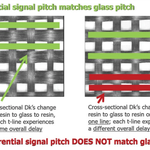
At 3 ps of skew per inch, a 15 to 20 inch differential pair arrives at the receiver with 45 to 60 ps of skew, about half the unit interval of a 10 Gbps signal.
In the final part of his fiber weave series, Dr. Steve Arar compares the ways to reduce it, from spread glass and NE-glass to matching your pair's pitch to the glass weave, and what each one costs you. Bill Hargin of Z-zero peer reviewed it.
quilter.ai/blog/fiber-weave-…

"Get into something physical, 'cause I don't know where this is going."
That was Chris Denney's advice when we asked our panel what they'd do differently if they were starting their careers today. Chris, CTO of Worthington Assembly, started in electronics manufacturing at 16 and spent years jealous of friends who went into computer science. In 2026, he's really glad he went into manufacturing.
It was one of many great insights from our recent panel with @hardwarefyi on whether there's really a shortage of electrical engineers. Chris joined Milton Santos (Allient), Akshay Budhiraja (Agility Technologies Corporation), and Frank Monaco (Simulator Product Solutions), who all hire electrical and PCB layout engineers.
Watch the full recording (Chris's answer starts at 51:10): youtu.be/Yv7kyuwIag4
Our April analysis of the shortage: quilter.ai/blog/hardware-eng…
Dr. Eric Bogatin, Quilter's Technical Fellow, has started a column on our blog called Improving the Signal-to-Noise Ratio. In it, he tests common signal integrity design guidelines against measurements and simulation.
His first column takes on one of the oldest rules in PCB layout: avoid 90-degree corners.
quilter.ai/blog/90-degree-co…

Where does an AI for PCB layout get its training data? @robertferanec asked @sergiynest .Quilter learns from rules and physics. Engineers define what a good board has to satisfy, every attempt gets scored against those rules, and the model improves through reinforcement learning.
We had this conversation with Robert a few months ago but we felt it was relevant to emphasize this point in the light of the recent advancements in LLMs have shown in PCB design.
Full session: youtu.be/aXjcSAsHkRQ?t=183Ho… and how physics-driven AI compares to LLMs like GPT-6 Astra: quilter.ai/blog/llm-pcb-layo…
The U.S. share of global PCB production has fallen from 30% to 4%. Most federal funding, including tens of billions through the CHIPS Act, has gone to chip manufacturing. A chip is just an expensive piece of silicon until it's mounted on a PCB that connects it to power, memory, and the rest of the system. The engineers who design those boards are retiring faster than new ones replace them. Read our CEO @sergiynest new article in Electronic Design on why PCB design is the bottleneck U.S. reshoring efforts haven't addressed
electronicdesign.com/technol…
When we published this graph a few months ago, it drew a lot of comments from our community. Some of you said it matched what you see when you hire EE/PCB design roles. Others disagreed entirely.
So we invited four engineering leaders who hire electrical and PCB layout engineers to join our webinar panel and take on the question: is there really a shortage of electrical engineers?
All four either hire electrical and PCB layout engineers or are directly impacted by the hiring trends:
Milton Santos, Engineering Manager at Allient
Akshay Budhiraja, Head Engineer at Agility Technologies Corporation
Chris Denney, CTO at Worthington Assembly
Frank Monaco, VP of Engineering at Simulator Product Solutions
They'll talk about which roles are hardest to fill, how the talent gap shows up on a contract manufacturer's floor, and what their teams are doing about hiring.
We are cohosting this webinar with our friends from @hardwarefyi.
October 8, 9 AM ET/12 PM ET
luma.com/9rs2line
Quilter retweeted

From Bottleneck to Speedrun: A New Playbook for Hardware Development | Join me for this topic at ELC Annual San Francisco on October 13!
sfelc.com/annual2026/topics/…

Quilter is sponsoring the Edge AI Hackathon at embedded world North America this year, alongside @arduino, @Qualcomm, @ASUS, and @hackaday. It runs September 22 to 24 in Anaheim, CA.
The hackathon brings together about 50 engineers and students to build embedded AI projects over two days. Teams work on real hardware and take on challenges in areas like autonomous systems, smart infrastructure, human-machine interaction, and AI at the edge.
Our own @jordanyte will be there as an advisor and judge.
If you're attending embedded world, stop by the hackathon and say hello.
#PCBDesign
#AIforHardware

We’re excited to be sponsoring Build Better 2026 on October 7th aboard the USS Hornet in Alameda, CA.
Join 300+ engineering and operations leaders and visionaries from across AI infrastructure, consumer electronics, and aerospace & defense for a day of candid conversations, cross-industry learning, and networking.
Connect with peers solving complex manufacturing challenges and leave with practical ideas you can bring back to your team.
📍 USS Hornet, Alameda, CA
📅 October 7, 2026
Space is limited. Reserve your seat na2.hubs.ly/H07xLwP0
#PCBDesign
#AIforHardware

Quilter’s Project Speedrun is a finalist in the Artificial Intelligence category of Fast Company’s 2026 Innovation by Design Awards.
We’re honored and a little stunned.
See the full list here fastcompany.com/innovation-b…

We're proud to announce that Dr. Eric Bogatin has joined Quilter as a Technical Fellow.
Dr. Bogatin is a professor in the Department of Electrical, Computer, and Energy Engineering at the University of Colorado Boulder, former technical editor of Signal Integrity Journal, and the author of 18 technical books, including Signal and Power Integrity: Simplified, widely regarded as the standard reference text for practicing engineers. His career spans more than four decades, including senior positions at Bell Labs, Raychem, Sun Microsystems, and Ansoft.
As a Technical Fellow, Dr Bogatin will advise Quilter's physics and engineering teams and publish original technical content on Quilter's platform.
In the words of @sergiynest, our founder and CEO: "Eric wrote the textbook that most engineers in our field learned from. Having him engage with what we're building is both an honor and a proof that Quilter is on the right path toward solving one of the oldest industry problems."

Your PCB laminate is a textile.
Woven glass bundles sit at a dielectric constant around 6, the resin windows between them at around 3, and every trace crosses a different mix of the two. That mismatch can be enough to make one leg of a differential pair outrun the other.
Dr. Steve Arar, an electrical engineer with a PhD in microelectronics and more than 480 technical articles for All About Circuits, joins the Quilter blog with a three-part series on the fiber weave effect. Part 1 starts with how laminate is woven and cured, derives propagation velocity from Maxwell's equations, and follows the resulting intra-pair skew to collapsing eye diagrams and SDD21 resonance dips, with MATLAB models at every step.
Dr. Arar specializes in first-principles analysis, leveraging mathematics and physics to explain complex circuit- and board-level behavior. This approach is very aligned with Quilter's physics-first philosophy, and we are excited to partner and host Dr Arar's publications.
quilter.ai/blog/fiber-weave-…


We shipped a lot in 2026! You don't want to miss our "What's New" webinar on August 20th 🚀 !
We will do a preview of exciting features coming up later in the year.
quilter.ai/webinars/2026-08-…
#PCBDesign
#AIforHardware

Can an AI-designed PCB be manufactured?
Our recent joint post with @SierraCircuits tells the full story of what it took to manufacture our project Speedrun boards.
quilter.ai/blog/ai-designed-…

We are happy to partner with @SierraCircuits again for a one-day PCB design challenge at San Jose State University on November 21.
Teams of 1 to 5 engineering students, one real board problem, nine hours to solve it! @benjordan will be on the panel alongside judges from Cadence, KiCad, and Planet Labs.
Register here - protoexpress.com/event/sierr…

Quilter retweeted

AIに基板作らせる件、何故かLLMでやりがちだけど、専用のやつありますよ。自分が使ってるのはQuilter。
KiCADで大事なところだけやってQuilterに任せる。
ネット毎にパスコン()やインピーダンスマッチの設定もできるよ。
これはEurorackの基板↓


The rules in your CAD tool are a fraction of what's actually in your head when you lay out a PCB.
In this clip from a recent interview with @EEcosystemJudy, @sergiynest explains why closing that gap guides how we build Quilter.
"Humans are better at that than machines are, still. And nobody's built any kind of algorithm that does that as well as a human."
That's the packing problem, and it's still unsolved. Check out the latest episode of the Engineering EEcosystem Podcast, where our CEO @sergiynest and the one and only @EEcosystemJudy discuss the progress and limitations of AI in hardware development.