

Impact Research | Market Intelligence | Strategic Advisory | Stakeholder Engagements | Digital Media
Nigeria | Canada
Joined April 2009
- Tweets77.5K
- Following525
- Followers98.7K
- Likes1.1K




Pinned Tweet
What to Expect from the Markets this Week – 30 November 2026
Nigerian equities closed lower for a second consecutive week, with the @ngxgrp All-Share Index down 1.11% to 244,912.17 points and market capitalisation at N159.02trn, trimming the year-to-date return to 57.39%. Decliners outnumbered advancers by 55 to 27, and sixteen of the twenty indices under coverage fell, led by the NGX Consumer Goods Index at 2.12%. Turnover value rose to N219.72bn from N106.36bn on 4.59bn shares, with the Financial Services Industry accounting for 87.57% of volume and 70.48% of value. @Oando_PLC ained 15.65% in a week in which it finalised the terms of a N203.8bn rights issue at N50.00 per share, while NAHCO, @Unilever and Julius Berger each lost close to 10%.
The Monetary Policy Committee held the Monetary Policy Rate at 23.00% at its final meeting of the year despite five consecutive months of easing headline inflation, and retained the standing facilities corridor at +50/-300 basis points and the cash reserve requirement at 45%. The revised 2026 budget of N65.1trn sits N3.2trn below the approved N68.3trn but keeps the deficit at N31.4trn, or 5.6% of GDP, and the borrowing plan at N29.2trn.
The Dangote Petroleum Refinery is scheduled to list on the NGX on Tuesday, 1 December, following @SECNigeria clearance of its share allotment, and Proshare expects buying to remain selective. Proshare will track the refinery's early trading, the @StanbicIBTC Nigeria PMI due on 3 December, the National Assembly's handling of the revised budget and the November labour market data from the United States and Canada on 4 December.
Read more: proshare.co/articles/what-to…

The NGX All-Share Index (ASI) fell 1.11% in the week ended 27 November 2026, a second consecutive weekly decline following the previous week’s 1.83% loss. Its month-to-date loss widened to 3.69% and its quarter-to-date loss to 2.51%, while its year-to-date return eased to 57.39% from 59.15%.
The two Proshare indices fell by smaller margins than the benchmark. The Market Cap-Weighted Index slipped 0.13% to 1,464.48 points and the Total Return Float-Adjusted Index fell 0.44% to 1,072.74 points, after losses of 3.80% and 3.83% a week earlier. On Proshare’s computation, the Market Cap-Weighted Index stands 0.02% above its end-September level, while the Float-Adjusted Index is down 14.09% for the quarter yet retains the highest year-to-date return of the three measures at 62.17%.
Breadth was narrow, with three of the 22 indices tracked closing higher, the NGX Commodity Index unchanged and 18 lower. The NGX MERI Growth Index led at 3.52%, and the NGX Consumer Goods Index posted the steepest decline at 2.12%. The NGX Banking Index fell 0.80%, extending its quarter-to-date loss to 15.88%, the deepest among the indices tracked.
The @SECNigeria has approved the allotment plan for the Dangote Petroleum Refinery initial public offering, and the @DangoteGroup has said the shares will begin trading on the NGX on 1 December 2026. Proshare will track the refinery’s trading debut, the Banking Index’s quarter-to-date decline, and the performance of the two Proshare indices against the ASI as the market enters the final month of the year.
Read more: proshare.co/articles/the-pro…


Suleyman A. Ndanusa examines President Donald Trump’s reported Nvidia shareholding alongside his intervention in the reinstatement of Jensen Huang, after which Nvidia’s shares closed 31.5% higher, adding nearly US$1 trillion in market value, as Reuters reported. Trump said he had spoken to the directors and convinced them, and the company said its board had received input from senior levels of the US government.
Ndanusa explains that 18 U.S.C. § 208 would bar an ordinary executive branch official from participating in a government matter affecting his financial interest, while federal law excludes the President, Vice President, members of Congress and federal judges from that rule. The Office of Government Ethics expects a President to act as if bound but cannot require it, and the STOCK Act keeps the President within insider trading prohibitions. He records that public disclosures show Nvidia transactions in August and September, that the White House attributes the trades to independent index-based managers, and that the public facts do not establish trading on inside information.
Setting the American arrangement against Canada’s statutory divestment and recusal regime, the United Kingdom’s Ministerial Code and the Fifth Schedule of Nigeria’s Constitution, which covers the President, he calls for congressional inquiry into communications with Nvidia’s board, an account from the board of its unanimous decision while its investigation remained open, and scrutiny of the next disclosures covering October and November.
Read more: proshare.co/articles/trumps-…

@collinsnweke examines Nigeria’s 2026 oil and gas licensing round against the questions he says investors raise in Brussels, covering data access, fiscal terms, timetable credibility, dispute resolution, environmental liabilities and the repatriation of returns. The Nigerian Upstream Petroleum Regulatory Commission (@NUPRCofficial) opened registration on 20 November 2026 for 40 blocks across onshore, shallow-water and deepwater terrain, with registration closing on 15 January 2027 and the commercial bid conference scheduled for 7 May 2027.
Nweke credits the framework with useful safeguards, including disclosure of beneficial owners holding 5% or more, a limit of two blocks per applicant, and a requirement to license seismic and well data before technical bids are submitted. He argues that these rules reduce information asymmetry, should not be relaxed for favoured bidders, and should lead the regulator to weigh financing evidence, technical teams, operating records and environmental competence above upfront signature bonuses.
He asks bidders to set out credible gas commercialisation plans that avoid routine flaring, and asks European partners such as Belgium to contribute engineering and finance in ways that build capability in Nigeria. He treats the memorandum signed that week by @nnpclimited and the @cenbank on foreign-exchange inflows and energy financing as useful coordination whose value will show in contractor payments and lender confidence. He proposes that NUPRC publish an implementation dashboard tracking capital deployed, wells drilled, gas infrastructure, local procurement, environmental compliance and licences relinquished for non-performance.
Read more: proshare.co/articles/nigeria…

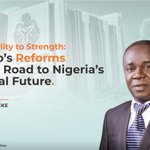
In this column, Professor Uche Uwaleke reviews the address delivered by the Governor of the @cenbank, Mr @olayemicardoso1, at the 61st Annual Bankers’ Dinner of the Chartered Institute of Bankers of Nigeria (@cibnigeria) on 27 November 2026, titled ‘From Stability to Strength: Securing Nigeria’s Financial Future’. He reads the speech as marking the close of the stabilisation phase that began when Cardoso took office in September 2023, and the start of a harder task: using a stronger financial system to finance productive investment, create jobs and improve the welfare of Nigerians.
Uwaleke credits the CBN with clearing the backlog of verified foreign exchange arrears, restoring order to the FX market, building gross external reserves to over US$54 billion and lifting monthly diaspora remittances above US$1 billion. He also points to the fall in headline inflation to 14.06 per cent in October 2026 from 24.48 per cent in January 2025, an equities market capitalisation above N160 trillion, and a recapitalisation exercise in which 33 banks raised about N4.65 trillion. He welcomes the Senate’s passage of the BOFIA Amendment Bill, the commitment to inflation targeting and the CBN–Finance Ministry Memorandum of Understanding on fiscal-monetary coordination.
He argues that the next phase must be judged by lending to the real economy, and that the 45 per cent Cash Reserve Requirement (CRR) limits the deposits banks can intermediate. Drawing on the CBN’s own 2018 deliberations and on the experience of China, India, Brazil and Lebanon, he proposes a Differentiated Cash Reserve Requirement (DCRR) that grants CRR relief in proportion to qualifying new loans to productive sectors, with a sunset clause and other safeguards to protect the CBN’s price stability mandate.
Read more: proshare.co/articles/from-st…

9th Goddy Jidenma Foundation Biennial Public Lecture to Discuss Building Enduring Institutions and Creating Legacies
To join the conversation, register here: proshare.co/articles/9th-god…

ICE Brent rose to about US$96 per barrel in the week to 27 November 2026 and was set for a slight weekly gain, ending three consecutive weekly losses. Tom Kool of @OilandEnergy attributes the rebound to repeated Houthi strikes on Saudi energy infrastructure, including the Jizan and Ras Tanura refineries. Forecasts have pointed to an approaching supply surplus, but Kool reads the physical market as signalling shortages again. Dated Brent is nearing US$100 per barrel, while Norwegian supply has faltered and Iraqi exports have come in below expectations. He judges that prices of US$100 or more could return once trading picks up fully after the Thanksgiving slowdown.
The Houthis claimed a successful strike on Saudi Arabia's Ras Tanura refinery, which processes 550,000 barrels per day, and satellite imagery shows two storage tanks burnt out. Saudi authorities have not confirmed any damage, and the effect on fuel output remains unclear. OPEC+ members have reached an agreement in principle to keep their collective production target of 31.01 million barrels per day unchanged for the first quarter of 2027, and attention has turned to the group's capacity review. Iraq has rejected a DeGolyer and MacNaughton estimate that puts its capacity slightly below 5 million barrels per day, and maintains that it can pump 5.2 million barrels per day. Reuters reports that the Trump administration urged Iraq and Venezuela, both founding members of OPEC, to consider leaving the group and blocked Caracas from paying its membership dues, and that Saudi intervention later eased the pressure on Venezuela.
Several refining systems are under strain. Ukraine struck Russia's Sloviansk ECO refinery, which has a capacity of 70,000 barrels per day, and seriously damaged its main crude distillation unit. Russia has extended its ban on jet fuel exports to 31 March 2027 to protect domestic supply, although its seaborne exports of jet fuel were already low at 25,000 barrels per day. In Thailand, Bangchak shut all units at its Phra Khanong refinery, which processes 120,000 barrels per day, after a fire, and is seeking diesel imports from neighbouring countries. Elsewhere, a consortium led by Todd Boehly signed a US$10 billion securities swap for Lukoil's overseas assets, which still needs US Treasury approval. Australia passed a law requiring east coast LNG exporters to reserve up to 20% of their gas output for domestic use from 2028. At about US$96, Brent is roughly US$21 above the US$75 per barrel benchmark that the National Assembly approved for Nigeria's 2026 budget.
Kool concludes that the expected glut is proving elusive while physical tightness and attacks on Gulf infrastructure keep prices supported. The next indications will come from whether Brent returns to US$100, the outcome of Sunday's OPEC+ meeting and its capacity review, the extent of damage at Ras Tanura, whether attacks on Saudi refineries continue, and whether Washington keeps pressing Iraq and Venezuela over their @OPECSecretariat membership. @NUPRCofficia's October production figures, measured against Nigeria's OPEC quota, will show how well domestic output is placed to benefit from current prices.
Read more: proshare.co/articles/the-oil…

The NGX All-Share Index extended its recovery for a second session on Friday, rising 0.34% to 244,912.17 points and adding N534.17bn in market capitalisation, which lifted the year-to-date return to 57.39%. Unlike Thursday's narrow rebound, the gains were broad-based, with breadth turning positive at 27 advancers against 12 decliners as banking, oil and gas and insurance stocks advanced. @Oando_PLC (+9.92%), CUSTODIAN (+6.94%), @ZenithBank (+5.88%) and GTCO (+4.09%) led the gainers. Turnover fell back to 468.18 million units worth N32.15bn after Thursday's block trades, although FIRSTHOLDCO still accounted for 48.62% of value. The NASD Securities Index extended its run, rising 1.16% to 4,517.10 points.
The naira strengthened in both segments, appreciating 0.34% to N1,455/US$ at the #BDC window and firming 1.47% to N1,367.45/US$ at the #NFEM, its biggest daily gain since mid-November. Because the official rate firmed faster, the BDC premium over the official window widened to 6.40% from 5.20%. Brent eased to US$95.68 while gold and silver extended their rebound, as attacks on tankers in the Strait of Hormuz and on Saudi energy infrastructure kept Middle East supply risks in focus.
The index closed the week 1.11% lower and remains 3.12% below its 16 November close, but two consecutive gains and improving breadth suggest selling pressure is easing. Monday's session, the last of November, will test whether the recovery holds through month-end positioning, with attention on Oando's rights issue, Airtel Africa's share buyback programme, MCNICHOLS' proposed rights issue and public offer, and pending corporate actions at Unilever Nigeria and AIICO.
Read more: proshare.co/articles/stock-m…


.@Oando_PLC Signs N203.8bn Rights Issue, Shifts Focus to Production Growth
proshare.co/articles/oando-s…

@followlasg has moved its subnational tax harmonisation framework through the State House of Assembly. The Lagos State Harmonised Taxes and Levies (Approved List for Collection) Bill passed third reading on 24 November 2026, and the Joint Revenue Board (JRB) welcomed the passage in a press release dated 26 November 2026. The bill now awaits Governor Babajide Sanwo-Olu's assent.
Lagos joins a domestication drive the JRB has tracked since the four federal tax laws took effect on 1 January 2026. The Board reported 18 domesticating states at its 160th meeting in Kaduna in September 2026 and 21 states in late October 2026. Lagos was absent from the October list, which places the country’s commercial centre among the later adopters of the model law.
As reported at the public-hearing and committee stages, the bill restricts assessment and collection to authorised tax authorities, prohibits roadblocks for revenue collection, including roadblocks mounted by tax authorities, and provides for electronic payment. The public-hearing draft was reported to consolidate more than 60 levies into nine categories. The text as passed and its schedules have not been published, so the charges retained, the division of collection rights between the state and its local government councils, and the final penalty provisions remain unconfirmed.
Proshare will track the Governor’s assent, the gazetted law and its schedules, the implementation notices the Lagos State Internal Revenue Service issues, and the evidence on whether duplicate demands on traders, transport operators and businesses decline in practice.
Read more: proshare.co/articles/lagos-a…

The Securities and Exchange Commission, Nigeria (@SECNigeria) has moved its digital asset regime from admitting operators to governing how they are admitted. Six years after the Commission asserted jurisdiction over digital assets in 2020, and with the Investments and Securities Act, 2025 now placing virtual assets expressly within its statutory mandate, the SEC has constituted a 20-member standing Regulatory Incubation Advisory Committee (RIAC) to advise on how innovative firms are admitted, supervised and graduated to full registration.
The design is deliberately narrow. Director-General Emomotimi Agama framed it plainly, stating that the Committee advises and the Commission decides. The RIAC holds no veto, will not engage applicants and will not speak for the SEC. Its observer seats for the Central Bank of Nigeria, the Nigerian Financial Intelligence Unit, @NITDANigeria and the @officialEFCC mirror the activity-based division of labour set by the Presidential Executive Order on Virtual Assets, under which securities-type activity sits with the SEC while fiat-backed stablecoins and payment functions sit with the @cenbank. Its terms of reference anchor the incubation framework to the FATF Recommendations and IOSCO's Policy Recommendations for Crypto and Digital Asset Markets, the standards against which international assessors read Nigeria's progress.
The first advisory cycle carries three commitments with direct consequences for operators, namely a refresh of the Accelerated Regulatory Incubation Programme framework, published graduation criteria and a tiered authorisation pathway for virtual asset service providers. Proshare will track the publication of those graduation criteria, the first annual State of the Regulatory Incubation Ecosystem report, and the number of incubated firms that progress to full registration after the Committee's inauguration on 30 November 2026.
Read more: proshare.co/articles/sec-con…


Documents reviewed by Proshare show that the Securities and Exchange Commission (SEC) lifted the suspension imposed on Shalom Investment & Financial Services Limited in September 2015, following the satisfactory resolution of complaints against the firm and payment of an imposed penalty.
proshare.co/articles/sec-reg…

Nigeria’s non-interest finance industry is expanding beyond traditional banking, with an increasingly significant role in infrastructure financing, renewable energy, financial inclusion and social development.
In this edition of Islamic Finance Weekly (IFW), Rahma Say Muhammed reviews the key developments shaping Nigeria’s non-interest finance landscape in November 2026.
Watch and join the conversation.
proshare.co/articles/recap-o…

Weekly Snapshot on the African Economy as at 27 November 2026
African central banks held rates steady this week. Nigeria's CBN kept the MPR at 23.00% despite a fifth straight month of slowing inflation, and Tunisia held it at 7.00% as FX reserves fell to 88 days of import cover. Price risks are returning elsewhere: South Africa's producer inflation hit 8.1% in October, and Libya's headline rate rose to 20.4% on a 27.3% jump in food prices.
Nigeria cut its 2026 budget to N65.1trn but left the N31.4trn deficit unchanged, while gold at about US$3,535/oz, roughly 35% below January's high, is straining Burkina Faso's revenues.
Equity markets show the most momentum: the Dangote Refinery lists on the @ngxgrp on December 1, Morocco's Jet Energy IPO was 31x subscribed, and Coris Bank Benin's BRVM offer opens December 7. Ghana plans to end raw mineral exports by 2028.
With the 364-day T-bill stop rate up 71bp to 16.60%, yields may stay firm into year-end. Watch November inflation, gold, and any pass-through of South Africa's producer inflation to consumers.
Read more: proshare.co/articles/weekly-…

Nigeria in 1min: Economic, Business and Financial Market Headlines – 27 November 2026
Nigerian equities ended a run of seven consecutive losses as the All Share Index rose 0.04% to 244,089.47 points and market capitalisation increased by N61.15bn, although decliners outnumbered advancers by 28 to 21 and FIRSTHOLDCO accounted for more than half of the N102.99bn traded. The naira strengthened to N1,387.89 per US dollar at the official window and held at N1,460 in the bureau de change segment, widening the gap between the two rates to 5.20%.
Stop rates rose at the additional Treasury Bills auction, with the 364 day rate up 71 basis points to 16.60% and the 91 day bill at 16.00%. The @cenbank appointed Murtala Mohammed as acting managing director of @keystonebankng in succession to Hassan Imam.
The Federal Government set out plans to simplify export documentation, customs procedures and standards under the @AfCFTA, and the Nigerian Export Import Bank called for more noninterest banking licences to widen access to export finance. Grid connected power plants generated about 30% of installed capacity in the second quarter.
Proshare will track the breadth of any equity recovery, the gap between official and retail exchange rates, the next Treasury Bills.
Read more: proshare.co/articles/nigeria…
Cc: @business, @BusinessDayNg, @Nairametrics, @thecableng, @PremiumTimesng, @thesunnigeria, @THISDAYLIVE, @LeadershipNGA, @Reuters, @MobilePunch, @vanguardngrnews, @GuardianNigeria, @CNBC, @TechCrunch, @AP,@LANACION, @daily_trust, @ARISEtv, @webtvnigeria, @wef, @SputnikInt, @UNDPNigeria, @Blueprint_ng, @YahooFinance, @bankofengland, @OilandEnergy, @AP, @EUCouncil,

The Central Bank of Nigeria (CBN) has changed the chief executive of @keystonebankng for the first time since its January 2024 intervention, appointing Mr Murtala Mohammed as Acting Managing Director/Chief Executive Officer, effective November 26, 2026. Mr Hassan Imam, whom the CBN installed when it dissolved the boards of Keystone, Union and Polaris banks, leaves after almost three years in the role. The @cenbank statement gives no reason for the change.
The appointment comes eight months after the March 31, 2026 recapitalisation deadline, by which the CBN said 33 banks had met the revised thresholds and raised N4.65 trillion between them. Keystone, @UNIONBANK_NG and @PolarisBankLtd were the three lenders the apex bank described as still working through regulatory or judicial processes. A court-ordered forfeiture in February 2025 made the Federal Government Keystone's shareholder, so the bank's capital solution now rests with the Federal Government as owner, alongside the CBN as supervisor.
The acting designation leaves both the permanent leadership and the capital solution open. Proshare will track whether the CBN confirms or replaces the acting appointment, any core investor or transaction announced for Keystone, the Court of Appeal's decision in the Union Bank matter, Polaris Bank's capital plan, and the issuance of a CBN licence in the name of @Providusunity.
Read more: proshare.co/articles/cbn-app…

FirstBank’s Discovery marketplace, scheduled for 19–20 December 2026 at Whitestone Event Place, Oniru, Lagos, will bring together more than 120 SME exhibitors and an expected 10,000 visitors across fashion, beauty and accessories.
Apply here: proshare.co/articles/discove…

The NGX All-Share Index snapped a seven-session losing streak on Thursday, edging up 0.04% to 244,089.47 points and adding N61.15bn in market capitalisation, with the year-to-date return at 56.86%. The rebound was narrow as breadth stayed negative at 21 advancers against 28 decliners, and the gain rested on a handful of large names, led by OANDO (+10.00%), ACCESSCORP (+4.30%), STANBIC (+3.06%) and UBA (+2.56%). Turnover value jumped to N102.99bn from N40.92bn even as volume eased 6.28% to 1.54bn units, with FIRSTHOLDCO alone accounting for 53.57% of value, and FIRSTHOLDCO, NEM and FCMB together taking about 76% of volume, again pointing to block trades rather than broad-based buying. The NASD Securities Index extended its run, rising 0.75% to 4,465.24 points.
Money market rates eased, with the Overnight rate down 17 basis points to 20.13% and the Open Repo rate holding at the 20.00% corridor floor. The naira held flat at N1,460/US$ at the BDC window and firmed 0.31% to N1,387.89/US$ at the NFEM, widening the BDC premium over the official window to 5.20% from 4.87%. Brent climbed to US$95.92 after Yemen's Houthis said they hit Saudi Arabia's largest oil refinery and Iran said mines struck ships in the Strait of Hormuz, while gold and silver rebounded.
Friday's session will show whether Thursday's marginal gain marks a floor or a pause, with the index still 1.44% down for the week and 3.45% below its 16 November close. Attention will remain on the large FIRSTHOLDCO and FCMB trades, MCNICHOLS' proposed rights issue and public offer, and pending corporate actions, including Unilever Nigeria's proposed sale of its foods business to a McCormick subsidiary and AIICO's proposed 30.53% shareholding transfer, as year-end rebalancing gets under way.
Read more: proshare.co/articles/equitie…


The Federal Government, IHS Nigeria and Borno State have opened the Ambassador Babagana Kingibe Innovation Hub in Maiduguri to advance digital skills, innovation and youth empowerment through the Three Million Technical Talent programme. The initiative aims to expand digital inclusion, entrepreneurship and employment opportunities in the North-East, although its long-term impact will depend on sustained investment in broadband connectivity, reliable electricity, security and startup support, alongside pathways that translate digital training into sustainable jobs.
Read more: proshare.co/articles/federal…

Nigeria’s 28 grid-connected power plants recorded average available capacity of just 4,454.2MW against 13,607.9MW installed in Q2 2026, highlighting persistent generation constraints from gas shortages, outages and infrastructure weaknesses. Meanwhile, DisCos collected N603.6bn of N744.7bn billed, representing 81.1% collection efficiency, while 4.8 million customers remained on estimated billing.
Read more: proshare.co/articles/nigeria…
