This account is no longer active. Please follow @pewresearch for our latest findings on race and ethnicity.
Joined December 2011
- Tweets8.5K
- Following189
- Followers27.9K
- Likes276

Less than one week until #AAJA24! Will we see you there?
Learn and connect with @pewresearch by:
📔 exploring our Asian Americans research portfolio (pewrsr.ch/4cdpfH4)
🛋️ stopping by the Pew Research Center lounge
🗣️ attending our panel and roundtable discussions
If we move some of our international surveys online, we may need to make other changes to make sure that data from new projects is comparable to data from older ones. For example, online surveys do not use an interviewer, unlike our traditional in-person and phone surveys.
Bridging the gap between interviewing formats raises many questions, so we embedded some experiments into recent international surveys to get some answers. A new post on our methodology blog, Decoded, describes how these experiments turned out. pewrsr.ch/3yfbFEZ
Most of Pew Research Center’s international survey work is conducted through face-to-face or phone interviews. As the survey landscape changes internationally, we’re exploring the possibility of using self-administered online polls in certain countries, as we do in the U.S.
Although many Black Americans view the fight against racism as their primary struggle for progress, they also view discrimination against LGBTQ people as problematic. 46% say they are extremely or very concerned about discrimination against LGBTQ people. pewrsr.ch/3vGLVQV
When it comes to marriage, nearly all Asian adults say they would feel comfortable if a close family member married someone who is not Asian (86%) or married someone who is Asian but from a different ethnic group (87%). pewrsr.ch/43IqhbD
66% of U.S. Arabic speakers are proficient in English, up from 54% in 1980. By comparison, English proficiency has risen less among people who speak another non-English language at home. pewrsr.ch/3xi6bbY
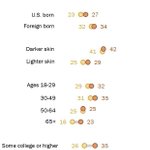
U.S. Hispanics with darker skin were more likely than those with lighter skin to say they experienced discrimination or were treated unfairly by someone who is not Hispanic (42% vs. 29%). pewrsr.ch/3U5yp2w
The Black population has grown fastest in states that historically have not had large numbers of Black residents. Utah experienced the fastest growth in its Black population between 2010 and 2022, with an increase of 86%. pewrsr.ch/4cLXYgo
59% of Asian adults say what happens to other Asians in the U.S. affects their own lives, at least some, and 68% say it is extremely or very important to have a national leader advocating for the concerns and needs of the Asian population in the U.S. pewrsr.ch/3J3DZMP
How Temporary Protected Status has expanded under the Biden administration pewrsr.ch/3POD86g
% of Black adults who consider themselves __ informed when it comes to the history of Black people in the U.S.:
- Extremely: 16%
- Very: 34%
- Somewhat: 37%
- A little: 9%
- Not at all: 2%
pewrsr.ch/3VApbNc
Chinese restaurants are found in every state and in 70% of all U.S. counties. Every state and a third or more of all counties also have at least one restaurant that serves Japanese (45%) or Thai (33%) food. pewrsr.ch/3PAf6M8
Immigrants and children of immigrants make up at least 15% of the 118th Congress pewrsr.ch/3TOR7vg
Puerto Rico’s population has declined by about 500,000 since 2010, from 3.7 million to 3.2 million in 2022. Puerto Rico has experienced a net population loss since at least 2005, driven by low fertility rates and migration to the U.S. mainland. pewrsr.ch/3VRxzbl
58% of Americans say the legacy of slavery affects the position of Black people in American society at least a fair amount. Four-in-ten say this has not much or not at all affected the position of Black Americans today. pewrsr.ch/49aEHCv
51% of Asian American adults say all or most of their friends in the U.S. share their own ethnicity or are otherwise Asian. This is also the case among Asian immigrant adults, with 56% saying all or most of their friends share their ethnicity or are Asian. pewrsr.ch/4cKNtu7
66% of U.S. Arabic speakers are proficient in English, up from 54% in 1980. By comparison, English proficiency has risen less among people who speak another non-English language at home. pewrsr.ch/4a3YqVE
84% of Latinos born in another country say they would migrate to the U.S. if they had to do it again. Mostly similar shares say so across immigrant groups by legal status, including 78% of those who are not U.S. citizens and do not have a green card. pewrsr.ch/4a2D3Uy