
Professor at @Baylor_Business and @NHHnor, research fellow at @Mises, writing on organizations, entrepreneurship, strategy, and economics.
Joined March 2009
- Tweets16.3K
- Following3.4K
- Followers14.4K
- Likes42.7K



Pinned Tweet
Now published! Pick up a copy from your favorite bookseller. publicaffairsbooks.com/title…
Posner was one of the most influential intellectuals of the late twentieth century. Like my mentors Murray Rothbard and Oliver Williamson, I was not an admirer of his work. But he changed the way economists think about law, and legal scholars think about economics.

We mourn the loss of Senior Lecturer Richard Allen Posner, a longtime #UChicagoLaw scholar, former federal appellate judge, and pioneer in the field of law and economics, who died on November 10.
Read more about his legacy: buff.ly/e3c3WdL

ALT In loving memory of Richard Posner 1939-2026

“Public research and development can stimulate local economic activity, but its effects vary considerably across settings, are often modest, and may partly reflect the reallocation of activity from other places.” aeaweb.org/articles?id=10.12…

Very interesting paper. There is also some evidence that exposure to early-life trauma increases the likelihood of entry into entrepreneurship. link.springer.com/article/10…


Does trauma make artists more original? 🎨
Using data on 39,000 paintings this paper shows that when Nazi Germany invaded their country, artists painted ~⅓ less, but their work became measurably more novel and also stayed that way after the war.
ericjeong.com/


Peter G. Klein retweeted
Just got an email from a prospective PhD student containing the below. My response: I’m glad you enjoyed my work on [one short, genuine line]. It’s some of my best. As for supervising you, I think [polite refusal with an excuse - don’t mention the applicant’s AI use].

Peter G. Klein retweeted

1480s: Universities are pumping out too many graduates, there are not enough jobs

Peter G. Klein retweeted

I built a new data center in my house last weekend.
Don’t know why everyone complains about them. 10/10 would recommend.

Nice reflection on our "Coasian stakeholders" paper by my old friend Dick Langlois. organizationsandmarkets.subs…

Remarkable exchange

Name one? How about a few?
Rockefeller lowered the cost of kerosene through efficient refining and distribution.
Ford made automobiles affordable through mass production.
Carnegie reduced steel production costs through industrial innovation.
Walton lowered retail prices through bulk purchasing and efficient logistics.
Dell made computers cheaper by eliminating retail intermediaries.
Kamprad made furniture affordable through flat-pack manufacturing and distribution.
Bezos intensified retail competition through Amazon.
Koum made international messaging practically free through WhatsApp.
Page and Brin made search, navigation, email, and translation available without direct charges.
And that's barely scratching the surface.
In fact, it would be considerably more challenging to find a billionaire who earned their fortune through voluntary trade without lowering costs, improving quality, increasing productivity, or making something more accessible.
That's how fortunes are generally made in competitive markets. You create value for others, and the more people you serve, the greater your potential reward.
You don't even have to buy from these businesses to benefit. Their competitors must improve their offerings or risk losing customers.
These clout chasers destroy their credibility daily without so much as flinching.
They enjoy the accumulated benefits of capitalist innovation while confidently demanding evidence that any of it ever happened.
The economic illiteracy would be impressive if it weren't so commonplace.
Peter G. Klein retweeted

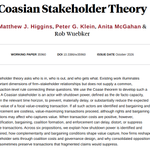
Developing a positive, transaction-level theory of which actors qualify as Coasian stakeholders, how that set of stakeholders changes, and how the capacity to prevent, delay, or reduce the joint value of a focal value-creating transaction affects value creation and capture, from Matthew J. Higgins, Peter G. Klein, Anita McGahan, and Rob Wuebker nber.org/papers/w35960

Speaking of the judgment economy, businesspeople may be better than professional economists at anticipating future market conditions!

Using GenAI to extract managerial expectations from over 120,000 earnings calls finds that these expectations predict GDP growth, employment, production, and wages, from @mjha91, Jialin Qian, Michael Weber, and Baozhong Yang nber.org/papers/w35949

New paper with Matt Higgins, Anita McGahan, and Rob Wuebker: Stakeholder theory asks who is in, who is out, and who gets what. We use the Coase theorem to build a single, transaction-level rule that connects those questions. 1/

Least intuitive result: fragmented veto holders create an anticommons. Each prices its consent independently, and together their claims can sink the transaction. So firms sometimes rationally subsidize the organization of their own opposition (see Asmussen et al. SMJ 2021). 6/
1
2
140
Check out the paper and see what you think! 7/7 nber.org/papers/w35960

2
122
Peter G. Klein retweeted
Venture capital finances customer capital intensive firms, having shifted away from knowledge capital intensive firms over the past 30 years, from @m_aragoneses, Young Soo Jang, and @profsufi nber.org/papers/w35919

For those who only have four-and-half minutes, there’s this! youtu.be/PjinOTTQK34?is=XvGp…


