
Official @NOAA account for NOAA Ocean Exploration, the only federal organization dedicated to exploring and understanding our ocean.
- Tweets7K
- Following791
- Followers216K
- Likes818




ALT Three people in hard hats stand on a cement pier with their hands on an orange, cylindrical AUV, which is suspended just off the ground next to a shipping container.

ALT A large crane holds a gray shipping container off the ground. Two small figures in hard hats are seen on the pavement next to the container.

ALT A large metal frame, about the size of a small bus, is seen flat on the back deck of a ship, surrounded by seven people in hard hats.

ALT A yellow AUV, a horizontal cylindrical vehicle with scientific instrumentation and landing gear at the bottom, is suspended in the air, with a bright sky and clouds behind it.

ALT A young man in safety gear works on a bright yellow AUV

ALT The deck of a ship at sea is seen from above; six people wearing safety gear are working on the deck next to two yellow AUVs about the size of a motorcycle.

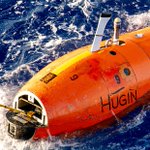
ALT The HUGIN AUV, an orange, rounded cylinder about 20 feet in length, is seen in a close up on the surface of the water with its nose open and tethered to a rope

ALT The HUGIN AUV, an orange, rounded cylinder about 20 feet in length is seen in dark ocean waters, illuminated by a light from its dorsal surface as it’s lifted towards a metal ramp.

ALT A large computer screen shows contour lines overlaid by the straight lines of the survey track. The back of a man’s head is seen as he looks at the screen; another person’s elbow appears behind him in the frame.

ALT The HUGIN AUV, an orange, rounded cylinder about 20 feet in length is seen being backed off a steep ramp

ALT An anemone on a coral stalk

ALT A photo of a deep-sea coral reef, dark with depth with a yellow fish swimming by, is overlaid with two animated characters (one holding a magnifying glass and notebook, the other a video camera), as well as logos for NOAA, USGS, BOEM, the Inner Space Center, and the National Marine Sanctuary Foundation. Overlaid text repeats the information available in the post as well as “Gulf Restoration Live!”

ALT A man in a hard hat and PFD looks over the railing of a ship at sea, holding on with his left hand and pointing downwards with his right.

ALT A young person squats down behind an underwater robot to work on it; they hold a wrench in their hand and look down at the lower part of the vessel.

ALT Two men in hard hats and PFDs watch as an orange underwater robot, connected by a tether, moves along a track towards the open ocean.

ALT Mission personnel conducting a ballast test on the HUGIN 6000 AUV.

ALT An image of a branching orange coral interlaced with white brittlestars is overlaid with logos for NOAA, USGS, BOEM, the Inner Space Center, and the National Marine Sanctuary Foundation. Overlaid text states that events will run for 30 minutes and include time for audience questions. Livestream dates and topics include: Tuesday, November 10 at 3 p.m. EST: Storytelling Through Animation Tuesday, December 1 at 1 p.m. EST: The Science of Deep-Sea Coral Restoration Tuesday, December 15 at 2 p.m. EST: How to Build an ROV

ALT A yellow underwater robot, shaped like a stout cylinder, is held aloft by a black crane, high over the heads of observers and an American flag.

ALT Map showing recently collected seafloor mapping (bathymetry) data filling in data gaps in waters of the U.S. Exclusive Economic Zone (EEZ) surrounding the Commonwealth of the Northern Mariana Islands (CNMI) and around Guam.

ALT During Dive 08 of the third Voyage to the Ridge 2022 expedition, a rarely observed aggregation of sea urchins (Conolampas sigsbei) was seen, much to the delight of scientists onboard and onshore. The urchins each appeared to have a cluster of debris on the apex of its body, leading scientists to liken them to “hats.” Image courtesy of NOAA Ocean Exploration. Alt: Two sea urchins on the seafloor with a cluster of debris on their tops.

ALT Monkfish: This monkfish was hard to spot camouflaged against the seafloor at 861 meters (2.825 feet) depth during a Windows to the Deep 2019 dive to explore the south-facing wall of Washington Canyon off the coast of Virginia. Image courtesy of NOAA Ocean Exploration. Alt: A fish the color of the seafloor beneath it with a flat body.

ALT Crab: This decorator crab was observed using its modified back legs to carry a glass sponge on its back at a depth of 762 meters (2,500 feet) during Dive 12 of Windows to the Deep 2021. It is thought that decorator crabs use materials from their environments, such as sponges, as camouflage, to avoid detection. Image courtesy of NOAA Ocean Exploration. Alt: A crab carrying a white sponge with its back legs.

ALT A man sits in front of a row of computer monitors in a dark room. Description: Chief Hydrographic Survey Technician Benjamin Bryan cleans seafloor mapping data during the 2026 American Samoa Mapping + Transit expedition. Image courtesy of NOAA Ocean Exploration.

ALT November calendar featuring a bright red king crab facing a dark orange crab on the sandy ocean floor with a flat rock topped with white fish eggs between them. The NOAA Ocean Exploration logo is in the lower left corner.

ALT People securing a large, white ROV on a research ship deck as others watch from above.