The latest stories in science, brought to you by the @ScienceMagazine news team.
Washington, D.C.
Joined October 2008
- Tweets46K
- Following638
- Followers767K
- Likes1.1K
A battle over the future of archaeology in the United States is about to enter a pivotal phase.
Next week, the Senate is expected to begin considering legislation that could substantially narrow rules that require developers to conduct archaeological reviews of projects funded or permitted by the federal government. scim.ag/4Aet0IS
NASA’s Neil Gehrels Swift Observatory has tumbled into the atmosphere after a 22-year career cataloging violent explosions and other high energy happenings across the universe.
Astronomers will mourn the loss of an instrument that transformed the study of supernovae and other fast-moving events.
Learn more: scim.ag/4el7g5H
Companies are using wearable neurotechnologies to train #AI models of the brain—without telling users.
Learn more: scim.ag/4BJLfY5 @pulitzercenter
Even NASA’s JWST, the largest telescope in space, struggles to take pictures of planets close to their stars. A star can be billions of times brighter than its planets, and even a coronagraph—a mask inside the telescope that blocks a star’s light—can’t eliminate its glare completely.
Now, astronomers have devised a way to model the minuscule imperfections in JWST’s optics and subtract that unwanted light.
The technique boosted the telescope’s sensitivity to faint planets by as much as 15 times in one test. It also revealed a previously known exoplanet, 51 Eridani b, at a midinfrared wavelength where it had not been detected before.
Learn more: scim.ag/3X5JNzq
Unlike elephants, walruses are not endangered. And commercial sale of their tusks is legal in the U.S. when the ivory is carved by Alaska Natives, who have been practicing the art for some 2000 years.
However, after a 13-year investigation, researchers say they have discovered widespread fraud in the walrus ivory trade: Indonesian carvings are being passed off as Alaska Native artworks, which are likely destined for the U.S.
Learn more: scim.ag/4iqNSGM
Forests across North America have seen a drop in the number of songbirds heralding the arrival of spring. To figure out why, biologists scour forests to capture birds and tag them with leg bands.
By going back to look for the tagged birds a year later, they can get a picture of how many survive from one year to the next. But the fieldwork takes untold hours, and capturing and banding can stress the birds.
A new paper lays out a quicker, gentler approach. It uses sound recorders and #AI to identify individual birds based on their song alone and track them over time.
Learn more: scim.ag/4zE48ui
Researchers have, for the first time, inserted receptors into the human brain that allow them to manipulate neuron activity with a drug.
The groundbreaking gene therapy was designed to help three people with drug-resistant epilepsy by dampening activity in the seizure-generating zones of their hippocampus.
The therapy did not produce major side effects, and appeared to reduce the incidence of seizures, the team conducting the clinical trial reported.
Learn more: scim.ag/3Wypb2F
Californians appear to have said yes to a plan authorizing up to $8.4 billion in state bonds to fund immunology and immunotherapy research.
But critics argue the proposal will end up funneling billions in taxpayer money to a single research institution—one founded by the same billionaire who funded the campaign to get Proposition 38 on the ballot. scim.ag/4eV78dg
In January 2027, microbiologist Jasmine Clark—who will be the first Black woman with a science Ph.D. to serve in Congress—hopes to gain a seat on the House science committee that Representative Zoe Lofgren is all but certain to chair after winning her 17th term.
Fresh from their victories, @RepZoeLofgren and @jasmineforga spoke to @ScienceInsider about their agendas. ⬇️ scim.ag/4k6lZFi
9
3,797
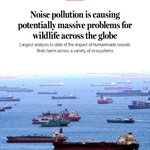
Scientists have long known that noise from human activities—from the roar of jet engines to the whir of ship propellers—can harm animals, stunting their growth and even scrambling their eggs. But it’s been unclear just how pervasive the problem is.
A massive analysis reveals the impacts are far more widespread than even researchers thought.
Data from 177 species that live on land and in the water reveal the vast majority are impacted by sound in some way, fundamentally altering their biology and behaviors, and causing many to die early.
Learn more: scim.ag/4A8miUG
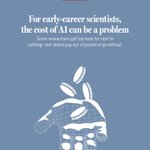
As #AI gets better at the work involved in science, more scientists see it as essential rather than a nice to have.
But researchers tell @ScienceCareers access to the best tools today depends less on need than on who can pay—and that the costs of AI are falling especially hard on early-career scientists, many of whom are reluctant to raise the issue because it feels taboo.
Learn more: scim.ag/4imKXPt
The midterm elections have given Democrats firm control of both chambers in the new U.S. Congress that will convene in January 2027, overturning Republican majorities.
Many in the research community are hoping the pending power shift means a more sympathetic audience for their criticisms of President Donald Trump’s policies.
Learn more: scim.ag/4zvKXTo
Plant scientists have high hopes for short corn.
Learn more: scim.ag/3LUA1uJ #ScienceMagArchives
When asked to draw a scientist, school-age kids in the United States are increasingly sketching women, according to a study from 2018.
Read more on #STEMSTEAMDay: scim.ag/41GMAz6
It's the first video evidence of polar bears hunting and eating reindeer—something that had long been assumed, but never clearly seen.
Learn more: scim.ag/48L5oAI #ScienceMagArchives
Artificial intelligence has tackled a mystery that has flummoxed cell biologists for decades.
Anthropic reports its key #AI model, Claude, has helped unearth new clues about vaults—strange, barrellike structures, found by the thousands in animal and plant cells, that still have no known function despite scores of studies.
In a blog post and related preprint, Anthropic describes how its small team of in-house biologists, guided by Claude, produced the first direct evidence that bacteria, viruses, and perhaps other simple microbes also make the odd structures.
Learn more: scim.ag/4eRMQRV
“We can actually get control of these three diseases,” says Mark Dybul, who will return to the Global Fund to Fight AIDS, Tuberculosis, and Malaria after 9 years. scim.ag/4ztROgb
Researchers funded through the European Union's pandemic recovery package are facing an uncertain future as the program comes to an end. @ScienceCareers scim.ag/3UxmbD8
For the second time this year, the Harvard Graduate Students Union has gone on strike after the university failed to provide a “meaningful response” to demands for better pay and stronger protections for survivors of harassment and noncitizen student workers. scim.ag/4enc6zr
1
11
3,387
Call it the coolest scientific result ever: Physicists in China have attained a temperature of just 9.7 picokelvins—less than ten-trillionths of a degree above absolute zero—in a quantum mechanical soup of atoms.
The result comes from an experiment aboard the China Space Station, which is also known as Tiangong.
The automated module created what’s known as a Bose-Einstein condensate that lowered the coldest temperature ever achieved by a factor of four and could open new ways to use cold atoms in space to explore fundamental physics.
Learn more: scim.ag/4ze7yTC