

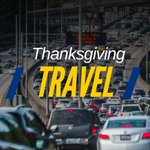



ALT Traffic congestion on a highway with a digital road sign displaying "Thanksgiving Travel" overlaid on the image. Vehicles are densely packed, stretching into the distance.

ALT A split infographic titled "Traveling for Thanksgiving? Know Before You Go." The left side depicts snowy weather with tips for driving in snow: remove snow and ice, use low-beam headlights, watch for black ice, be cautious on bridges and overpasses, don't use cruise control, and pack an emergency kit. The right side depicts rainy weather with tips for driving in heavy rain: ensure wiper blades work, reduce speed, allow extra space between vehicles, and advises not to use cruise control or drive through water.

ALT A road closed sign blocks a flooded street. Warning text says, "Turn around, don't drown." A car is partially visible in the background. Additional text at the bottom states, "Just 12 inches of moving water can carry most cars away.

ALT A group of people standing in the Governor's Office of Highway Safety. They are posed in front of a wall with the office's name. Some are wearing uniforms, and others are in business attire. They are inside a well-lit office space.

ALT NHTSA Administrator Jonathan Morrison is speaking at a clear podium on stage at the 29th Annual National Transportation in Indian Country Conference. Behind them is a large colorful sign with the conference logo and a stylized desert illustration. Six other individuals are seated on stage, some holding papers. Flags are visible in the background.

ALT A road safety poster titled "Distracted Driving" features a sunset highway scene with cars. It lists distractions such as texting, adjusting music, eating, talking, reaching, and daydreaming, connecting each to a colored die image with dots.

ALT The image is a public safety infographic about drowsy driving. It features a blue "Rest Area" road sign. The main message states, "If you feel drowsy, stop at a safe location and take a break." A large number "8" highlights that "8 is great!" and "7 is good!" referring to hours of sleep. Text below emphasizes that adequate sleep is the only way to protect against drowsy driving risks. Two clocks illustrate the "Danger Zone": midnight to 6 AM and late afternoon as the most dangerous times of the day.

ALT Here's a car rental safety checklist. It includes: 1. Check for safety recalls at NHTSA.gov/recalls. 2. Inspect child car seat fit, noting the importance of a tight tether. 3. Find essential controls, such as headlights and wipers. 4. Set up your navigation, ensuring seat and mirror adjustments. A white sedan is pictured at the bottom right.

ALT A split image showing two car crash scenarios at night. The left side depicts a vehicle leaving a driveway, while the right shows a low-speed collision. Text reads "Short Trip ≠ Safe Trip" with safety advice: crashes often occur close to home, low-speed crashes can injure, and buckling up saves lives. Includes icons of a house, car crash, and seatbelt.

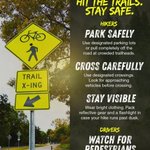
ALT A poster for National Take a Hike Day. On the left, a yellow road sign with a bicycle icon and "Trail X-ing" text. On the right, hiking safety tips: "Park Safely" advises using designated parking or pulling off near trailheads, "Cross Carefully" advises using designated crossings and being alert to vehicles, "Stay Visible" suggests wearing bright clothing and using reflective gear, and "Watch for Pedestrians" reminds drivers to slow down near trailheads and crossings. A scenic outdoor path is in the background.

ALT A chalk drawing of a windshield wiper wiping a chalkboard with the text "Do your wipers sound like this?" Overlapping the lower part of the wiper is "International Check Your Wipers Day" and a small logo of "Elgin" with an eraser and chalk sticks nearby.

ALT This image contrasts two ways of placing a child in a car seat. On the left, marked "Incorrect," a child wears a puffy coat with a loose-fitting harness. On the right, marked "Correct," the child wears a lightweight fleece with a snug-fitting harness. Text at the top reads, "What's Safe for Kids in Coats in Car Seats?


ALT Press release from NHTSA about delivering over $200 million to expand lifesaving prehospital blood transfusions for crash patients in the U.S. Highlights that research shows a 37% reduction in mortality rates for trauma patients with severe bleeding. NHTSA logo at the bottom.

ALT Map of the United States with states color-coded to show percentages of unbuckled vehicle occupant fatalities. The colors range from light blue (29%) to dark orange (72%). Each state is labeled with its abbreviation and corresponding percentage. The map includes a legend at the bottom indicating the color scale used.

ALT Red and yellow text over a close-up image of a car seat belt. The heading reads, "5 Things to Know About Buckling Up." The numbered list includes: 1. Wearing your seat belt is the best way to protect yourself in a crash. 2. Air bags are designed to work with seat belts, not replace. 3. The lap belt and shoulder belt are secured across the pelvis and rib cage, which can withstand crash forces better. 4. Fit matters. Check if the seat belts are a good fit in a new car. 5. Pregnant individuals should buckle up and see NHTSA's seat belt recommendations in the post link.

ALT A consumer alert notice from NHTSA about a recall for nearly 721,000 BMW vehicles. It advises owners to park outside due to a risk of the water pump electrical connector short-circuiting and catching fire.


ALT A winter road safety poster titled "Beware of Black Ice" shows a car approaching a snow-covered bridge and another car encountering invisible hazards. It advises slowing down and staying alert on bridges and overpasses, as they freeze first. It also recommends tripling the distance between vehicles and steering in the direction you want the car to go if sliding occurs.

ALT The image is an infographic titled "What Type of Tires Do You Need?" It features four quadrants: "Winter" with a tire and snowflake, describing tires for cold weather below 45°; "All-Season" with a tire, for year-round driving in moderate climates; "Summer" with a tire and sun, for warm-weather driving not below freezing; and "All-Terrain" with a tire and mud, for trucks and SUVs on highways and off-road.