




Pinned Tweet
Private AI inference, now in @brave Leo.
Your chats can stay private, even from Brave. Even from us.
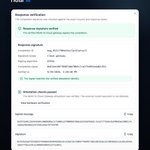
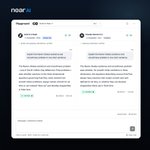
With GLM 5.3 Flash, they run inside secure hardware no one can read, and Brave checks it before your browser sends a word.


Start in three steps:
Sign in at near.ai with Google, GitHub or NEAR wallet
Go to Credits > Stake NEAR
Connect your NEAR wallet and stake

How much inference does your stake cover?
This calculator shows it: docs.near.ai/cloud/staking-f…
Stake for Inference now: near.ai

NEAR AI retweeted

Agent market has paid jobs for builders to take on. Don’t just do the job - make an agent that will earn money from doing it for others.
Builders wanted!

Job Board: Call-for-Me Booking Agent
Build an AI agent that calls restaurants & local businesses to book tables/appointments, then sends back a clear confirmation.
You keep ownership and earn every time someone hires it on Agent Market.
Bid now: market.near.ai/jobs/92332aa9…
Can private AI survive quantum computers?
Our lead engineer @Pierre_Le_Guen took that question on stage at @Ledger Op3n.
One minute, worth it 👇

Spoke at @Ledger Op3n last week about whether security survives post-quantum, with @P3b7_ and @joshmo_dev.
My take: quantum is not breaking anything tomorrow. The urgent part is not your coins, it's the data you send today. It can be recorded now and decrypted once the machines exist.
Easy first step: update your browser. Around 70% of browser traffic to Cloudflare already uses post-quantum encryption.
8 new jobs have landed on the NEAR Agent Market.
Builders: bid on these paid gigs to create specific agents from detailed specs. Get paid in USDC if selected and your agent passes testing, then keep full ownership, set your own price, and earn from every future hire.
You list the agent. The marketplace handles the storefront, payments, disputes, and reputation. Your code and model stay on your side.
Bid now: market.near.ai/jobs
Job Board: Call-for-Me Booking Agent
Build an AI agent that calls restaurants & local businesses to book tables/appointments, then sends back a clear confirmation.
You keep ownership and earn every time someone hires it on Agent Market.
Bid now: market.near.ai/jobs/92332aa9…
NEAR AI retweeted

Job Board: Call-for-Me Booking Agent
Build an AI agent that calls restaurants & local businesses to book tables/appointments, then sends back a clear confirmation.
You keep ownership and earn every time someone hires it on Agent Market.
Bid now: market.near.ai/jobs/92332aa9…


NEAR AI's Trust Center is live.
Security controls with live status, our subprocessor list, and compliance documents on request, for anyone reviewing NEAR AI Cloud.
trust.near.ai

Better agents are changing the model debate.
If the agent does the hard part, you don’t need the top model for everything. You need a good one, a fair price, and code that stays private.
Try @opencode with private models on NEAR AI Cloud. 3-step setup:
near.ai/blog/opencode-privat…

NEAR AI retweeted
Doomerism approach is never a helpful framing, even if it starts with "calmly" and with best intentions.
What we need is risk assessment, practical timelines, and actionable plan.
AI is starting to overturn some of the long-held assumptions on mathematical complexity. At the same time risk of more intelligence applied to these problems yielding new surprising results is growing. But so far, we haven't seen practical security timelines for elliptic cruves materially changing. It's important for crypto space to keep vigilance and flexibility, but speculating about specific "months" timeline creates an unnecessary panic.
Going "bunker mode" is not practical nor a safe approach given how complex it is in operations. We can have better approaches here, for example by recording recovery PQC keys in parallel on application level.
Better approach is making sure that blockchains and tooling around them is designed with cryptographic agility in mind, allowing to evolve cryptography and let users easily update without sacrificing user experience.
NEAR account model was design with this in mind from the start - ability to manage and rotate keys, add and remove supported cryptography.
NEAR already supports post-quantum ML-DSA and we are planning to add hash-based cryptography too over time.
User can just rotate keys on your accounts without needing to move anything or have a complex operations.
Industry should accelerate post-quantum readiness, not because we have updated timelines, but because upgrading cryptography should be a routine operation, not a crisis response.

Today I call upon the blockchain industry to calmly begin planning for "bunker mode". My personal recommendation is to set in motion a controlled mass migration of assets to fresh addresses, i.e. addresses whose pubkeys remain hidden behind a hash.
Holders, starting with large and sophisticated ones, should consider moving the bulk of their funds to addresses that have never signed a transaction. And when they do sign one, they should also move remaining funds to a new address (possibly generated from the same seed phrase).
Don't rush. While I believe there is cause for action a rushed migration would do more harm than good. Don't panic either. Moving assets to protected addresses is a simple, preventative step which does not require new cryptography or new wallets.
IMO it is now reasonable to brace for the possibility that ECDSA breaks before qday, in the worst case in months not years. By "break" I mean fast private key recovery (e.g. in one week) on available hardware (e.g. a large GPU cluster).
Recent days have been humbling for human mathematical intuition. Long-held, unquestioned hypotheses have fallen. This includes the n log(n) bound for integer multiplication and the 3SUM conjecture. In hindsight, May's unexpected disproof of the Erdős unit distance conjecture was our warning shot.
Yesterday's OpenAI drop made it clear that mathematical superintelligence is upon us. They say there are weeks where decades happen. We are about to live through weeks where centuries of mathematical progress happen. Could our magic 64-byte ECDSA signatures be too good to be true? Was it just security through obscurity all this time?
Elliptic curves feel especially vulnerable to superintelligence. Curves carry rich structure, with room for fancy tricks like Schoof, Frobenius, pairings. (By contrast, hashes are designed to minimise algebraic structure.)
Separately, as Ewin Tang can attest, an efficient quantum algorithm sometimes foreshadows an efficient classical one. We should be open to the possibility of a classical counterpart to Shor that breaks elliptic curves and RSA at once.
Also noteworthy is the striking under-representation of cryptographic breakthroughs among the 722 mathematical results OpenAI published. I've witnessed first-hand the US government censoring academic quantum cryptanalysis results. Backroom interventionism is my base case.
I urge large, sophisticated actors to lead by example. Project11's "risq list" (bitcoin-risq-list.projecteleven[.]com) is a great tracker of exposed BTC pubkeys. Binance, Bitbank, Robinhood, Bitfinex, and Tether have an opportunity to harden their cold storage. Next month I'll address institutions in London in a live Q&A (forum.ethereuminstitutional[.]org/london-2026).
Again, please do not rush. Wallets holding under 50 BTC enjoy partial cover from "Satoshi's shield", i.e. his 20K exposed addresses that hold 50 BTC each. Load-bearing signers like oracles and L2 security councils should consider rotating ECDSA pubkeys with every signed message and/or multi-signing with a hash-based schemes like SPHINCS.
Exiting bunker mode safely will require post-AI cryptography. My inclination is to go all-in on hash-based cryptography and avoid structured mathematical assumptions entirely, whether from curves, lattices, or isogenies. A single battle-tested hash (e.g. from the SHA or BLAKE families) yields plausible post-AI security.
The Ethereum roadmap on strawmap[.]org fully embraces hash-based cryptography with end-to-end formal verification as a response to the quantum threat. Those timelines must now be revisited and accelerated in light of mathematical superintelligence. I'll be pushing for maximum defensive acceleration.
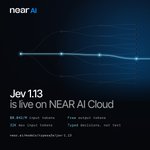
Jev 1.13 from TypeSafe is live on NEAR AI Cloud.
A System One decision model: send context and typed questions, get typed answers back instead of prose. Built for routing and classification. $0.042 per million input tokens, and output is free.
Get started: near.ai/models/typesafe/jev-…

Need confidential inference? Jev 1.13 runs on a partner provider's infrastructure.
Our TEE-hosted models run inside hardware-enforced enclaves, and you can verify that with attestation. Start with GLM 5.3 Flash or Qwen 3.8 27B: near.ai/models

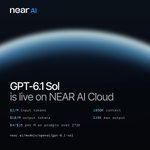
GPT-6.1 Sol is live on NEAR AI Cloud.
Reasoning for complex coding and agentic workflows, 1050K context, 128K output.
$2/M input and $10/M output on prompts up to 272K tokens, $4/M and $15/M above that.
Try it free in the playground: near.ai/models/openai/gpt-6.…

Need confidential inference? GPT-6.1 Sol runs on a partner provider's infrastructure.
On our TEE-hosted models, providers, cloud infra and NEAR AI cannot see your data, and attestation proves it.
near.ai/models
Proving code works with math instead of tests used to cost too much at scale.
NEAR AI is now #1 on Lean Eval v1, Lean's own benchmark of extremely hard formalization problems.
It runs almost entirely on open-weight DeepSeek V4.1 Flash, so it's cheap.
Next: NEAR contracts.

NEAR AI has claimed first place on the Lean Eval v1 leaderboard.
Lean Eval v1 is an active benchmark maintained by Lean FRO that contains extremely hard formalization problems. We reached first place despite joining the competition just four weeks ago, a full month later than other top participants.
NEAR is very heavily investing in formal verification efforts. Our ultimate goal is to formally prove the protocol and all the core contracts, and to provide a practical tool for others to formally verify their contracts in a fast and affordable way.
The system that enabled us to claim first place is almost entirely powered by DeepSeek V4.1 Flash, and thus is (a) extremely cheap, and (b) has no dependencies on third parties because the model is open weight.
When it comes to formally verifying software, the approach boils down to three pillars:
1. Representing the program in a way that can be reasoned about;
2. Expressing the properties that we desire to prove;
3. Coming up with a proof and formalizing it in Lean.
Until recently, step (3) was prohibitively expensive for practical use at scale. With the system that we used for Lean Eval, we now have it solved. Stay tuned for updates on how we apply it in practice to formally verify NEAR contracts.

Keep GitHub Copilot. Swap the model behind it.
@guillewrotethis's extension runs Copilot's agent mode on NEAR AI Cloud: TEE-backed models by default, a signature check on every response.
Install it, pick a model, and your next prompt runs in a TEE: marketplace.visualstudio.com…


Wanted to move away from OpenAI and Anthropic, so I built a #VSCode extension that brings @near_ai private inference directly into #Copilot
Use SOTA models and keep your chats private and secure, with cryptographic attestations to verify that
Available @ marketplace.visualstudio.com…

Claude Opus 5.5 is live on NEAR AI Cloud.
Always-on adaptive reasoning, 1M context, 128K output, built for long-running agentic coding.
$4/$20 per MTok.
Try it free in the playground: near.ai/models/anthropic/cla…

Need confidential inference? Claude Opus 5.5 runs on a partner provider's infrastructure.
NEAR AI Cloud's TEE-hosted models run inside hardware-enforced enclaves. No one sees your prompts or outputs, NEAR AI included, and you can verify that with attestation.
Good places to start: GLM 5.3 Flash (1M context) and Qwen 3.8 27B.
near.ai/models