
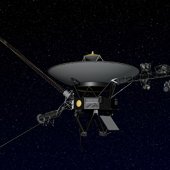
This account has been archived. Follow @NASAJPL & @NASASolarSystem to get the latest updates on Voyager 1 & 2, the longest operating spacecraft in deep space.
- Tweets625
- Following50
- Followers818K
- Likes2.2K
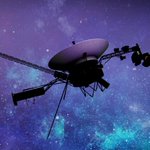



ALT Illustration of a Voyager spacecraft in space, silhouetted against a colorful, star-filled background in shades of purple and blue. The spacecraft's large dish antenna and extended instrument arms are prominently visible, evoking its ongoing journey through interstellar space.


ALT Poster-style graphic for the Voyager documentary The Stuff of Dreams. A silhouetted Voyager spacecraft is shown in the foreground, set against a colorful, swirling space background resembling infrared or radio waves. The title text reads “The Stuff of Dreams,” with “Stuff” and “of” in white and “DREAMS” in bold blue overlaid by horizontal blue bars.

ALT Illustrated graphic showing the positions of NASA’s Voyager 1 and Voyager 2 spacecraft as they travel beyond the heliosphere into interstellar space. The image depicts the Sun at the center, surrounded by the blue termination shock, the outer heliosheath, and the edge of the heliosphere. Both spacecraft have crossed the heliopause—the boundary where the solar wind is stopped by the interstellar medium—marking their entry into interstellar space. The background features colorful clouds of interstellar gas and distant stars, highlighting the vastness of space beyond our solar system.

ALT Musician Chuck Berry and scientist Carl Sagan on stage at NASA’s Jet Propulsion Laboratory in 1989, celebrating the Voyager 2 spacecraft’s successful flyby of Neptune. Berry, wearing a white suit and holding a guitar, looks toward Sagan, who is dressed in a beige suit and speaking into a microphone with a raised hand. The event honored the mission’s milestone and Berry’s music, which was included on the Voyager Golden Record sent into space. A cheering audience is visible in the background.

ALT Vibrant image of Neptune captured by NASA’s Voyager 2 spacecraft in 1989. The planet appears as a deep blue sphere with dynamic cloud bands and a prominent dark storm system known as the Great Dark Spot near the center. Wispy white clouds streak across the atmosphere, highlighting the planet’s active and turbulent weather. The dark backdrop of space contrasts with Neptune’s brilliant hues, emphasizing its remote, icy beauty.

ALT Dramatic image of Uranus captured by NASA’s Voyager 2 spacecraft in 1986, showing the planet as a thin, glowing crescent against the blackness of space. Only the outer edge of the planet is illuminated by the Sun, creating a soft, pale blue-green arc. The rest of Uranus fades into shadow, emphasizing its distant, cold, and mysterious nature. This image was taken as Voyager 2 departed the Uranian system, looking back toward the Sun.

ALT False-color image of Saturn’s rings captured by NASA’s Voyager 2 spacecraft in 1981. The image reveals intricate ring structures in vivid bands of red, orange, blue, and purple, representing variations in particle composition and size. The rings curve gracefully across the frame, with the colors artificially enhanced to highlight subtle differences not visible to the human eye. The dark background of space contrasts sharply with the vibrant arcs, showcasing the complexity and beauty of Saturn’s ring system.

ALT Collage of twelve images taken by NASA's Voyager spacecraft during their encounters with Jupiter and its moons. The images show: close-ups of Jupiter’s swirling cloud tops and Great Red Spot; the planet's faint ring system; and detailed views of its four largest moons—Io, Europa, Ganymede, and Callisto. The moons appear in various colors and lighting, with visible surface features such as volcanic activity on Io, icy cracks on Europa, and cratered terrain on Ganymede and Callisto.


ALT A screenshot of a web application showing the current position of the Voyager 1 spacecraft outside the orbit of Neptune.

ALT Nighttime photo of large radio antennas at the Madrid Deep Space Communications Complex in Spain, part of NASA's Deep Space Network. Multiple dish-shaped antennas are illuminated against the dark sky, with red lights on top and surrounding floodlights casting a glow on nearby vegetation. The array is used to communicate with distant spacecraft, including the Voyager missions.

ALT Diagram showing the trajectories of NASA’s Voyager 1 and Voyager 2 spacecraft through the solar system. Both spacecraft launched in 1977—Voyager 2 on August 20 and Voyager 1 on September 5. Their paths curve outward from the Sun, passing by several outer planets. Voyager 1 flew by Jupiter on March 5, 1979, and Saturn on November 12, 1980, before heading upward out of the solar system. Voyager 2 took a longer path, encountering Jupiter on July 9, 1979, Saturn on August 25, 1981, Uranus on January 24, 1986, and Neptune on August 25, 1989, before exiting the solar system in a different direction.


ALT Archival image from 1977 showing the Voyager 2 spacecraft inside the Spacecraft Assembly and Encapsulation Facility at NASA’s Kennedy Space Center in Cape Canaveral, Florida. The spacecraft is vertically positioned and partially enclosed in a white payload fairing, surrounded by scaffolding and platforms. Technicians in white cleanroom suits work around the base, preparing the spacecraft for encapsulation and launch.

ALT A Multi-Hundred Watt Radioisotope Thermoelectric Generator (RTG) used on NASA's Voyager spacecraft. The cylindrical device is mounted vertically in a testing rig, with two dark-colored finned sections for heat dissipation and various wires and connectors attached. The RTG is shown indoors, in a clean lab environment with cables on the floor and industrial equipment in the background.


ALT Illustration of NASA’s Voyager spacecraft speeding through deep space, with its large white dish antenna facing forward and long boom arms extending outward. The background features a vibrant, streaked purple and blue starfield, evoking a sense of swift motion through the cosmos.