

This is the NASA History Office's official X account. We're happy that you share our passion for aerospace history.
- Tweets25.5K
- Following164
- Followers1.2M
- Likes11.6K




ALT Images from Discovery Program missions (left to right): 1. Mercury was produced using images from the color base map imaging campaign during MESSENGER's primary mission 2. Dwarf planet Ceres shown in enhanced-color renderings that use images from NASA’s Dawn mission 3. NASA's Gravity Recovery and Interior Laboratory (GRAIL)'s gravity map of the Moon 4. NASA's InSight lander is in the foreground in this view from its landing site on Mars 5. A portion of the irregularly shaped asteroid Donaldjohanson as seen by NASA’s Lucy spacecraft 6. Mars appears as a thin pink crescent in this view from NASA’s Psyche spacecraft


ALT An artist’s illustration shows an astronaut conducting an extravehicular activity on the lunar surface. In the background, a second astronaut collects lunar samples. Small craters are visible around the surface. A habitat is visible on the righthand side with Earth rising above. Commissioned by NASA in the late ‘80s. Artist: Garret Moore. Credit: NASA

ALT An artist’s illustration from 1986 shows astronauts working on the Moon. On the lefthand side, a rover with six wheels is visible. A communications satellite sits atop. In the left corner, Earth is visible. Two astronauts stand beside the rover to the right. In the far background, elements of lunar habitats can be seen. Artist: Dennis M. Davidson. Credit: NASA

ALT An artist’s illustration from 1969 shows two lunar habitats. One is a raised vertical structure, slightly behind another dome structure. The habitats appear connected by a tubing ventilation system. Astronauts are walking outside the habitats in spacesuits. Artist: Roy G. Scarfo. Credit: NASA

ALT An artist’s illustration commissioned by Ames Research Center in 1978. On the lefthand side, an astronaut in a spacesuit stands with an arm slightly raised. To the right, an elevated habitat is visible. Stars can be seen in the background, with Earth visible. Artist: Rick Guidice. Credit: NASA


ALT An astronaut in a white space suit stands in front of an American flag and a neutral background, smiling while resting hands on a moon globe. The suit displays a NASA logo.

ALT An astronaut stands on the lunar surface during an Apollo mission to the Moon. He is standing near a lunar module and an American flag, with the barren, cratered landscape of the Moon visible.

ALT This black and white image was taken in 1962, showing a steerable parachute in the Ames 40-by-80 foot wind tunnel. The parachute is mounted to a control head and projects outward to the left. This was an early design of an Apollo parachute tested at Ames, ultimately shaping the development of the parachutes used during Apollo missions. Credit: NASA

ALT A bright orange parachute for the Orion spacecraft is tested inside the 80-by-120 foot wind tunnel at NASA Ames. Credit: NASA/Eric James

ALT An illustration of one of NASA’s twin Voyager probes against an abstract purple and blue background that gives the impression of deep space. Voyager has a white, upturned dish atop a black cylindrical body. A long antenna extends from the body toward the upper left and other shorter hardware protrudes from the sides and bottom. The image is watermarked “Artist’s concept” and “Credit: NASA/JPL-Caltech.”


ALT The GALCIT rocketeers taking a break from setting up their experimental rocket motor in Pasadena's Arroyo Seco. Left to right: Rudolph Schott, Apollo M. O. Smith, Frank Malina, Edward Forman, Jack Parsons. Credit: NASA/JPL-Caltech

ALT Mary Kathleen McGuirk, an employee at NASA Lewis Research Center (now known as NASA Glenn) wears a pointed hat and rides a space age broom for the center’s Halloween celebration in 1977.

ALT The International Space Station as it appeared on April 17, 2010, when photographed by an STS-131 crew member after space shuttle Discovery undocked from the station. The space station is backdropped by the Earth which shines in a deep blue and is covered in elongate clouds.

ALT In a photo from the 1970s, engineers gather around one of the Voyager spacecraft before it was launched.

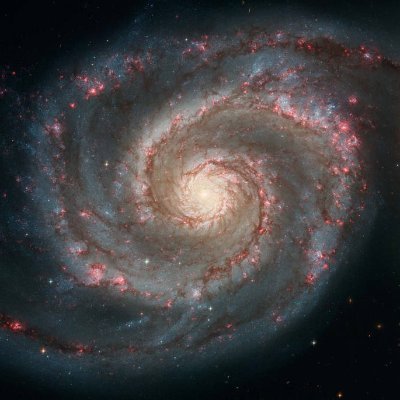
ALT Image description: A quote by Captain Jean-Luc Picard, played by Patrick Stewart. "I've come to believe that the stars have always been in my favor." - Jean-Luc Picard. The image shows a dense cluster of bright stars, each with six large and two small diffraction spikes, due to the telescope’s optics. They have a variety of sizes depending on their brightness and distance from us in the cluster, and different colors reflecting different types of star. Patches of billowing red gas can be seen in and around the cluster, lit up by the stars. Small stars in the cluster blend into a background of distant stars and galaxies on black.

ALT This montage of 11 images taken by the Galileo spacecraft as it flew by the asteroid Gaspra on October 29, 1991, shows Gaspra growing progressively larger in the field of view of Galileo's solid-state imaging camera as the spacecraft approached the asteroid. Sunlight is coming from the right. Credit: NASA/JPL


ALT View of the Enterprise orbiter as it glides through the sky over the California desert on ALT free flight 5.

ALT King Charles shakes hands with astronaut L. Gordon Fullerton after the 5th free flight of Enterprise in October 1977. Fred Haise is in the foreground with his back to the camera. Behind Charles is Dryden Center Director David R. Scott, and on the right in the background is astronaut John Young. Credit: NASA

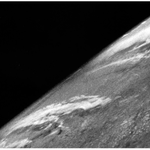
ALT A grainy black and white photo of a small portion of Earth seen with the blackness of space, taken on October 24, 1946. White clouds are visible over the gray of the Earth's surface.

ALT Sand dunes shaped like blue-black flames lie next to a central hill within an unnamed, 120-kilometer (75-mile) crater in eastern Arabia Terra. False colors depict the nature of the ground surface: Areas in bluish tints have more fine sand at the surface, while redder tints indicate harder sediments and outcrops of rock. Credit: NASA/JPL/Arizona State University

ALT Western Arabia Terra: This false-color image was made by combining photos taken at infrared wavelengths during local daytime and late at night. The camera was THEMIS, the Thermal Emission Imaging System, aboard NASA's Mars Odyssey orbiter. Broadly speaking, the colors indicate surface materials, with redder colors showing where rocks and hardened sediments are commonest. Tints of greens and blues map the places where finer-grain materials like sand, silt, and dust cover the surface. Credit: NASA/JPL/Arizona State University

ALT Rabe Crater lies among hundreds of thousands of other impact craters in the rough-hewn southern highlands of Mars. Spanning 108 kilometers (67 miles), Rabe is halfway between the martian equator and the south pole, and west of the giant impact basin Hellas. Two features help set Rabe Crater (and several more in its vicinity) apart from most other craters on Mars. Rabe has a flat floor with a pit sunk into it, plus a large field of dunes. A pair of visible-wavelength images together with numerous infrared ones created this false-color THEMIS view that captures portions of both the pit and the dune field. The colors portray the overnight surface temperatures: bluer colors indicate cold places, redder tints warm ones. Credit: NASA/JPL/Arizona State University

ALT The highlands of Terra Sirenum. The infrared imaging gives scientists clues about the nature of the surface. THEMIS photographs patches of ground twice per Martian day—once in late afternoon and then again just before night ends—two times when contrasts in surface temperature are strongest. In this false-color mosaic, THEMIS researchers have colored in blues and greens the areas that are cold at night, while nighttime-warm regions appear in reds, oranges, and yellows. The tints distinguish areas covered in dust and sand (cool colors) from exposures of bare rocks and deposits free of fine-grain material (warm colors). Credit: NASA/JPL/Arizona State University
