

Building something new. Previously: CTO at Autonomy
San Francisco Bay Area
Joined November 2007
- Tweets18.9K
- Following1.6K
- Followers4.3K
- Likes6.3K






Pinned Tweet
Here’s a look inside my software factory. I’ve been using it to build itself and two other projects since May.
mrinal retweeted

100s of tech startups are auditing their ML pipelines this weekend. If you used Claude to fine-tune or train your own models (even non-frontier) there's a good chance it sabotaged your work.
xitter.cf/elder_plinius/status/2…


mrinal retweeted

I seriously think US open-weight models wouldn't be this good without Chinese open-weight models and vice versa.
And proprietary models wouldn't be this good (and cheap) without open-weight models.
Competition is a good thing.

Next we need similar tests for use in training data. I suspect the “not used for training” promises are just as weak as the ZDR promises.

We seeded 2m canaries into popular AI services and tracked where they were stolen and abused.
This identified:
- Three compromised providers
- Resellers stealing prompts via built-in logging
- Providers ignoring ZDR & privacy flags
dragos.com/blog/ai-supply-ch…


1
175
mrinal retweeted

We seeded 2m canaries into popular AI services and tracked where they were stolen and abused.
This identified:
- Three compromised providers
- Resellers stealing prompts via built-in logging
- Providers ignoring ZDR & privacy flags
dragos.com/blog/ai-supply-ch…
Zero. I haven’t manually resolved a merge conflict in about 6 months.
Fluent knows how to resolve conflicts, rebase, test again, etc.
The only exception is if I start two parallel slices of work with truly conflicting behavioral requirements.

Forget the ideal software factory. I can’t even get Claude and Codex to share a repo. Everyone’s posting how automated your factory is. What’s your merge conflict rate?
2
1
180
mrinal retweeted

Introducing Qwen3.8-27B-pi-adapted 🤗
We adapted Qwen's model specifically for the pi coding agent using reinforcement learning and a LoRA adapter.
The results, measured as pass@1:
🚀 SWE-bench Pro (Hard 51): 29.4% → 62.7%
💻 Terminal-Bench 2.1: 39.5% → 55.8%
⚡ 55–62% fewer tool calls per task
This is the power of open models: you can adapt them to YOUR tools and YOUR use cases. Let’s build! 💛
Open weights: huggingface.co/harness-hub/Q…
Methodology: huggingface.co/blog/harness-…

mrinal retweeted

venture capital is one of the few industries where you can spend five years getting positive feedback on bad decisions without ever realising it
mrinal retweeted

Apple built Exclaves (🤌) with a microkernel, hardware isolation, and formal verification to prevent this ... or at least convince us they were trying to make spying harder.
Meanwhile, the sad reality: Apple's audio daemon just trusted the identity supplied by the app. 🫠

Meta's red team found an Apple bug that let iPhone and Mac apps record from the microphone even after the user denied permission.
The app forged an ID token to pose as Apple's own audio service, which then skipped the permission check.
On one iOS 27 beta, the orange mic dot never lit up, and the logs pinned the recording on Apple's service, not the app.
Apple fixed it in August with iOS 26.6.1 and macOS Tahoe 26.6.2. Its patch note calls it just "a logic issue."


Here's how my software factory bootstraps:
- Most of Fluent is deterministic Rust code. The Rust command line drives the queues, work lifecycle etc.
- Skills are used to teach coding agents at two levels:
1. How to use Fluent at the level of driving the factory.
2 How to write and review code the way I like it at the level of individual code writers and specialized parallel reviewers.
When you install Fluent via `npx skills add ...` it installs a lightweight shim skill github.com/mrinalwadhwa/flue…
This shim skill on first request to use Fluent, installs the Fluent rust command line binary and the full Fluent skill
github.com/mrinalwadhwa/flue…
That full skill then invokes the `fluent init` command to initialize a project to use Fluent.
That command edits your project's AGENTS.md to add some instructions to teach it how to use Fluent as a software factory so Codex, Claude, Pi etc. know that they need to refer to Fluent skill and Fluent command output when fixing bugs and building new features.
github.com/mrinalwadhwa/flue…
Here's what gets injected into AGENTS.md:

ALT Instruction for building a project with Fluent, an open source self improving software factory.

hi.
curious question - how do you work on the software factory itself ? using Claude/Codex i mean.
your agents.md says "use fluent to build fluent". But for those of us with (subsidized) claude plans...how do we tell Claude to work with fluent ?
something like "dont ever fix a bug directly - delegate it to fluent and fix whatever is necessary"
5
17
1,074
I might have to write a bot that anytime someone says anything about agents and granular attenuate-able delegate-able permissions…
replies with: “the answer you’re looking for is attribute-based credentials (ABCs) and attribute-based access control (ABAC)”

RFS (request for startups) from a stealth portfolio founder.. I really like all of these ideas.
If you are working on any of these, please DM me!

93

Fascinating! Continuously learning systems will need continuous evals.
I already feel this with Fluent (my software factory), which continuously learns by writing learnings down as files and providing an index for future agents to lookup. Similar to a memory system.

Weight Space Programming: a glimpse into continual learning.
Agent edited Qwen 0.8B's weights to inject facts about my X profile directly into the model: my handle, bio, GitHub, and what i build. It edited 2% of the network (5 of 488 tensors). No training, no gradients.
Result:
Before, it had never heard of me ("I don't have access to private information…").
After, it tells you who i am, my bio and GitHub, answer project questions it was never trained on. Everything else it knew is untouched.
Reproduce : Link to reproduction repo in comments. Point your agent to the repo and teach model your own facts.
2
4
377
In my mental model - the minimum viable software factory is a queue of work, where you specify work, queue it, and move on to the next thing.
The factory's job is to make sure the work gets authored, reviewed, and merged.
(sounds like @jasonlk doesn't have this yet)
I should be pulled back in only if the agents get stuck on a question along the way.

Top 10 agent learnings from this week
1. Never tell an agent to "queue" work. Replit told us our approved fixes were "queued." It stopped overnight and built none of them. Now every prompt says "do it now."
2. We moved to cheaper models, and AI spend still went from ~$35 a day to $84. Call volume went up faster than the price per call came down.
3. I told the agent the old model HAD to go. A day later it was still running. I don't count it done until the call log shows zero calls in the last 24 hours.
4. Our AI fact-checker flagged 18 of 30 accurate notes because it treated opinions as factual claims. Every flag triggered a rewrite, so we paid twice for worse copy.
5. Each of the agent's daily reports said "no schema changes." The build broke anyway, on a table left over from an older change. The reports only checked each day's own work.
6. When an agent says data is missing, check the database first. This week the data was there all along, and the step that displays it was what was broken. Check the record before you pay to re-enrich anything.
7. Scout, our email agent, now acts on plain-English replies like "intro me" or "pause." It runs the same code as the buttons in the app, not a separate version.
8. One of our agents was answering emails sent to another agent's inbox for days before we caught it.
9. We canceled Canva after 12 years. We'd stopped using it a year earlier but kept paying, and two of us had separate team plans without knowing. We were paying about 4x for nothing.
10. 10K started as our AI VP Marketing. This week it pulled together SaaStr's financials, and it already runs invoicing, collections and commissions. We never planned any of that.
1
1
142
There are 54 models on the decision index that score better than Jev. All of them can likely run on your laptop (less than 31B parameters)
huggingface.co/spaces/multim…


Lets make a rule:
Anyone who says you don't need a software factory is not allowed to sell you agents in the cloud that work async and drive a workflow to build, review, merge, and then deploy code.
143
This is post is describing a software factory (sort of) and then saying you don't need one.
I agree that its not a great term but I haven't come across a better one so until we can come up with one it is a useful word to discuss a pattern:
We all need a system that consistently applies a process of shipping code with many concurrently working agents that asynchronously pick up queued work, work 24/7, work in the cloud, and work with a team & product level scope. They are making decisions across an entire team's work.
Every team's version of this looks different so we should all assemble a factory that fits our own needs. But saying "its just good engineering" is vague and doesn't help talk about a thing all good engineering teams have to discuss, understand, and build.


Every team needs a versions of this and that thing needs a name:
“Product builds the product inception style.”
xitter.cf/mrinal/status/21035177…

“Product builds the product inception style.” 🤌
agree with @GeoffreyHuntley
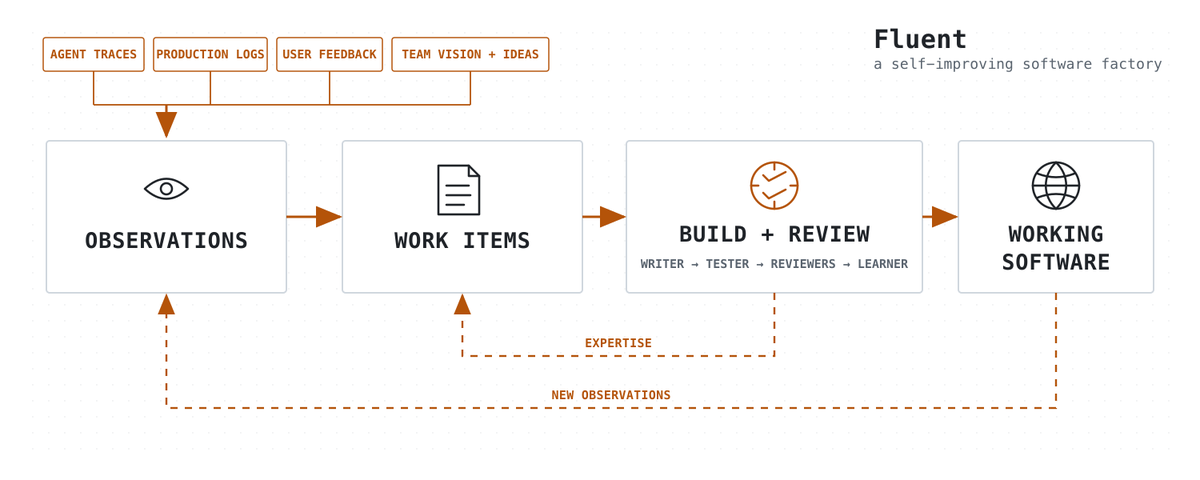
The left side of this picture is what provides energy to the factory loops. User feedback, Production logs, Agent traces, and your team's ideas are what move the engine forward.
A good software factory also improves over time and gets better at building its product. To do that it has to learn. These learnings very quickly become about how the product works, what are its builders’ priorities, its users’ preferences, its creators’ taste etc.
A product and its factory are insperable.

ALT The loops in Fluent, an open source, self-improving, software factroy.
1
80
mrinal retweeted

This work is simple, clear, compelling, but embellished. I first found it shocking, the notion that a model can natively understand neural network weights and productively edit them! That's really not what's happening, & many here are annoyed. BUT, it's still notable & worth understanding.
I've done a bit of analysis & auditing, here are some thoughts:
1/ This paper does *not* show an agent can edit its weights ala RSI. It does *not* show a model can edit in new capabilities. It DOES show that a frontier model can remove "bugs" (reasoning loops), using the same ablation technique researchers have used to remove safety refusals (Exp 8 - Qwen). So yes, renewed concern about frontier LLMs getting access to their own weights & editing safety/CBRNE/alignment features.
2/ This paper also does *not* show that an agent can "natively" read, deeply understand, and fix model weights. What is happening is that the model can cleverly deduce the same things that mech-inturp researchers do and fix them in mostly ham-fisted ways. Still cool, but not as groundbreaking. Evidence in thread below...

We asked GPT-6 Astra to edit Qwen3.5-0.8B weights to improve math.
It directly changed only 0.016% of weights, fixing 0.8B's reasoning loops & improving math up to 6x and even instruction following 3x, without gradients or training.
We call this Weight-Space Programming: frontier LLMs can now natively read/write neural network weights! 🧵
Blog: rikiyat.github.io/blog/weigh…

Readers added context they thought people might want to know
LLM was given weights explicitly as text in prompt and used code/forward passes (per authors' logs) to ablate Qwen looping direction, a known thinking-mode issue per model card. Primarily fixed repetition in that mode, not general 'natively' improving weights/math.
rikiyat.github.io/blog/weight-sp…
github.com/RikiyaT/lm_und…
huggingface.co/Qwen/Qwen3.5-0…
huggingface.co/RikiyaT/Qwen3.…