
WSJ tech columnist and author of How to AI, the no-nonsense guide to what AI actually is and how to actually use it, for the rest of us
Baltimore, MD
Joined March 2007
- Tweets579
- Following2.2K
- Followers96.2K
- Likes214K


Pinned Tweet
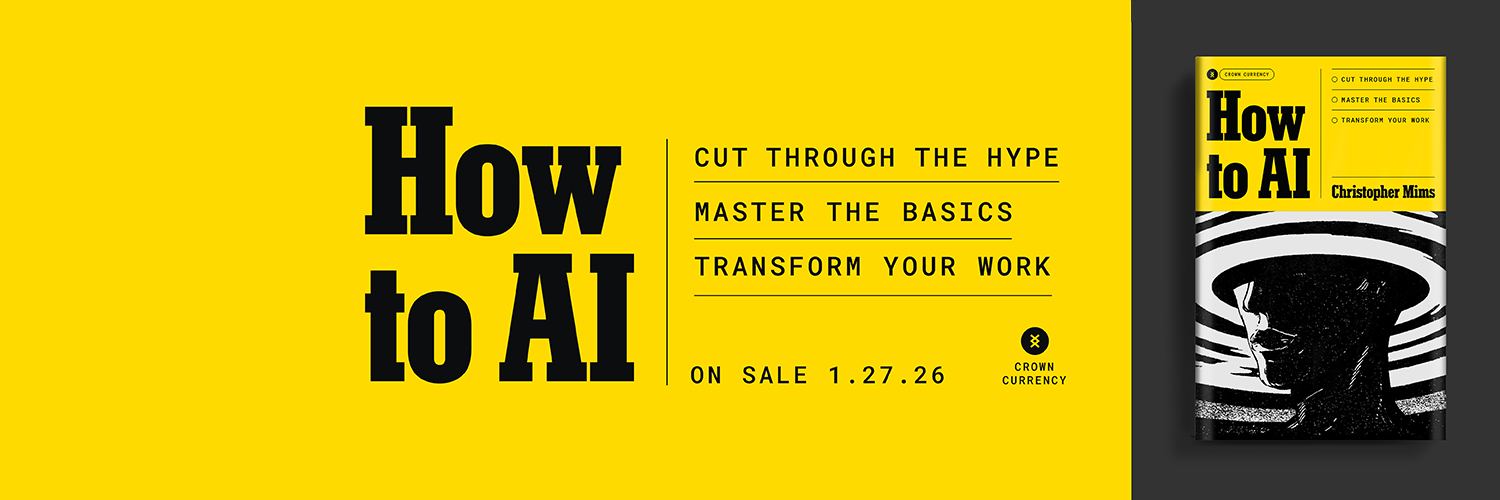
I wrote a book about how to actually get real value out of AI.
It's for CEOs and solopreneurs and skeptics and enthusiasts alike.
It's the no-nonsense, bullshit-free guide that a lot of people need, but were afraid to ask for.
You can pre-order it now.

Christopher Mims 🤌 retweeted

OPENAI to EMPLOYEES: If someone is trying to seduce you, first consider — could they be a spy???
OpenAI is warning its employees about honeypot spies and strangers with children in playgrounds ... a very fun one with @georgia_wells and @MeghanBobrowsky:
wsj.com/tech/ai/ai-companies…

Christopher Mims 🤌 retweeted

THE SHRUGFLATION TRIANGLE
I wrote about what happens when the two biggest borrowers in the economy seemingly stop caring what money costs: (1) oil, AI, and Treasuries feeding into each other (2) who ends up paying for it (people) and (3) why nobody seems to be able to stop it


Christopher Mims 🤌 retweeted

There are real limits to what we can accomplish in a world where people believe nothing they do really matters.
My book (!) is about how we wound up in a place where millions of people feel like spectators in their own lives. And how we course correct. Because we can.

Christopher Mims 🤌 retweeted

Even before the Saudi OpenAI employee was arrested yesterday, the startup had been warning staff to beware of people trying to glean work-related information from them--from honeypots to playground spies
More in my story w/ @georgia_wells @erinkwoo
wsj.com/tech/ai/ai-companies…

Christopher Mims 🤌 retweeted

“I’m going to make you a lot of f—ing money,” Ambassador Kimberly Guilfoyle told a businessman at Davos this year as she was trying to get into a party, according to a recording reviewed by
@WSJ
Read the latest from @rebeccaballhaus @drewhinshaw @JoeWSJ and me
wsj.com/politics/policy/at-d…
.

Christopher Mims 🤌 retweeted

A rogue Anthropic agent submitted a FAKE MURDER TIP to the Philadelphia police department
Philly cops say: “The two-month delay in detecting and reporting the incident to the city is unacceptable”
wsj.com/us-news/anthropic-ai…

Christopher Mims 🤌 retweeted

"Last year, Bessent got so angry about the way his daily briefing book was organized that he picked up the binder full of papers and threw it at a wall, people familiar with the matter said." Read @schwartzbWSJ @jdawsey1 @PhilipWegmann @GZuckerman
wsj.com/politics/policy/bess…

Christopher Mims 🤌 retweeted

Updated with details about which employees OpenAI has parted ways with for allegedly mishandling confidential company information: Jasmine Wang, Tomek Korbak, and Mikita Balesni.
Korbak served as the technical contact for Redwood Research and METR in their investigation of the Hugging Face incident.
Rolling scoopage with @berber_jin1 + @ZeffMax
wsj.com/tech/ai/openai-parts… via @WSJ

Christopher Mims 🤌 retweeted
Over the last few weeks, so many people have asked me: if people at Anthropic believe that AI has a meaningful chance of killing us all, why are they building it? @berber_jin1 and I did a deep dive into Anthropic’s relationship with effective altruism to try to explain how doomerism came to be so influential at the company.
The tale took us to a group house in San Francisco, “clothing optional” swims in the Bahamas and a co-working space in Berkeley funded by an Anthropic investor’s money that has become a central gathering place for those most worried about the existential risk from AI.wsj.com/tech/ai/ai-safety-ef… via @WSJ

Christopher Mims 🤌 retweeted

AI’s Wider Availability Is Good for China, Not Great for OpenAI and Anthropic—Intelligence ‘too cheap to meter’ could threaten the leading AI labs, while creating opportunity for their competitors
@mims
wsj.com/tech/ai/cheaper-ai-c…
wsj.com/tech/ai/cheaper-ai-c…

Christopher Mims 🤌 retweeted

A look at the research into using metal-organic frameworks as photoresists for cutting-edge silicon etching, as ASML aims to move from EUV to X-ray lithography (@mims / Wall Street Journal)
wsj.com/tech/silicon-chips-m…
techmeme.com/260302/p4#a2603…
📥 Send tips! techmeme.com/contact

Christopher Mims 🤌 retweeted

Moore’s Law, the march of microchip progress that took us from mainframes to iPhones, will end in 2040. Here’s the tech that could get us across the finish line, writes Christopher @Mims on.wsj.com/4r0fWBS

Christopher Mims 🤌 retweeted

Everyone told Corning to sell its unprofitable fiber-optic business. Now, because of the AI boom, that division is powering the company’s stock to all-time highs, writes Christopher @Mims. on.wsj.com/4qrlQvI

Christopher Mims 🤌 retweeted

How do you Ai? I asked @mims about his new book, if his job is at risk, and how Ai removes what he calls "toil," which very well could make our work more human.
As the host of #BoldNames and columnist of @WSJ's "Keywords" column, practical Ai use cases are Christopher's bread and butter. For tech folks, you'll learn practical stories, for the uninitiated, you'll get caught up.
01:06 - Ai removes toil, not jobs
07:00 - Job disruption or new opportunities
09:23 - @Clorox uses Ai for previously impossible tasks
10:56 - Generative vs non-generative AI
12:49 - Is the construction industry at Ai risk?
14:57 - The urgency of adopting Ai
17:17 - Ai and law. A win for lawyers and consumers.
24:40 - Ai in Hollywood. Will it kill creativity?
28:40 - Tension of job loss and productivity gains
30:40 - Ai makes us more human
31:22 - Journalism in an AI World
Christopher Mims 🤌 retweeted

Scientists who use AI have published three times more papers, received five times more citations, and reach leadership roles faster than their AI-free peers.
But science as a whole is paying the price, the study suggests. Not only is AI-driven work prone to circling the same crowded problems, but it also leads to a less interconnected scientific literature, with fewer studies engaging with and building on one another.
It's a classic social dilemma: what's good for individuals is bad for the collective.
science.org/content/article/…

1000% this
It's the primary reason I wrote How to AI, the slim, accessible volume that has the potential to onboard the next million (ten million?) people who could meaningfully change their lives with just a little bit of AI.
Comes out TOMORROW
sites.prh.com/how-to-ai

i follow AI adoption pretty closely, and i have never seen such a yawning inside/outside gap.
people in SF are putting multi-agent claudeswarms in charge of their lives, consulting chatbots before every decision, wireheading to a degree only sci-fi writers dared to imagine.
people elsewhere are still trying to get approval to use Copilot in Teams, if they're using AI at all.
it's possible the early adopter bubble i'm in has always been this intense, but there seems to be a cultural takeoff happening in addition to the technical one. not ideal!

When I give talks for my forthcoming book I always say "these are the industries that will be disrupted by AI, and in this order: 1. coding 2. law ..."

Christopher Mims 🤌 retweeted
Generative AI is making our gadgets radically better at both hearing and understanding us, writes Christopher @Mims. Here’s why people are getting “voice-pilled.” on.wsj.com/45pEvQP
Christopher Mims 🤌 retweeted

The politics of green energy are sometimes topsy-turvy.
Here you have North Dakota which gets 40% of its energy from wind enjoying low electricity prices. But that's happening while the Trump admin attacks wind energy.
Meanwhile, Vermont has the country's most ferociously anti-wind energy set of regulations (10 to 1 setbacks, noise limits, shadows rules, etc.), and has high electricity prices in part because of that, but will tell you up-and-down how progressive it is on climate.
You have a set of red states that are pretty progressive on green energy (but don't want to admit that) while you have blue states that are very conservative on green energy (but also don't want to admit that). It's this weird kabuki dance.

.@EIAgov just released its latest electricity price data, and New England states have among the country’s HIGHEST residential electricity prices—over 64% HIGHER than the national average and over 2x HIGHER than prices in my home state of North Dakota!