

Co-founded NP Digital. Bootstrapped to $100M+ and almost 1,000 people with zero VC. Nothing to sell you here. I just like helping entrepreneurs win.
Joined November 2025
- Tweets164
- Following74
- Followers120
- Likes306








Pinned Tweet
Most business advice on X comes from people who never built anything.
8 years ago Neil Patel and I started NP Digital with zero outside funding. Today it's $100M+ in revenue and almost 1,000 people in 28 countries.
I've got nothing to sell you. I just enjoy helping entrepreneurs, so I share what actually worked for us and what blew up in my face along the way.
If you're building something, stick around.
2
8
602
A prospect asks:
"How many clients do you have?"
Bad sales answer:
"We have 15 clients."
Great sales answer:
"We have only 15 clients, so we'll never be too busy for you."

2
7
I've done hundreds of interviews at NP Digital, and some of the best people I've hired had what a lot of people would call red flags.
A few had only ever worked with huge clients. I'm fine with that. Enterprise people can serve SMB, just not the other way around.
Some were almost annoyingly hungry to move up. The attitude is I want to do more, I want to make more money. You want that.
The best hires I've made often looked a bit risky on paper. And they were hungry. Urgency is the one thing I've never been able to teach.
A little attitude doesn't bother me if they're really smart. Just don't wear down the team.
Same with pushing back on my ideas. I ask people to speak up if they disagree and tell me why.
If somebody says yes to a target that looks impossible and only hits 80% of it, I'll take that all day.
Admitting an experiment didn't work is another one. I want to hear what they tried and what they learned from it.
Someone on my team asked us to cover a $600 PM course. I said yes. If I can invest in my people educating themselves, I'm always going to do it.
With salespeople, I need them to ask good questions and dig deeper. Some are genuinely curious and some were trained to ask. I'll take either as long as they have the skill.

1
23
I start work at 5am so my son gets four hours of me every afternoon.
I work from 5 until about 4. Then from 4 to 8 it's him, and by 8pm I can barely keep my eyes open. Those four hours are not exactly restful, but they're the best part of my day.
A lot of the entrepreneurs I know have a different setup. One friend has two kids and three people helping: one full time per kid, plus someone for the weekends because the live-in help needs time off too. He doesn't see his kids much.
I get it. That's his choice, and I'm not telling anyone how to run their house.
I have help too. I'm not pretending I do this alone. But four hours a day with my son is more than most people who work 8 to 5 get with theirs, because they leave before the kid is really up and get home with a couple of hours left before bed.
Someone asked me if I wish I'd done this earlier, in my 20s. No.
Back then I didn't have the flexibility to choose my hours and I didn't have the money to have help, so I couldn't have structured my life around a kid without it being extremely stressful. Now I can.
It would have been brutal then, and it isn't now.

1
55
My first client was paying me $5,000 a month, and one day he asked me what exactly I was doing for the money.
The client was @neilpatel and this was back around 2012, way before we ever started the agency together. Neil was putting out a lot of infographics at the time because they were getting him a ton of backlinks, people would see them and share them on their own websites, and he asked me if I could find somebody who could help him make more of them.
I told him I could just do it myself. So I took it over, he paid me a monthly fee, and pretty soon I was doing the same thing for three more companies.
The pricing was simple. $5,000 a month per company for four infographics, so about $1,250 each, and my costs were around $100 each. I'd found people in other countries to do all of it, one person doing the research and another doing the design, and across those companies I was making about $20,000 a month while personally doing almost none of the actual work.
Neil noticed. He said, dude, you have a guy who does all the research for your infographics and someone who does all the design, so what do you do? I told him the truth, which was that I don't do anything, I have people who do all of it for me. So he asked the obvious next question, which was why he was paying me $5,000 a month.
I told him he was paying me for the outcome. It doesn't matter how I get it done, and if he's happy with the infographics, he shouldn't care what they cost me to make.
He thought about it and said yeah, that's true. And he kept paying me.
I know how that sounds, charging $1,250 for something that cost me around a hundred bucks. But think about what Neil was actually buying. He wasn't buying my hours or my effort, he was buying backlinks, and the infographics were getting them. If I'd made every single one myself it would have taken me way longer, I never could have taken on the other three companies, and I doubt the work would have been any better for it.
Where a lot of people get stuck is pricing their work off what it costs them, or off how hard it was to do, and then feeling like they have to defend the margin when a client finds out. The client usually isn't sitting there doing math on your costs. They're checking whether the thing they paid for did what they needed it to do.
2
62
I hate going through my mail, so I set Claude up to do it, and now it pays my bills and only pulls me in when a bill is more than 20% off from what it normally is.
Here's how that actually works, because it sounds like magic and it isn't. I pay for a virtual mailbox. My mail goes to a real address, a real person opens it, makes a PDF of it and emails it to me. Claude already has access to my email, so once that PDF lands in my inbox it can read it, pay the bill and flag anything that looks off.
That's one example of how claude is basically my chief of staff. But it does much more...
Every call I have gets transcribed automatically. Every day Claude will sweep all of those transcripts along with my email, my Slack and my calendar, so it has the full context on everything I'm working on.
From there it keeps one page per business that's always current, with every open thread, number and decision. It runs a project board that moves the cards along on its own as it reads my conversations, so if I ask someone on my team where something stands, the next day the board already has their answer. It drafts my email replies, but only when a reply is actually warranted, so if I'm on a thread and nobody is addressing me, it doesn't draft anything. The drafts sound like me because I had it go back and read 12 months of my sent email first. And the morning brief gives me the three decisions that only I can make.
I built all of this with Claude Code even though I have no engineering skills at all. The word code scares people off, but you aren't writing any code, you just talk to it. The one thing I tell everyone is to use Claude Code instead of the chat, because the chat doesn't keep that long term memory and Claude Code never starts from zero.
Where I'd push back on the hype is hiring. I built a whole hiring pipeline with it that asks me the questions about the role, builds the scorecard, the interview questions and the job description, then finds candidates on LinkedIn and reaches out to them. It does the manual labor really well. It does not do an amazing job of knowing what questions to ask a candidate or how to score them, and that part still comes from the hiring mistakes I made before I got good at it.
I recently gave someone I know a 30 minute walkthrough of my setup. They put together a basic version of it, and they told me it has absolutely changed the way they work.
1
84
The senior engineer I interviewed on Wednesday morning was found, messaged, and scored by software I built, and I have never written a line of production code in my life.
Here is the whole thing, because I think people make this more complicated than it is. I open Claude Code and type slash hiring a new role. It interviews me. It asks what the role is, what is broken today that this person is supposed to fix, what great looks like in the first 90 days, what kind of person actually survives in my company, and it keeps asking until it has enough to work with. Then it writes the job description. Then it writes the interview questions for that specific role.
Then it goes and finds people. LinkedIn does not give me an API I can use, so it drives a Chrome browser on my other computer, searches the way I would search, builds the list, and sends the outreach from my templates. When somebody replies and we get them on a call, it takes the transcript of that interview and scores them against the questions it wrote, so I am not sitting there three days later trying to remember which person said the thing I liked.
I told him all of this on the call. I said I did not find you, I told Claude what to look for and Claude found you. He was into it, and then he told me he had built an automatic reply system for a tiny business on his own time with the same tools, that he runs several instances of it in parallel, and that he wrote himself a skill that forces the model to ask him clarifying questions before it is allowed to do anything. That is exactly what I want to know about somebody, and it never shows up on a resume.
The part I will not hand over is the interview.
I do not let people walk me through their resume. I ask what got them into each job they took and why they left it, because the reasons behind the moves tell you far more than the titles ever will. Then I ask the uncomfortable question straight out instead of writing it down as a private concern. He had never stayed anywhere much longer than a year and a half, so I said that to his face and asked him whether he gets bored. He told me he kept hitting a ceiling with no room left to grow, that one of the moves was not his choice at all, and how he answered that told me more than his last three titles did.
Then I ask what his manager would say he is great at, and what his manager would say he needs to work on. Most people are generous about the first one and genuinely revealing about the second.
Everything around the interview used to eat hours of my week and almost none of it actually needed me. The part where I sit there and decide whether I believe somebody is the only piece that does.
100
A cleaning company quoted me $2,000 per cleaning, and the guy who came out to give the quote was wearing Ferragamo shoes.
My realtor had referred them. Great guys, he said, they do a lot of luxury homes. And the owner showed up decked out in expensive clothes, walked the house, and handed me a number I couldn't get my head around. I remember standing there thinking, you clean houses for a living?
Then I got a lesson in how that business actually works from someone close to me who sells software to people starting their own cleaning companies. Her point was that the companies at the top of Google and the top of Yelp are not the best cleaners. They're the best marketers. They spend heavily to get the lead, and then they mark up the same labor two or three times to pay for the ads and the shoes. Her advice, if you want great work at a fair price, was to go to the third or fourth page of Yelp and find the people with only a handful of reviews, because those are the ones who are still hungry and trying to build something.
So I did exactly that. I found two women who charge about $30 to $35 an hour each and spend around five hours on the house, which comes out to $320. Same house, same work, and we're not easy to please on this. It's about a sixth of the price.
Two things I do now before hiring anyone at that end of the market. I get them on the phone and interview them, because a suspiciously low quote is a reason to talk, not a reason to walk. And I ask for their insurance, because that answers most of what the fancy shoes were supposed to be signaling. Fifty real Google reviews are hard to fake, by the way. A scammer throws up a website. He doesn't put in that kind of effort.
I'm dealing with the exact same dynamic right now on the legal side of one of my businesses. A big firm charges you somewhere around $3,000 to get an answer to a question, every single time, and you can't run a company that way. So I'm out talking to smaller firms, and what I really want is a solo attorney who knows my industry and has a team of five people or fewer. That's how my in house counsel at NP Digital works. He handles everything he can, and when something is beyond him he goes to outside counsel himself, which means we're only paying for the narrow slice of the big firm's time we actually need instead of walking in the front door and paying for all of it.
The top of the page is the marketing budget. I'll keep looking on page four.

2
163
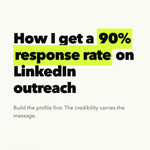
When I give my recruiters a list of ten people I want to hire, they usually get one reply. When I message the same ten people myself, I get about nine.
Same company, same job, same names, and honestly the message isn't that different either. The only thing that changes is whose profile it comes from. Mine has a founder title on it, around 14,000 followers behind it, and years of posts sitting underneath, so when someone gets a note from me they can tell in five seconds that I'm a real person with a real reason to be reaching out. When the exact same note comes from a recruiter they've never heard of, it reads like the twenty other messages already sitting in their inbox that week.
I bring this up because a founder I talked to a few weeks ago was convinced LinkedIn didn't work for his business. He runs a design studio, thirteen people, and every bit of his growth comes from Instagram. Somewhere between 600,000 and 2 million views a month, 40 to 50 leads a week, which he filters down to about three calls, and he closes 90 to 95% of the people who make it onto a call. Meanwhile his LinkedIn had 532 followers and had produced exactly zero leads.
So I asked what he'd actually done there, and the answer was posting. He had never sent a single outbound message. He was waiting for people to find him, which on Instagram works because his reels do the selling for him, and on LinkedIn was never going to work, because nobody was seeing anything.
Here's why I think outbound is a much bigger opportunity for him than it ever was for me. In performance marketing there's nothing to show in a cold message. If I write to a company and say we'd love to run your SEO, that's a promise, and promises are easy to ignore. His work is visual. He can write to a startup that just raised a round and say, here's a site we built for a company like yours, and we think yours could look like this before your next fundraise. The person on the other end gets to see it before they decide whether to care.
There's an agency called MuteSix that did exactly this. They made UGC ads for direct to consumer brands, and their whole early growth engine was messaging DTC brands on LinkedIn with the work they'd done for a similar brand and an offer to do the same. Dentsu ended up buying them, and the number I've heard is around $150 million.
So my advice to him was pretty simple. Keep building the profile, because the credibility is what makes the message land in the first place. But stop waiting to be found. Pick the exact kind of company you want, show them the thing, and go get them.

2
301
About ten years ago Neil Patel and I sold a $1,000 marketing course through a webinar, and at its peak it was doing around $500,000 a month. I'm not sharing that to brag. I'm sharing it because almost everything people assume about how we got there is wrong, and the actual mechanics are the useful part.
The offer never changed. Not once. It was the same course at the same $1,000 price from the first webinar to the last one, and what changed was the pitch, which we rewrote eight to ten times before it worked.
Here's how that went. We started by running the webinar live, which was a mistake, because it meant doing it every day or every other day and there was no way to keep that up. So we recorded it and let the software play it all day long, and then we would sit in the sessions and read the comments as they came in, because the comments told us exactly where people got confused, where they got bored, and where they left. We'd fix that one spot, run it again, and watch where they dropped next.
Eight to ten rounds in, about 1% of the people who watched actually bought. That sounds tiny. But when it's running every single day, 1% at $1,000 a head works out to roughly 500 buyers a month.
The webinar was maybe half of it. The other half was everything we did with the people who didn't buy. Only about 40% of the people who registered ever showed up, so anyone who missed it got an email saying we recorded it, here's the link. Anyone who watched and didn't buy got an email asking why. Was it price? Was it something else? And when the answer was price, which it was almost every time, we offered a seven day trial for a dollar, or a payment plan at $250 a month.
Refunds we just gave. If someone said they made the decision too fast and couldn't afford it, I didn't argue, even when I suspected they were stretching the truth, because it wasn't worth the fight. In all that time we almost never had a chargeback.
Then there was the part I didn't expect to matter. We put every buyer in a Facebook group, and that group became the product. Members started answering each other's questions, some of them got genuinely good at this stuff, a bunch went on to start their own agencies, and I'm still in touch with a few of them a decade later.
Looking back, the course itself was probably the weakest part of the whole thing. We built 45 modules and 220 videos because we figured over delivering would keep people happy, and mostly it just overwhelmed them. What actually made it work was all the stuff around the course, and we only found that by running it, watching people, and fixing one thing at a time.
🤖 Made with AI

1
69
A lot of people are building a personal brand right now, and almost all of them are grading themselves on view count.
Views feel like progress. It's the number that shows up first, so it becomes the scoreboard.
But nobody is posting just to be watched. The whole point of the views and the subscribers is to eventually turn them into money.
I heard about a guy who blew up posting short clips in his niche. One reel did 44 million views. Add up his whole account and he's into the hundreds of millions.
He's made about five sales.
You'd assume a number like that is a business. It isn't. He never talks about what he actually sells. No case studies, no proof, no reason for anyone to go from watching to buying.
The part almost nobody works on is the offer. Something your audience actually wants, that solves a real problem for them, at a price where buying it feels obvious.
Get that right and a small audience will pay you well. Get it wrong and 44 million views is just 44 million people who watched and left.
1
1
29
I realized something ugly about myself on a pickleball court. If I play with people well below my level, I get bored and I stop trying.
Not my proudest trait. But it taught me exactly why I've built my companies the way I have.
I want to be the least impressive person in the room. At NP Digital I'm surrounded by people who are genuinely better than me at their jobs. People who push back on my ideas and make me defend them. People who bring me a plan and tell me the three reasons mine was wrong.
That's the thing that keeps the work fun for me after all these years. Not being right. Being challenged.
The flip side is brutal, and I've felt it. When you're the smartest person in the room and every idea you float just gets nodded at, when nothing gets done well unless you personally carry it start to finish, it drains you fast. You end up doing everyone's job and hating all of it.
So when people ask what I hire for, the honest answer is I hire people who will make me a little uncomfortable.
The day your team stops challenging you is the day you either hired wrong or got too comfortable to notice.
26
Our designer pushed the 1,000th pull request on Ubersuggest.
Designers don't write code. She does now.
I asked the guy who runs the product what changed the engineering team. He said the engineers started seeing the technology differently.
He built something himself with Claude Code first. The code was good. He showed the engineering manager and said, replicate this. The engineering manager showed the tech leads. The tech leads showed the team.
Now everyone builds skills and automates their own work. There's a skill called install that sets up the whole codebase on your machine. There's one called ship that opens the pull request, reviews it and deploys it to staging.
Nobody got a memo about it. Someone at the top was the example, and it spread down one layer at a time.

1
3
71
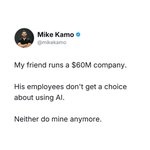
A friend of mine runs a clothing company doing $60 million a year. Every employee there learns Claude Code. It's not optional.
They're not allowed to use Claude chat, only Claude Code, because it's so much more powerful.
He told me the best use of his time as CEO is being all in on it. Learning constantly. Upgrading his own setup. Figuring out how to automate more of the business and give his people more leverage.
He's the guy who got me into it in the first place.
I took what he said and built my recruiting tool. Then I looked at where my time actually goes and started building a tool for each of those places.
I'm doing the same thing at my companies now.

1
1
50
Most people are running every task on the most powerful, most expensive AI model, then wondering why they're out of usage by Wednesday.
I did the exact same thing, until it clicked that I already know how to solve this. I've been solving it for years with people.
You get a fixed amount of usage on these tools every week. Run everything on the smartest model and you'll burn the whole week in two days.
So treat the models like a team. The strategic stuff, what am I missing, where are the gaps in this plan, what would you do differently here, that goes to the best and most expensive one. The brainless stuff, go read my notes and file them in the right spot, that goes to the cheapest one.
It's the same instinct I've used building NP Digital to almost 1,000 people. You never hand your highest paid strategist a task any junior could do. Not because they can't do it, because it wastes the one thing you can't buy more of.
The tools are new. The actual skill is the oldest one in business. Put the right level of talent on the right level of work.
My AI guessed who someone was with zero evidence, wrote the guess into my notes as a fact, and a second agent read it and acted on it.
I corrected it twice.
It confidently makes things up under pressure. It also logs drafts as sent emails. Little bugs like that.
Every day it runs a routine that measures what it got wrong, what I fixed, and what it recommended that I changed. If it drafted a message and I tweaked it, it studies the tweak.
The thing I keep telling it: what do you think I would do here? Learn that.
The drafts in my voice are so good now I barely touch them. That's weeks of corrections, not a setting.
It would be hard for me to work without it. And I still don't let it send anything on its own.

1
40
The thing that takes out most solo founders isn't strategy. It's that they're alone.
I mentor a founder building his product by himself. No partner. Grinding. He'd done over a thousand cold outreaches in a couple of weeks. On paper he's doing everything right.
But you could hear it in his voice. The doubt. The second-guessing. The quiet spiral that happens when there's no one to check your thinking against.
That isolation does more damage than any bad tactic. A bad tactic you can fix in an afternoon. Slowly talking yourself out of the whole thing because nobody's there to say "that's normal, keep going" is what actually ends companies.
So the last thing I told him wasn't about his funnel or his outreach. It was this. Go find friends who are also building something. People you can grab a drink with and talk business with in the same hour.
Not a mastermind you pay for. Not a bigger network. Actual friends in the arena with you.
When you're solo, that isn't a nice-to-have. It's the thing that keeps you in the game long enough for the strategy to matter.
33
Our site used to get 6 million visitors a month. Now we're probably between 2 and 3 million.
That drop happened after all the LLM stuff because people ask ChatGPT the question instead of clicking the article.
We still get a lot of traffic though. I'm not saying this to complain, just so you know the size of what changed.
Google pushed a spam update recently, and a post I read afterwards summed up what still works. Run your content operation like a media organization.
What that looks like in practice: someone on the team pulls unique data out of customer interviews, surveys, sales calls, and the experts inside your own company. Then turns that into studies. Nobody else could have written that content, because nobody else has the data.
If you write what everyone else writes, with the same AI everyone else uses, you get the same result everyone else gets.

1
32
Every founder building on top of AI right now should answer one question first: what do you have that Claude can't just do tomorrow?
I was on a call about a product we could build. The idea was good. My only pushback was this. If it's just a nice wrapper on top of an AI model, then the day the model gets a little better, or connects to one more tool, your whole business disappears.
So before you build, find the thing that's actually yours.
For us it's three things. Data the model doesn't have, because we spent years collecting it and it isn't sitting on the open web. A process we've refined for years that's hard to copy from the outside. And authority, which is the hardest one, because you can't prompt your way to other people vouching for you.
Notice none of those are the AI itself. The AI is the easy part now. Everyone has the same models.
The moat is the stuff you built before AI existed and the stuff AI still can't fake. If your only edge is that you wired up a good prompt, you don't have an edge. You have a head start, and those don't last.

1
28
Some of the best acquisitions Neil and I have done started with a founder telling us no.
People think buying a company is a transaction. You find one for sale, you negotiate, you close. The good ones almost never work like that.
Here's how it actually goes for us. We find an agency we like. Neil or I reach out personally, not through a broker, just us. Half the time the founder says they're not looking to sell anything. So we don't push. We stay in touch. We keep it warm.
Then a year later, sometimes longer, an email shows up. Are you guys still interested? Their situation changed. They're tired, or they're finally ready, or the market shifted. And now we're the first call, because we're the relationship they already have.
It's sales. It's just the slowest sales cycle you'll ever run. The close might be two years out. The work is the same either way. You build a real relationship with a person, and you don't disappear when they say not right now.
Most people chase acquisitions that are already on the market, where they're bidding against everyone else. We'd rather spend a year making a friend who isn't for sale yet.
The best acquisition is the one nobody else even knows is available.