MIT Sloan School of Management (@MITSloan) header
MIT Sloan School of Management (@MITSloan) profile picture

Insights for your work from MIT experts

Cambridge, MA
Joined September 2007
Photo by MIT Sloan School of Management (@MITSloan)Photo by MIT Sloan School of Management (@MITSloan)Photo by MIT Sloan School of Management (@MITSloan)Photo by MIT Sloan School of Management (@MITSloan)Photo by MIT Sloan School of Management (@MITSloan)Photo by MIT Sloan School of Management (@MITSloan)Photo by MIT Sloan School of Management (@MITSloan)Photo by MIT Sloan School of Management (@MITSloan)Photo by MIT Sloan School of Management (@MITSloan)Photo by MIT Sloan School of Management (@MITSloan)
Artificial intelligence is fueling innovation across industries, but it’s also introducing unanticipated risks and consequences for organizations. In this landscape, traditional enterprise risk management frameworks are no longer sufficient. mitsloan.mit.edu/ideas-made-…
3
7
962
As more organizations begin implementing agentic AI at scale, the way we manage employees will need to change. During a recent MIT Sloan alumni event, MIT Sloan School of Management professor Katherine Kellogg described a world in which we might be managing AI agents more than we manage people. Learn more: bit.ly/4iMYznq
10
14
8
44
3,377
Many of the past decade’s great business ventures were platform plays. As entrepreneurs and businesses consider this strategy for their next endeavor, they need to understand the platform’s role and how AI agents might shake up this field. @pierre_azoulay @johnjhorton mitsloan.mit.edu/ideas-made-…
1
6
1
18
1,420
Leading agentic AI transformations requires deep understanding of the technology. Having the right mental model of how AI works under the hood helps leaders move beyond automation to reimagining their business. mitsloan.mit.edu/ideas-made-…
4
3
30
2,196
Researchers from the MIT Sloan School of Management argue that as AI tools become more widely available, competitive advantage will depend on the trust, data, expertise, operating capabilities, and work redesign that companies build around them. mitsloan.mit.edu/ideas-made-…
1
11
1
52
2,806
Organizations are under pressure to innovate amid changing customer demands and continuously fluctuating markets. Artificial intelligence can help — serving as a catalyst for changing work patterns and enhancing innovation and creativity processes. mitsloan.mit.edu/ideas-made-…
4
26
3,214
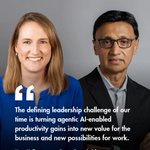
In a recent article, MIT Sloan’s Katherine Kellogg and Rama Ramakrishnan examine what it takes to redesign workflows, prepare employees for evolving roles, and turn AI-enabled productivity into sustainable business growth in the age of agentic AI. Learn more: bit.ly/3WEjjF0
7
9
1
38
3,172
Given the up-front cost of training models, AI’s advantage is best realized when production occurs at a large scale. As a result, bigger enterprises are far more likely to be early adopters than smaller companies with fewer resources. mitsloan.mit.edu/ideas-made-…
3
2
15
1,607
Artificial intelligence is making it easier for organizations to experiment, build prototypes, and launch new applications. But as AI activity spreads across an organization, so can redundant investments, applications that don’t scale, and unexpected operational costs and risks. mitsloan.mit.edu/ideas-made-…
2
4
1
22
1,746
What tasks should AI be trusted with, and when should humans remain involved? Designing those decision rights is one of the defining challenges of the AI era. Researchers at the MIT Center for Information Systems Research have developed a framework to help. Learn more: bit.ly/4zed20M
20
4
103
4,982