

Database Systems Engineer, #DBA #ITNews #Technology, #WomenInTech
Barcelona, Spain
Joined November 2008
- Tweets1.5K
- Following709
- Followers272
- Likes3.9K




Pinned Tweet
Thanks for your participation in our session! I felt delighted to spread out my knowledge
on this Multicloud
adventure.
Thank you to #OracleCloud for giving us this space for the community and talk about our use
case in this huge event #OracleCloudWorld22 #ocw22 Las Vegas,🇺🇸 – at Las Vegas, NV


Lizz Q. retweeted

🐘🌪️ Do you know your default autovacuum thresholds?
❄️🔥 How do they depend on the hot/cold data split?
👇🏼 I ran a small test to visualize the staleness accumulation over time: dev.to/franckpachot/the-auto…

Lizz Q. retweeted

This. Queda muchísimo para ese futuro que muchos boards y CEOs imaginan, con una AI operando sistemas de forma completamente autónoma. La realidad hoy es que la probabilidad de acabar creando un sistema que acabe colapsando es alta.

I strongly believe there are entire companies right now under heavy AI psychosis and its impossible to have rational conversations about it with them. I can't name any specific people because they include personal friends I deeply respect, but I worry about how this plays out.
I lived through the great MTBF vs MTTR (mean-time-between-failure vs. mean-time-to-recovery) reckoning of infrastructure during the transition to cloud and cloud automation. All those arguments are rearing their ugly heads again but now its... the whole software development industry (maybe the whole world, really).
It's frightening, because the psychosis folks operate under an almost absolute "MTTR is all you need" mentality: "its fine to ship bugs because the agents will fix them so quickly and at a scale humans can't do!" We learned in infrastructure that MTTR is great but you can't yeet resilient systems entirely.
The main issue is I don't even know how to bring this up to people I know personally, because bringing this topic up leads to immediately dismissals like "no no, it has full test coverage" or "bug reports are going down" or something, which just don't paint the whole picture.
We already learned this lesson once in infrastructure: you can automate yourself into a very resilient catastrophe machine. Systems can appear healthy by local metrics while globally becoming incomprehensible. Bug reports can go down while latent risk explodes. Test coverage can rise while semantic understanding falls. Changes happens so fast that nobody notices the underlying architecture decaying.
I worry.
Lizz Q. retweeted

BRUTAL recurso para crear Bases de Datos SQL:
✓ Crea tablas y datos con IA
✓ Dibuja los diagramas y relaciones
✓ Despliega a Supabase con un click
Lo mejor, es gratuito → database.build



Lizz Q. retweeted
La mítica base de datos MySQL se está apagando…
Lleva más de 4 meses sin recibir ni un solo commit en su repositorio público de GitHub. Mala señal.
La pausa coincide con los despidos de septiembre en Oracle dentro del equipo.
No significa que vaya a desaparecer. Está en millones de servidores y seguirá funcionando durante años.
Pero sí es una señal clara de algo más profundo:
MySQL ya no compite como comunidad open source, sino como producto puramente comercial.
Menos transparente, con otras prioridades.
El sorpasso de PostgreSQL ya es inevitable.

ALT Repositorio público de mysql-server en GitHub, mostrando la rama trunk con el listado de carpetas y commits, donde el último commit visible indica que el proyecto no se actualiza desde hace aproximadamente 4 meses.

The World of the Databases this decade is 🔥


Lizz Q. retweeted
The Evolution of LinkedIn’s Generative AI Tech Stack
Over the past two years, LinkedIn has undergone a rapid transformation in how it builds and ships AI-powered products.
What began with a handful of GenAI features, such as collaborative articles, AI-assisted Recruiter capabilities, and AI-powered insights for members and customers, has evolved into a comprehensive platform strategy that now involves multiple products. One of the most prominent examples of this shift is Hiring Assistant, LinkedIn’s first large-scale AI agent for recruiters, designed to help streamline candidate sourcing and engagement.
Behind these product launches was a clear motivation to scale GenAI use cases efficiently and responsibly across LinkedIn’s ecosystem.
Early GenAI experiments were valuable but siloed because each product team built its own scaffolding for prompts, model calls, and memory management. This fragmented approach made it difficult to maintain consistency, slowed iteration, and risked duplicating efforts. As adoption grew, the engineering organization recognized the need for a unified GenAI application stack that could serve as the foundation for all future AI-driven initiatives.
Note: This article is written in collaboration with the engineering team of LinkedIn. Special thanks to Karthik Ramgopal, a Distinguished Engineer from the LinkedIn engineering team, for helping us understand the GenAI architecture at LinkedIn. All credit for the technical details and diagrams shared in this article goes to the LinkedIn Engineering Team.
Read the full article here: blog.bytebytego.com/p/the-ev…

Lizz Q. retweeted
“When mistakes are cheap, you can move fast and fix what doesn't work. When mistakes are expensive, you overthink everything and still choose wrong”
From Brain Food


Lizz Q. retweeted

An undergrad student broke a 40-year-old belief in computer science.
Since 1985, it was believed that hash tables, when nearly full, must check many spots to find or add data.
Andrew Krapivin discovered a new way to organize data inside a hash table that avoids this slowdown.
Instead of checking slots randomly or in order, his method uses a more efficient structure to guide the search.
This reduces the worst-case time from O(n) to (log n)² steps, even when the table is almost full.

Lizz Q. retweeted

25 Papers That Completely Transformed the Computer World.
1. Dynamo - Amazon’s Highly Available Key Value Store
2. Google File System: Insights into a highly scalable file system
3. Scaling Memcached at Facebook: A look at the complexities of Caching
4. BigTable: The design principles behind a distributed storage system
5. Borg - Large Scale Cluster Management at Google
6. Cassandra: A look at the design and architecture of a distributed NoSQL database
7. Attention Is All You Need: Into a new deep learning architecture known as the transformer
8. Kafka: Internals of the distributed messaging platform
9. FoundationDB: A look at how a distributed database
10. Amazon Aurora: To learn how Amazon provides high-availability and performance
11. Spanner: Design and architecture of Google’s globally distributed databas
12. MapReduce: A detailed look at how MapReduce enables parallel processing of massive volumes of data
13. Shard Manager: Understanding the generic shard management framework
14. Dapper: Insights into Google’s distributed systems tracing infrastructure
15. Flink: A detailed look at the unified architecture of stream and batch processing
16. A Comprehensive Survey on Vector Databases
17. Zanzibar: A look at the design, implementation and deployment of a global system for managing access control lists at Google
18. Monarch: Architecture of Google’s in-memory time series database
19. Thrift: Explore the design choices behind Facebook’s code-generation tool
20. Bitcoin: The ground-breaking introduction to the peer-to-peer electronic cash system
21. WTF - Who to Follow Service at Twitter: Twitter’s (now X) user recommendation system
22. MyRocks: LSM-Tree Database Storage Engine
23. GoTo Considered Harmful
24. Raft Consensus Algorithm: To learn about the more understandable consensus algorithm
25. Time Clocks and Ordering of Events: The extremely important paper that explains the concept of time and event ordering in a distributed system
Over to you: I’m sure we missed many important papers. Which ones do you think should be included?
--
Subscribe to our weekly newsletter to get a Free System Design PDF (158 pages): bit.ly/bbg-social

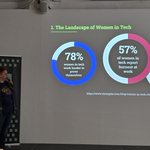
Strong words "Confidence is something your learn by doing" by Jesica Wulf #IWD25 in the event with the @wtmbcn #WTMBarcelona #WTMVueling

Hablando de IA en el #IWD25 "Liderazgo en la Era de la IA: Adaptabilidad, Conciencia y Power Skills" con nuestra tremenda ponente Daniela Vargas. "Nuestras emociones son las que se quedan en nuestra memoria, la IA son datos" #WTMBarcelona #WTMVueling

Who is interested about Kafka? We have the third talk about that. Coming from Gemma Minihan "Product Manager at Aiven- Kafka Made Simple: A Beginner's Guide to Event" #Aiven #IWD25 #wtmbarcelona #WTMvueling
