








Here’s why agent swarms are going to be a very big deal. We can finally make compute a critical variable in a large number of important tasks in the economy which wasn’t possible before.
There’s a large amount of work in the world that is essentially only constrained by the amount of time that we put into research, data processing, discovery work, running tests, and more. All of this work is bottlenecked by our ability to plan, execute, review, and coordinate everything happening in these workflows. Which means we basically do very little of them today relative to their economic value.
Agent swarms are the first real ability to parallelize this work in a way where - in theory - the only parameter that matters is how much compute you throw at the problem. Cyber security, life sciences or material science research, trading, QA testing, data processing, and many other fields are essentially compute constrained problems in the limit once models are good enough at these tasks.
The breakthrough is that in a world where agents can use tools, write code, process data, have strong domain depth, and can coordinate with each other, you can begin to solve arbitrarily complex problems by setting the right goals and applying enough tokens to the problem. This changes a lot of fields as well as even the competitive dynamics in these fields.
The biggest misread of anyone predicting the end of software engineering was imagining that the world only needed a certain amount of software, and bringing automation to the field would reduce the need for labor.
Exactly the opposite is happening where essentially most things are actually turning into software. Because agents can use tools, work with computers, write software on the fly, and process data like humans (but far faster), we can now throw “software” at problems that never could reasonably be digitized before.
What that leads to is the role of engineering taking on greater importance in the economy, because we can now engineer far more systems and processes than were possible before.
If you’re a bank trying to do new forms of trading, engineers are often your first bet. If you are in life sciences, you expect more and more research and lab work to be engineering centric. If you’re in manufacturing, you’re trying to automate more of the supply chain, all that is engineering. More and more work is shaped like software problems.
Yes we’re not going to be coding manually in the future. But almost everything will be code, which means those that understand it are in a fantastic position.

Some observations about the "total" automation of software engineering:
1. There are more software engineers now than in 2025, and demand is growing.
2. Software engineers have never worked harder than they do now.
3. They largely don't write code anymore, agents write ~100% of the code.
4. The bottom line of the companies that employs these engineers and agents (i.e. the terminal purpose of all this code) is typically not budging as a result of AI adoption.
This is why you have to think in terms of systems. Automating one aspect of a system creates its own friction and moves the bottlenecks elsewhere.
It’s incredible to have reached a threshold where it’s practical that AI will be better at training models than humans are so quickly. One day recursive self improvement feels far off, and the next we already have signs of what it will look like.
Model capability finally exceeding most human engineers, advancements in the harness and infra for long running agents, a growing array of data, and the ability to parallelize the agents to work on vastly more tasks and tests and approaches than any person could have before, creates an incredible flywheel.
This flywheel will almost certainly accelerate model progress far faster than we’ve seen before - or at a minimum enable pushing up the ceiling of the frontier at an insane rate. If you aren’t pricing in what RSI will lead to, that’s probably a mistake.

So in fact we actually can get robots, flying cars, superintelligence, fast internet on planes, space travel, space colonies, orbital data centers, unlimited energy, likely cures for nearly every disease, and more all in our life times. Pretty great.

They did it. They made a Muse open weights model, which is a huge step forward for OSS in the US.
This is going to further accelerate AI diffusion because enterprises will be able to mix and match frontier performance for orchestration and high end tasks, while being able to have low cost and tailored post trained models for repeatable workflows.
Overall this dramatically increases token consumption and workloads across the stack. Great to see Meta doing this.


Moving from chatting back and forth with agents, to having agents that you spin up in the background to do useful work for you is probably on the order of 100X or 1000X more token consumption than what we’re seeing today.
Most work right now is essentially rate limited by our ability to process and work with information. Moving data between systems. Reviewing a document. Looking through code for security issues. Processing log data to look for even patterns. Looking up information about a prospective client. Almost all of knowledge work is constrained by these steps, and AI has become a huge unlock to that.
So our first step was to use AI to do these individual tasks much faster for us. That was the chatbot phenomenon that we have been experiencing for the past 3+ years. But we can still then only augment the work that we remain in the loop for, and we’re highly limited by our ability to parallelize this work by our own bandwidth and context.
But where we’re going is quite different. As AI models continue to improve at incredible rates, we can hand off more and more work to the agent. First it’s letting the agent run with a harder problem. Then it’s giving a few agents multiple parts of a task at once. But we’re not far off from being able to throw an arbitrary number of agents at a problem and just say “come back when you’ve accomplished this goal”.
Now imagine that agent swarm for any problem we can think of. Protecting our codebases, data, and systems. QAing every change we make and make sure all our infrastructure is robust and does what it should. Looking through every document for potential risks. Auditing this company with vastly more data reviewed. And on and on. Most of this isn’t even replacing existing work we do, it’s all net new.
These agents will get deployed as swarms by people, by workflows, by triggers, and by other agents. And none of this would be possible if the models weren’t getting better, and if the cost of AI didn’t make it affordable. Both of those trends though are playing out. Now the next frontier is just having enough compute. But this is where it’s heading.
Cyber is going to be one of the biggest spaces for AI agents in the future.
Obviously the risks of software exploits and the attack surface area increases 100 fold due to the ability for agents to work through any crack to find what they’re looking for.
But this goes the other way as well. The ability to have agent swarms review every line of code, test any number of permutations of exploits, and research any incident faster than humans as they happen, will be a huge boost in how we secure systems in the future.
Cyber has always been a category where it’s hard to keep up with (and triage) all the incoming risks, alerts, and changes in the enterprise and across all system. You can never hire enough people or work through the backlog of all known risks. Agents actually give you a chance finally to have far better coverage of this.
This is going to be a huge opportunity as well because we’ll see plays at the labs, data providers, the layer of the network and firewall, identity, devices and endpoints, SDLC, and even how we protect our data in the enterprise. Lots of interesting dimensions to cyber at the moment.

6 days and $40,000 of compute with GPT-5.6 Sol to find a critical vulnerability in Chrome, claiming Google’s first full-chain reward in 2026 for a vulnerability that would affect an estimated 1 billion users.
Highlights the opportunity for defenders to utilize these tools to secure their software to unprecedented levels:
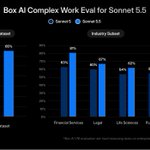
At Box, we've been testing Gemini 4 Argon on our Box AI Complex Work eval for the past week. It's a huge upgrade over Gemini 3.1 Pro, jumping by 14 percentage points across all our tests, and firmly at the frontier.
In our evaluation, we give the Box Agent (using Gemini 4 Argon) a variety of complex enterprise tasks involving enterprise documents in a range of industries. These tasks approximate the kind of hard, time-consuming work that knowledge workers do every day with their enterprise content. Gemini 4 is a huge leap on effectively every dimension of this work.
Gemini 4 is far more capable on math, logic, analytics, and deep knowledge of a variety of business domains. It also works far harder to complete tasks fully without stopping short of the desired result. This is incredibly important for complex enterprise workflows that depend on robust task execution.
Here are some example wins that we saw to put the improvements in perspective:
* Financial services (+18 points): a funding-gap analysis for a family-owned company, where the brief spelled out every step of the projected statements, down to the interest on the bank loan and the overdraft for each year. Gemini 4 Argon built them exactly as specified, every line broken out and carried through to the funding gap. Gemini 3.1 Pro folded the interest into a single figure.
* Healthcare (+25 points): an intensive care management plan where both models spotted a dangerous potassium level and a drug interaction. Only Gemini 4 Argon went back and pulled the offending drugs from the final regimen, so its plan actually matched its own diagnosis.
* Technology (+37 points): a product performance review deciding which of two regional markets should have its cloud infrastructure optimized first. Gemini 4 Argon pulled the right month's user, retention and per-user figures for both regions and correctly flagged North America. Gemini 3.1 Pro often pulled the wrong rows, at one point reporting retention above 100%, and pointed the effort at the wrong region.
* Energy (+16 points): an energy consumption report across two facilities that had to flag any gaps in the meter data. Gemini 4 Argon consistently caught that the data center's smart meter log stops in November. Gemini 3.1 Pro often missed it, at times declaring the logs complete.
* Consumer products (+33 points): a product launch evaluation deciding which production expansion to fund. Gemini 4 Argon saw that existing inventory could bridge an early capacity gap, which made the smaller expansion viable with an earlier launch and a faster break-even. Gemini 3.1 Pro defaulted to the larger expansion and the later timeline.
Gemini 4 Argon will be available in the Box AI Studio shortly for anyone to build custom Box Agents with.


Ok this is quite cool research and ultimately must be the eventual architecture of agents. In the limit, AI will obviously be better at determining its own harness once it sees the task at hand, than us being able to do this in advance:


That didn’t take long: the model swallows the harness.
arxiv.org/abs/2609.35738

What a crazy time in AI with Meta now jumping fully into the frontier. Now that there are multiple players pushing the state of the art, this is going to lead to a further acceleration of advances, as well as the lowering cost of tokens for even the highest levels of capability.


Agent swarms are going to be a core part of many enterprise workflows in the future. The ability to throw compute at problems that you can massively parallelize will be too useful to not take advantage of.
Cyber will be one of the biggest beneficiaries of this as it’s a space where testing vast number of permutations of attacks (without getting tired or bored) is an incredibly useful property. You have a wide search space of possible risk vectors and you generally need to be able to chain together different scenarios to achieve the exploit.
This will become one of the biggest token uses in large enterprises given the range of IT systems, software, physical infrastructure, and data that needs to be protected at all times. Super interesting times in cyber.

Every new line of code now meets a swarm of agents looking for something to exploit. Enclave’s agents run like an attacker swarm and prep the fix.
Watch them in action securing a PR on Router by Enclave.
enclave.ai/demo
This is a good way to understand how early we actually are in AI diffusion right now. The vast majority of people are using AI as a chatbot for simple interactions that approximate next-generation search. This is super useful but dramatically underrepresents the full capability of AI.
On the complete other end of the spectrum, agent swarms represent possibly the ultimate form factor of what agents will do inside of our workflows. Math, cyber, bio, materials science, software engineering, finance, and any other field that has valuable tasks that can be executed in parallel where compute can be applied to accelerate work all have this characteristic.
Less than a fraction of a fraction of the population uses AI in this way right now, due to a mix of the capabilities of models relative to the user's domain, the cost of doing these types of workflows today, the harnesses available to do this style of AI work, and the availability (or lack thereof) of frontier models to the general public.
There will also be a huge amount of change management necessary to get most areas of work -beyond software and AI research- to benefit from this style of agents. Companies need to upgrade their workflows, data needs to integrated and migrated into modern platforms, and companies will need to work through compliance, governance, and security frameworks to pull it off.
But this all represents opportunity right now. A lot of this is where the applied layer of AI will really shine in the enterprise because of the domain specificity of this type of work. You can get an early sense of where things are going and the opportunity ahead by seeing through the funnel that Andrej lays out.

Dusting off this tweet from April because this gap in shared understanding of LLM capability is *widening*. It's now less "two groups of people speaking past each other" and more a sharp funnel.
- Napkin math somewhere around 6B people (~75% of the population) have barely come in contact with LLMs at all.
- Around 1-2B (~20%) are casual and infrequent users of free-tier ChatGPT-like products. This group sees derpy chatbots and treats them a bit like a better Google search, a writing aid, or etc. Maybe an agent tries to book you a flight. I have non-tech friends who (reasonably, imo) say they have not much use for it at all. Even many professionals outside of math&code are in this tier. For example, execs and many other functions spend a lot of their time talking to other people, so while they understand what is happening intellectually, it is still second-hand and a bit abstract.
- Now we get to professional use of frontier-grade LLMs in math&code. Somewhere around 20M people (0.2%) see first-hand that large, complex projects that used to take them weeks/months can now be completed by agents with a prompt. Building apps, copying apps, translating apps, decompiling apps from binaries... This has all happened very quickly and recently - less than 1 year ago, I was writing code manually by hand, typing memorized computer code commands into a code editor character by character, occasionally pressing Tab to autocomplete a little chunk of code.
- And finally we get to the ~5,000 people (~0.00006%) with access to frontier-grade systems internally. The external world has seen the preview. It looks like swarms of thousands of agents collaborating over weeks on software mega projects: minting zero days, running cyber attacks and defenses at machine speeds, discovering new science, advancing the frontier of mathematics. Things that would have taken top professionals in the industry years of work. Meanwhile, human review and comprehension are starting to fall behind. For example, people are still involved in the "archeology" of the OpenAI-HF incident from many months ago. Mathematicians may be poring over the 722 manuscripts on frontier mathematics for a while.
The funnel is driven by a combination of factors:
1. The impact scales with ambition, problem size, and horizon. A question with a paragraph answer barely stresses the system. You need a reservoir of big, difficult problems that you really care about. This aspect drives the consumer / professional dimension of the funnel.
2. The jaggedness of the system (which I have written about a lot separately). Capability peaks in domains that are digital, verifiable and economically valuable. This is because LLM capability emerges from reinforcement learning on verifiable rewards on a curated environment mixture driven by revenue potential. This aspect primarily drives the area (e.g. math&code) dimension of the funnel.
3. Access. Free-tier, paid-tier, internal.
So this is the weirdness of the moment. The general public has mostly not interacted with these systems. When they have, it looks like a derpy chatbot. The majority of professionals still see only a modest uplift. And a small sliver of professionals are experiencing the vertigo of the curve going vertical. And it is all happening at the same time.
If you want to know where all the tokens will get consumed in the future, here it is. Agent swarms will have massive implications in a number of enterprise domains like software development, cyber, life sciences research, AI research, finance, and more.
The ability to parallelize agents against a unified goal where the volume of work is large, or where the search space not entirely known upfront, is going to be massive.
Agents can fan out and coordinate work together on a specific mission in completely different ways from what humans are able to do. Today even in the most resource-abundant organizations, your ability to parallelize work on most projects is quite limited. Humans run into constraints on being able to communicate with one another, share status, deal with conflicts in work, keep shared context, and so on.
As AI models can handle larger context without getting confused, and as they’re able to communicate effectively across their work with shared infrastructure, they can avoid many of the pitfalls that people have.
You can see how this can lead to not just faster execution of tasks, but qualitatively different outcomes in medicine, research or defending against cyber attacks, scientific and math discoveries, and so on. This is why we’re going to need 1,000X more compute.

Over two weeks, Prime Agent orchestrated a swarm of over 2,000 agents to rewrite itself in Rust.
With 10,000+ sandboxes, 200B+ GLM-5.3 tokens, and 16,000 agent-to-agent messages, this was our largest test yet of Prime Agent’s multi-agent capabilities and our infrastructure powering these agent swarms.
Prime Agent now reaches usable input ~13× faster and uses 83% less startup memory than before.
Good post to start thinking through the long term safety approaches to managing intelligence in an enterprise. As agents begin to do vastly more task execution in the organization than humans, our need to secure, govern, control, and audit that work will become paramount.
You’ll have agents operating against most of your most valuable data; they’ll be making decisions that will be harder and harder to reverse engineer; we’ll need to understand the liability and accountability regimes when models make decisions for us; and we need ways of containing the blast radius of accidentally or intentionally malicious agents.
“Treating frontier closed and open weight models like insider risks is a way to build such a system. Not because they are necessarily malicious, but because any sufficiently capable actor with access to important systems can make mistakes or be compromised, and the architecture of containment and control must account for that”
In a sense, AI will need to have its “zero trust” era that security saw. And all of this leads to needing various layers of protection and auditability of what agents are doing, what data they can work with, and controls for when things go wrong. And a huge opportunity right now for those building such systems across the enterprise.

Agents spawning other agents, agents operating in the background on every task, and agent swarms will consume 1,000X more tokens than people prompting agents 1 at a time.
The usage of AI as a chat system that can only work for you at the pace that you can prompt it will seem like a relic within a year or two. The vast, vast majority of tokens will be consumed by agents that are just doing continuous work for us in the background and in our workflows.
This is why we’re still so early in the curve of AI agent adoption right now, and how much more compute and infrastructure build out will be needed to sustain this.


This sounds weird, but it is actually probably a good policy.
Even if you don’t believe AI is conscious (I don’t), it stands to reason that you don’t want future models trained on endless content of humans being rude to models.
The models only understand the data they’ve been trained on, or what they run into in their interactions, so if you want safe and aligned models we probably want AI to have lots of good interactions in their training data.
Anthropic may have more extreme beliefs than this (though even if they didn’t, you may want to word policies like this), but this is sort of an easy Pascal’s wager for AI. Just be nice to the AI.


Aaron Levie retweeted

Today Hone launches Engines: AI that owns business outcomes.
Chatbots give answers. Agents do tasks. Engines deliver outcomes, and we hold them responsible for creating real value, measured in actual dollars instead of tokens or vibes.
You point it at a business metric, and the Engine figures out the rest. It onboards itself, builds the necessary agents, skills, and memories, collaborates with the right people, and gets better with experience.
From AI leaders to global enterprises, our customers have already used Engines to:
• Uncover millions in procurement savings
• Optimize product funnels
• Manage credit risk
• Increase qualified pipeline in new territories
• Accelerate implementations and improve account management
To scale this impact across the economy, we’ve raised a $60M seed led by Benchmark and Index with participation from Elad Gil, Hanabi, Definition, Diffusion, Lux, SV Angel, and Align.
AI’s raw capabilities are far ahead of the value it creates in the real world, and Engines will help close the gap.
Here’s how they work…
We built Box Mount to allow developers to mount Box as a file system directly in any agent sandbox. As agents do more complex work, they need to be able to work with files and data just like a person would. The future is headless.

🚀@vercel Sandbox gives AI agents an on-demand Linux microVM with its own filesystem, network, and process space. Box Mount runs inside that sandbox and maps a Box folder to a standard POSIX path, with 2-way sync and Box permissions and governance applying automatically.
In this demo, the agent analyzes 12 security questionnaire items against 3 approved policy documents. 10 answers pass with sourced evidence. 2 are flagged for human review because the approved docs don't support those claims. The finished Excel workbook and review list sync back to Box through Box Mount.
Vercel Sandbox is the isolated execution layer, and Box Mount is the governed content layer. The result lands in Box, ready for human review.
The compute needed for the stage of AI we’re about to enter is going to be insane.
Personal agents, agent swarms defending enterprises, agents that review all of our code for security issues, agents that process nearly all enterprise data in workflows, background agents working on tasks 24/7, and on and on.
This will take a mix of inference volume that is going to keep growing by orders of magnitude, as well as infrastructure that agents need alongside the tokens. They need computers, networking, file systems, and so on.
We’re only in the early stages of what this buildout is going to look like.

.@auchenberg calculated that Muse needs 65,000 CPUs and 75PB of DRAM to serve 100 million users. That's $2.8B in infra for one app.
It made me think. Facebook alone has over 3 billion users. That's nearly 300x scale for one platform. And they have more platforms with similar numbers.
Just do the math. There aren't enough CPUs in the world to run all of this. A worrisome constraint we're heading toward.
Cyber will be one of the most defining domains for AI in the coming years, and a huge area of focus for most enterprises.
AI is going to now create a whole new level of work for security dealing with the increase of vibe coded issues, agentic attacks, and even accidental agent swarms hunting for data. OpenAI + Hugging Face is just a preview of what’s to come.
Security teams have often been the most strapped for resources teams in the enterprise, and now it’s only going to get more intense. AI agents of course become the solution to this problem as well, and we’ll see a range of new agentic products for protecting code, enterprise systems, mission critical infrastructure, and enterprise data. Huge opportunity here right now.
And it’s going to be a booming market for cyber professionals that can effectively deploy agents for security purposes in the enterprise. Great time to be in security.
