

KAUST is finding solutions to transform the future of Saudi Arabia and the world. Through Inspiration, Discovery. Follow us in Arabic @KAUST_NewsAR
Saudi Arabia
Joined March 2009
- Tweets14.2K
- Following4
- Followers109K
- Likes2.8K




KAUST retweeted

KAUST’s DeepHadad uses AI to make damaged #inscriptions on a nearly 3,000-year-old statue easier to read. By digitally reconstructing the carved surfaces, it supports historians studying ancient written records.
يستخدم نموذج DeepHadad من كاوست الذكاء الاصطناعي لتحسين وضوح نقوش متضررة على تمثال يعود إلى نحو ثلاثة آلاف عام. ومن خلال إعادة بناء الأسطح المنحوتة رقميًا، يدعم المؤرخين في #دراسة السجلات المكتوبة القديمة.
DeepHadad, développé à KAUST, utilise l’#IA pour rendre plus lisibles des inscriptions endommagées sur une statue vieille de près de 3 000 ans. La reconstruction numérique des surfaces gravées aide les historiens à étudier ces témoignages anciens.


KAUST’s TIE Cohort 2 students share how global immersion in Shenzhen, Silicon Valley and London helped them advance their ventures through rapid prototyping, industry connections and early customer engagement.
Their experiences highlight TIE’s approach to developing research-driven entrepreneurs.
Learn more: kaust.link/12pCt


KAUST North Marina receives a tourist marina operator license from @RedSeaSaudi, strengthening KAUST's role in sustainable marine tourism and reflecting its commitment to safety and marine protection standards while raising service quality.

KAUST-supported startups attract US$1.4 billion in total funding, driving growth in Saudi Arabia’s venture capital ecosystem.
Read more: kaust.news/12kM0


Can AI help us read inscriptions carved nearly 3,000 years ago?
Developed at KAUST, DeepHadad uses 3D scans and AI to reconstruct damaged inscriptions on an ancient statue, helping historians study written records that time has worn away.
Find out more: kaust.news/12dw7
KAUST graduates: on a mission for Saudi Arabia and the world.
Ahead of Commencement 2026, meet Murtadha Malallah, whose research explored the volcanic history of the Red Sea and the potential of basalt rocks for CO₂ storage.
From KAUST labs to OceanXplorer expeditions, his time at KAUST was full of discovery.


KAUST retweeted

At COP31, Saudi Arabia is showcasing the KAUST Coral Restoration Initiative and its work to restore reefs in the Red Sea. The initiative’s facility is designed to produce up to 360,000 coral colonies a year.
Congratulations to TerraSense, a venture emerging from KAUST’s Technology Innovation and Entrepreneurship (TIE) master’s program, on winning first place in the Environmental Sustainability and Basic Needs category at the fifth edition of the Innovation Incubator, organized by @QassimUniv1 in Riyadh.
TerraSense develops AI-powered robotics and smart soil monitoring technologies to improve irrigation efficiency and advance sustainable agriculture.
Another milestone highlighting the potential of innovation emerging from KAUST to address environmental challenges.

22
2,776
Another global achievement for FlowGuard, a venture emerging from KAUST’s Technology Innovation and Entrepreneurship (TIE) master’s program!
Representing Saudi Arabia at the Enactus World Cup 2026 in São Paulo, Brazil, FlowGuard secured second place in the Impact Competition, marking a milestone in the Kingdom’s first participation.
FlowGuard develops a smart water leak detection and consumption monitoring system, using advanced sensors and AI-powered analytics to prevent water waste and protect buildings from damage.
A testament to the global potential of innovation emerging from KAUST.
@enactus


KAUST graduates: on a mission for Saudi Arabia and the world.
For Wenxuan Zhang, years of research, learning, and experimentation have led to this milestone: earning her Ph.D. in Computer Science at KAUST. Her research explores how mathematical theory can help make AI models smarter. As she looks ahead to a career in industry, she hopes to keep connecting mathematics with modern AI.
Congratulations, Dr. Zhang!


1
29
3,826
Congratulations to the 16 KAUST researchers recognized as authors of the world's top 1% most-cited research papers in their respective fields. These recognitions make up 70% of researchers in Saudi Arabia, ranking KAUST once again No. 1 among universities in the Arab world for the number of researchers recognized.
Their work drives scientific progress and shapes research across disciplines worldwide.
kaust.news/xclarivate

Planting the seeds for a greener future.
KAUST brought together its community and local Saudi schools to plant mangroves along the Red Sea, supporting biodiversity and the Saudi Green Initiative’s ambition to plant 100 million mangroves by 2030.


7
1,788
Every battery still has value.
Enabled through KAUST’s National Transformation Institute (NTI), CirCoLi is recovering critical materials from used batteries to support a cleaner circular economy.
Made possible by KAUST.
kaust.link/11CPz
Three KAUST professors — Tariq Alkhalifah, Raquel Peixoto and Husam Alshareef — have been elected to the 2027 class of UNESCO-TWAS Fellows.
Their research spans advanced electronics, seismic imaging and coral resilience, contributing to scientific progress in Saudi Arabia and beyond.
kaust.news/12LSx

This World Diabetes Day, early action starts with research.
Meet the next generation of KAUST researchers exploring new ways to detect and understand diabetes, an important health priority in Saudi Arabia.
From insulin resistance to glucose and fasting, their work is helping advance our understanding of diabetes.

KAUST retweeted

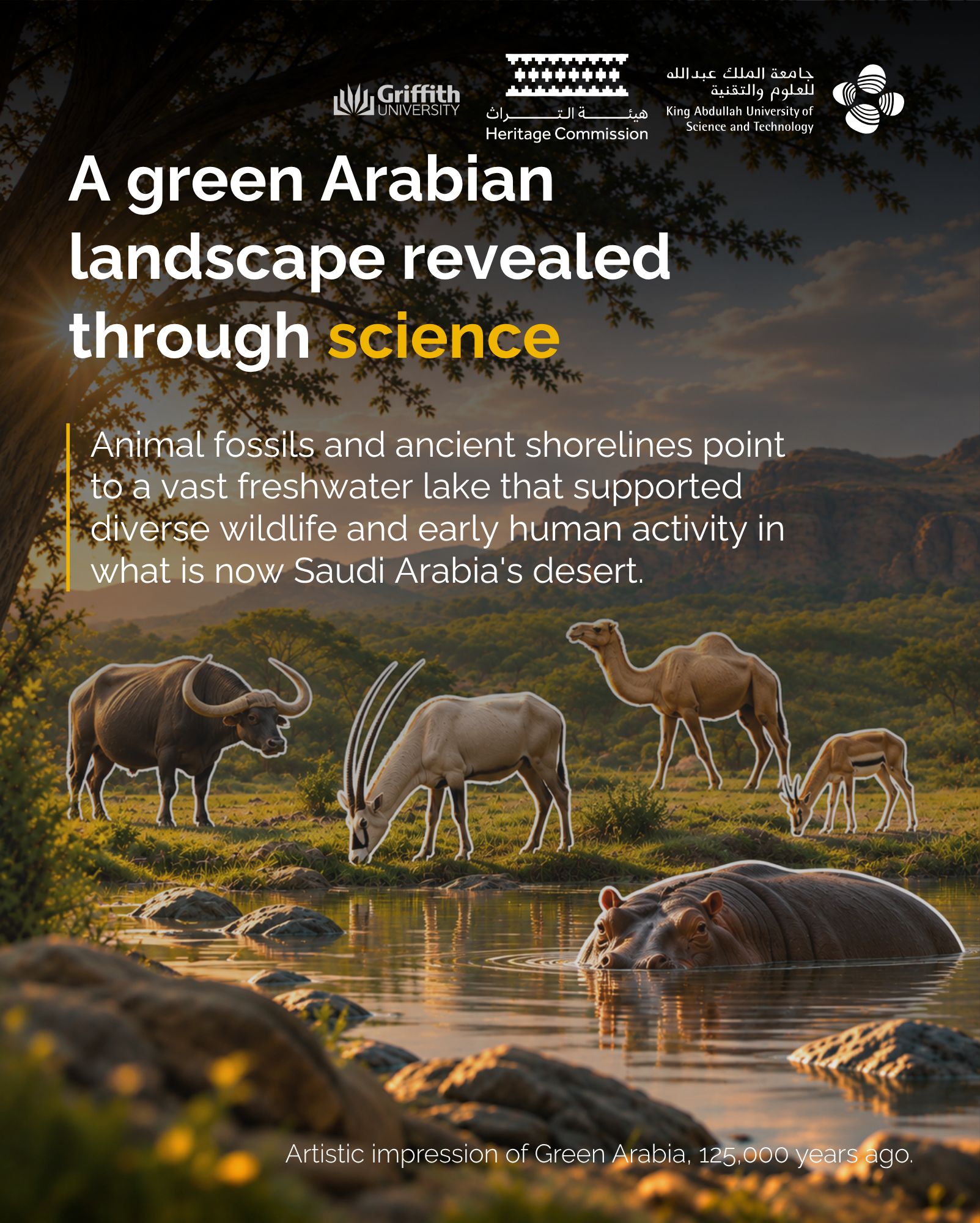
Our research efforts have revealed evidence of human activity dating back 125,000 years at the Mundafan Palaeolake site in the Empty Quarter, southern Saudi Arabia.
#SaudiHeritageCommission
A KAUST co-led research team at Mundafan has uncovered one of the most detailed pictures yet of prehistoric human life in Arabia, revealing how people lived, hunted and used their environment 125,000 years ago during the greener, wetter period known as Green Arabia.
More: kaust.news/12Gz9
@MOCHeritage @Griffith_Uni


KAUST Ph.D. candidate Wenyi Wang has been awarded the 2026–27 Google PhD Fellowship in Machine Learning and ML Foundations, recognizing his research on recursively self-improving AI systems.
The fellowship supports his doctoral research and connects him with Google’s research community as he explores how AI can improve its own learning processes.
Read more: kaust.news/12GuQ

KAUST graduates: on a mission for Saudi Arabia and the world.
Naif Alotaibi, a Master's graduate in Technology Innovation and Entrepreneurship, is the co-founder and CTO of TerraSense, a startup developing a robot that uses soil sensing and AI to help farmers identify crop stress and make better irrigation decisions.
As he graduates, Naif looks ahead to growing TerraSense and bringing its technology to farmers.


