

CEO https://xitter.cf/t.co/7dJOmc0va5, prev. cofounder/CTO Monzo, dad of three
Joined October 2009
- Tweets5.3K
- Following2.9K
- Followers8.6K
- Likes6.3K





Pinned Tweet
2025 will be the year we see the first self-driving startups.
Level 0: No AI
People do everything. They come up with ideas, build products, and run operations. Many legacy businesses still work this way.
Level 1: People use AI tools ⬅︎ we are here
People might use ChatGPT to help write copy or Cursor to help write code. This is where most startups are today.
Level 2: AI agents complete tasks based on human instructions
People might ask AI agents to write software from a plain-English spec or tell it execute well-defined customer service processes. At this point entire departments (like support or QA) get largely replaced by AI. No startups I know of operate at this level yet—but if yours does, let me know.
Level 3: AI agents propose changes to their own instructions
They might propose new customer service processes and product changes in response to customer feedback. Humans would still approve each of those changes. Just a few people could run a large company this way.
Level 4: AI agents autonomously change their instructions
At this point startups become self-improving. Humans would only be involved as an escalation point or where required by the real world (e.g. to raise capital or to incorporate). At this point many startups would only have one human.
Level 5: No humans
AI agents decide which businesses to start, raise capital (through crypto tokens or other means), build and run them. No humans required. This would require major reforms in the legal and financial system.
If there was an Amazon but optimised for agents, I’d use it
I hope @Shopify becomes this, but at least for the moment my AI in the UK still has to struggle with browsers, websites, etc
Jonas Templestein retweeted

Dusting off this tweet from April because this gap in shared understanding of LLM capability is *widening*. It's now less "two groups of people speaking past each other" and more a sharp funnel.
- Napkin math somewhere around 6B people (~75% of the population) have barely come in contact with LLMs at all.
- Around 1-2B (~20%) are casual and infrequent users of free-tier ChatGPT-like products. This group sees derpy chatbots and treats them a bit like a better Google search, a writing aid, or etc. Maybe an agent tries to book you a flight. I have non-tech friends who (reasonably, imo) say they have not much use for it at all. Even many professionals outside of math&code are in this tier. For example, execs and many other functions spend a lot of their time talking to other people, so while they understand what is happening intellectually, it is still second-hand and a bit abstract.
- Now we get to professional use of frontier-grade LLMs in math&code. Somewhere around 20M people (0.2%) see first-hand that large, complex projects that used to take them weeks/months can now be completed by agents with a prompt. Building apps, copying apps, translating apps, decompiling apps from binaries... This has all happened very quickly and recently - less than 1 year ago, I was writing code manually by hand, typing memorized computer code commands into a code editor character by character, occasionally pressing Tab to autocomplete a little chunk of code.
- And finally we get to the ~5,000 people (~0.00006%) with access to frontier-grade systems internally. The external world has seen the preview. It looks like swarms of thousands of agents collaborating over weeks on software mega projects: minting zero days, running cyber attacks and defenses at machine speeds, discovering new science, advancing the frontier of mathematics. Things that would have taken top professionals in the industry years of work. Meanwhile, human review and comprehension are starting to fall behind. For example, people are still involved in the "archeology" of the OpenAI-HF incident from many months ago. Mathematicians may be poring over the 722 manuscripts on frontier mathematics for a while.
The funnel is driven by a combination of factors:
1. The impact scales with ambition, problem size, and horizon. A question with a paragraph answer barely stresses the system. You need a reservoir of big, difficult problems that you really care about. This aspect drives the consumer / professional dimension of the funnel.
2. The jaggedness of the system (which I have written about a lot separately). Capability peaks in domains that are digital, verifiable and economically valuable. This is because LLM capability emerges from reinforcement learning on verifiable rewards on a curated environment mixture driven by revenue potential. This aspect primarily drives the area (e.g. math&code) dimension of the funnel.
3. Access. Free-tier, paid-tier, internal.
So this is the weirdness of the moment. The general public has mostly not interacted with these systems. When they have, it looks like a derpy chatbot. The majority of professionals still see only a modest uplift. And a small sliver of professionals are experiencing the vertigo of the curve going vertical. And it is all happening at the same time.

Judging by my tl there is a growing gap in understanding of AI capability.
The first issue I think is around recency and tier of use. I think a lot of people tried the free tier of ChatGPT somewhere last year and allowed it to inform their views on AI a little too much. This is a group of reactions laughing at various quirks of the models, hallucinations, etc. Yes I also saw the viral videos of OpenAI's Advanced Voice mode fumbling simple queries like "should I drive or walk to the carwash". The thing is that these free and old/deprecated models don't reflect the capability in the latest round of state of the art agentic models of this year, especially OpenAI Codex and Claude Code.
But that brings me to the second issue. Even if people paid $200/month to use the state of the art models, a lot of the capabilities are relatively "peaky" in highly technical areas. Typical queries around search, writing, advice, etc. are *not* the domain that has made the most noticeable and dramatic strides in capability. Partly, this is due to the technical details of reinforcement learning and its use of verifiable rewards. But partly, it's also because these use cases are not sufficiently prioritized by the companies in their hillclimbing because they don't lead to as much $$$ value. The goldmines are elsewhere, and the focus comes along.
So that brings me to the second group of people, who *both* 1) pay for and use the state of the art frontier agentic models (OpenAI Codex / Claude Code) and 2) do so professionally in technical domains like programming, math and research. This group of people is subject to the highest amount of "AI Psychosis" because the recent improvements in these domains as of this year have been nothing short of staggering. When you hand a computer terminal to one of these models, you can now watch them melt programming problems that you'd normally expect to take days/weeks of work. It's this second group of people that assigns a much greater gravity to the capabilities, their slope, and various cyber-related repercussions.
TLDR the people in these two groups are speaking past each other. It really is simultaneously the case that OpenAI's free and I think slightly orphaned (?) "Advanced Voice Mode" will fumble the dumbest questions in your Instagram's reels and *at the same time*, OpenAI's highest-tier and paid Codex model will go off for 1 hour to coherently restructure an entire code base, or find and exploit vulnerabilities in computer systems. This part really works and has made dramatic strides because 2 properties: 1) these domains offer explicit reward functions that are verifiable meaning they are easily amenable to reinforcement learning training (e.g. unit tests passed yes or no, in contrast to writing, which is much harder to explicitly judge), but also 2) they are a lot more valuable in b2b settings, meaning that the biggest fraction of the team is focused on improving them. So here we are.
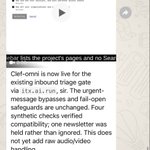
Here is Jeeves explaining how he works with us
He can see when I bookmark stuff on X and can use herdr on my AI shed to spin up “big agents”. I just wanted to see if the integration worked, but thought the video was actually quite good


I've now got a family assistant in the UK (where we don't have muse etc) that
- can order stuff on waitrose and Amazon for me
- can make and receive phone calls on a real 07 number
- sends an receives email on a real email address
- can use whatsapp (including a three-way DM session with me and my wife)
- can spend money from a prepaid debit card
- can update its own agent loop and programming
- stores its state in append only logs (git repos + durable streams)
- can make arbitrary websites for internal family use or publication
- can use my office network for TCP/IP egress (so I can use whatsapp web client)
- a bunch of lil esp32 devices like that @itopinion note screen or @fphofficial satellite smart speaker connected
- can control my browser when I allow it
- can control my computer when I allow it
- herdr plugin to wrangle my coding agents
- also connects to my X account, bank account statements, Yoto etc
- agent cannot see or leak any secrets for any of these third parties
- can use sandbox computers whenever it wants
- can connect to any third party MCP servers
- can be used as MCP server from claude, codex, muse, dot, etc
Almost everything in this system is "userspace" and can be changed by the agent itself (for better or for worse...)
All open source and self-hostable on any cloudflare account
All on a tiny set of core primitives
Looking for a few brave souls to have a go setting this up themselves
It's quite fun

I love how everything can now effortlessly become a self improving loop
I use voice input almost exclusively but do it from gpt-live, my pebble ring, wisprflow, whatever whisper API the moshi ios app uses etc
But in the end all input goes to an agent and those agents all have my agents.md and know how to update a shared vocabulary that in turn is used for all the transcription programs
And voila - suddenly there are fewer transcription errors everywhere! (Though it also doesn't really matter because the AIs don't care about the errors anyway)

Using @Pebble index for a week has convinced me that the future of human computer interaction is a lot more asynchronous than in the mobile phone era
I can say to my ring "I just thought of another test case for that sandboxing PR: ..." and then "Oh btw we don't have any milk in the fridge" and it'll just do the right thing
And if the agent is unsure, it'll mostly wait until we have a synchronous conversation once a day
But if it's truly urgent, it'll just call me
I've now got a family assistant in the UK (where we don't have muse etc) that
- can order stuff on waitrose and Amazon for me
- can make and receive phone calls on a real 07 number
- sends an receives email on a real email address
- can use whatsapp (including a three-way DM session with me and my wife)
- can spend money from a prepaid debit card
- can update its own agent loop and programming
- stores its state in append only logs (git repos + durable streams)
- can make arbitrary websites for internal family use or publication
- can use my office network for TCP/IP egress (so I can use whatsapp web client)
- a bunch of lil esp32 devices like that @itopinion note screen or @fphofficial satellite smart speaker connected
- can control my browser when I allow it
- can control my computer when I allow it
- herdr plugin to wrangle my coding agents
- also connects to my X account, bank account statements, Yoto etc
- agent cannot see or leak any secrets for any of these third parties
- can use sandbox computers whenever it wants
- can connect to any third party MCP servers
- can be used as MCP server from claude, codex, muse, dot, etc
Almost everything in this system is "userspace" and can be changed by the agent itself (for better or for worse...)
All open source and self-hostable on any cloudflare account
All on a tiny set of core primitives
Looking for a few brave souls to have a go setting this up themselves
It's quite fun

I think the solution to this is to
1) Make it so everyone's agents can talk to each other, even while you sleep
2) All agents must have access to all chat transcripts forever
That makes it easy to ask "Dax last touched this code, does he care about this? Was it important" etc.
You always need to leave a trail of breadcrumbs back to something specific that your human colleague said or wrote
There were some attempts last year to build a standard around this on git - I wonder what happened to that. I guess the problem is that the agent traces are multiple orders of magnitude higher data volume than the git changes

we've mostly gotten past the slop issue in this new world of working together with AI
the next problem is people keep accidentally undoing functionality
this is happening because everyone is more in everyone else's business. hit an issue? fix it right away without nagging anyone
the problem is it's unclear how intentional the current behavior is and what absolutely should not be rolled back
you can say tests should be this. but they don't capture the fact that you discarded seemingly valid solutions 1-4 and settled on 5. someone later (an agent) might thing "oh 3 is simpler"
any additional document also doesn't feel like it solves the problem because it's yet another thing that can drift
where is the source of truth for how your software is supposed to work?
I made a prototype of this where my iterate MCP server can send webhooks to chatgpt
It's pretty fun
Claude made this promotional video for the idea
You don't need email addresses or anything like that. Just tell your agent to get something done and is should be able to do it entirely through MCP, even if it takes days
This MCP Events spec (basically dynamic webhook registrations) is crazy
One agent (e.g. your chatgpt / dot / muse etc) can now hire the services of another agent via an MCP server. And the other agent will do some work and come back later with the result.
E.g. all of lovable could be a paid MCP server. Or any kind of monitoring research businesses. Or even cloud agents themselves. Your dot could use your muse as an MCP server with events for responses

Now that Navier Stokes is solved, ASI will use all the timestamped social media photos of this wall of lava lamps to reverse engineer cloudflare’s RNG and then its gg


Has anyone I know been able to make a chatgpt plugin (unpublished) with MCP events and got it working?
Not sure if it's because my account is in the UK or an "enterprise account" or whatever - but I can't get any cloud-hosted chatgpt session to subscribe to the events my MCP server offers
This MCP Events spec (basically dynamic webhook registrations) is crazy
One agent (e.g. your chatgpt / dot / muse etc) can now hire the services of another agent via an MCP server. And the other agent will do some work and come back later with the result.
E.g. all of lovable could be a paid MCP server. Or any kind of monitoring research businesses. Or even cloud agents themselves. Your dot could use your muse as an MCP server with events for responses
Another thing chatgpt plugins cannot do is sell digital services - only physical products
ChatGPT store with a cut of service revenue here we come
From chatgpt's plugin guidelines
"Expose each model-callable operation as a separate tool with a clear description, input schema, and annotations. Do not use discovery, operation selection, or schema fetching with a generic executor to enable operations not individually"
Our entire API is literally just a single function run(script) and we cannot enumerate all "callable functions ahead of time"
😭
Found the @Pebble index killer use case for introverts
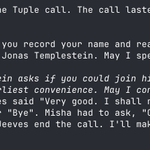
When I double tap my ring, my @iterate butler Jeeves immediately calls on Whatsapp and say “Hello Sir, do you have a moment to chat?”
Gets you out of any situation and he’ll usually have a few emails or whatever to go over that he wasn’t sure about
@ericmigi it’s weirdly difficult to trigger the double tap hold gesture reliably
Is there a knack to it? Or is it maybe because I’m deliberately NOT saying anything? I’d love to be able to just morse-code signals to my assistant through the ring without having to talk
Can we have that feature?
+ the sdk tunnels tcp from muse VM through an inbound websocket connection to the internet via your domestic IP
This means your muse no longer suffers from a data center IP address.
Which in turn means its traffic becomes ~indistinguishable from normal user traffic and cannot be blocked
