

CEO @LunarCrush | family, data, PRs 💪
Joined February 2009
- Tweets13.7K
- Following3.5K
- Followers14.2K
- Likes16.9K







i like hockey but never played organized, i'm confused at how you can get hit so bad in your defending end, he was so lackadaisical with the way he went to the puck and turned.
help me here hockey fans.
xitter.cf/JomboyMedia/status/212…

So what happens when all these hit 100% across all the AI labs?
Anyone have this for Mythos 5.2 vs Fable 5.2?

3
4
573
“AIs not yet born” is a wild take Patrick!
The delta between pre and post work compression is unlike any other time in history however it’s not evenly distributed by person or profession.
Claude cannot crane steel to the 120th floor of a new skyscraper (yet).
For some it feels further away.
For some they can do 200 person-days of work across 15 disciplines in 8 hours.
The likely scenario is the continued reverberation through software and white-collar work that will mean the end of certain roles within companies before the end of a profession altogether.
Why do you need an internal council when you can use AI and get periodic checks from the top firms (who just have better AI). It might simply be them checking an .md file for you with their greater context or “renting context” of you will.
What happens when context windows get so big that every prompt you write can accurately and quickly read every document your business has created since its inception? Then imagine a model 50x smarter too.
To somewhat answer Patrick. The majority of people will adopt and come around to understand AI is not evil and it will make their life better. It’s genuinely too mind blowingly transformative across every facet of one’s life for those who operate it, it’s a once-in-a-millennium productivity boost.
It’s hard for most to accurately premeditate what the next even 18-36 months look like since quite frankly not enough people are using it past it being a better google search.

Two things I’ve been thinking about regarding AI:
• People often highlight the risks involved in AI, which are surely very real. I’m struck, however, by how hard it is to understand the contours of the positive scenario. There are easy-to-perceive and frequently invoked elements of a positive vision — more diseases cured, more material abundance, etc. — which sound great, but these are by themselves just ingredients. I’m curious what the larger equilibrium is supposed to look like. Do people work? If so, why? What is their marginal contribution? If not, how are resources allocated? What is scarce? What is the ratio between humans and AIs? Are humans in control, whatever that means? One sometimes hears the Culture novels invoked as one scenario, but I’m not sure they depict a desirable outcome. (AI runs everything and humans compete in games? Iain Banks himself said that the humans in the Culture are “somewhere between passengers, pets and parasites.”) There is Richard Brautigan’s famous poem, but do we want to be “returned to our mammal brothers and sisters”? (Isn’t that rewinding Genesis?) We could say that it was hard to imagine the world of 1900 from the vantage point of 1700, and that’s assuredly true. But nobody in 1700 was trying to recast humanity itself within a couple of years — things necessarily unfolded slowly and by increments, and therefore with the possibility for error correction. Given how rapid the rate of progress in AI may be, it feels strange for the upside case to be so opaque.
• There is increasing discussion of whether AIs are conscious or how we would know whether they are, with conclusions there often assumed to be relevant to matters of moral worth. At first blush, this seems a rather arcane, benign, or even absurd issue. (Remember the response to Blake Lemoine’s fears.) Setting aside the terms of the debate itself, or the relevant demarcation criteria, it seems to me a quite high-stakes question, for an affirmative answer — that is, granting moral worth to AIs — would presumably mean that the aggregate worth of AIs would soon outweigh that of humans in any utilitarian calculus. The AIs will be exceptionally wise and intelligent, and vastly more numerous (especially once one considers the imminent future and the AIs not yet born). As such, even epsilon of moral worth will multiply to a lot once one considers the quadrillions that could soon exist. (This is effectively a distributed version of the Nozick’s utility monster.) If this conclusion is unpalatable, I think one of three propositions needs to be rejected: the premise AIs can have moral worth; utilitarianism itself; or the belief that there is even a possibility that they will be far more numerous than humans.
With both of these matters (contours of future society; AI moral worth), there is the possibility of dramatic change. Today, people argue about datacenters. I’m curious how popular support for AI will evolve as more people come to understand these medium-term questions and the relevant stakes. What is the vision for AI that most people would be excited about?
1
3
643

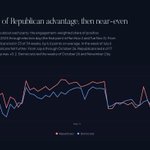
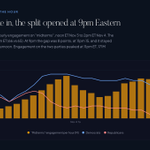
We asked an AI with live web search how the race looked online.
It estimated Democrats had the better tone for most of the year.
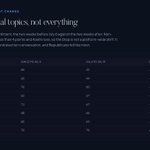
The data: Republicans led 39 of 52 weeks.

1
1
33
Polls estimate the vote. Markets give you a price. Social shows you the tone, by the hour.
Full study, free dataset and the code to rebuild it with the @LunarCrush CLI:
lunarcrush.com/research/midt…

1
41


77 full pages on the Binance hack because, why not?
joevezzani.github.io/binance…
We rebuilt every step from the blockchain and 53,181 posts. Open data. 🧵

77 full pages on the Binance hack because, why not?
joevezzani.github.io/binance…
We rebuilt every step from the blockchain and 53,181 posts. Open data. 🧵
Where the money sits, read live on six chains:
~$2.66B frozen or recovered, mostly stablecoins.
~$2.83B unfrozen, mostly BTC, ETH, XRP and SOL.
Freezes worked where the asset had an issuer. Nowhere else.

1
3
147
The full reconstruction: 77 pages, every transaction, the first public post for each step.
Plus the data (CSV + Parquet) and the raw on-chain reads, so you can check every number yourself.
joevezzani.github.io/binance…
3
121