
An Aussie fellow promoting uplifting joyful genuine math thinking and doing for students & teachers alike. Thrilled: https://xitter.cf/t.co/1MUZpXFold reaching millions!
Phoenix, AZ
Joined December 2009
- Tweets21.1K
- Following991
- Followers33.4K
- Likes11.4K





You flip a coin until you see an equal number of heads and tails. Ooh! Hang on! Are you sure to eventually see an equal count of each?
What is the smallest N for which it is possible to color each of 1, 2, 3, ..., N one of two colors, so that if a<b, then a, b, a+b, ab are sure NOT to be all the same color? (The example makes a start.)

Is it possible to colour each counting number 1, 2, 3, 4, .. one of two colours so that if a and b are distinct integers greater than 1 of the same color, their product ab is sure to be the opposite colour?

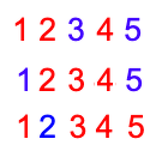
Color each of the numbers 1 through 8 either red or blue so that if a and b are two distinct numbers of the same color, a+b, if present, is sure to be the opposite color. (The example shown fails.)
Can this feat be accomplished with the numbers 1, 2, 3, ..., 9?


Prove that if one were to color each of the counting numbers 1, 2, 3, ... one of k colors, there is sure to be a triple a, b, a+b all the same color (a=b allowed.)


Color the numbers 1 through N each one of 2 colors, so that if a & b are the same color, a=b allowed, then a+b is not that color (if it is present). This must fail if N is 5 or more.
What is first N that fails if we conduct this exercise with 3 colors?

Color the numbers 1 through N each either red or blue so that if a & b are the same color (a=b allowed), then a+b is sure to be the opposite color, if it is present.
The example shown fails for N = 7. (Why?)
Find a good coloring for 1,2,...,7 or convince me one does not exist.


We can color each of the numbers 1 through 8 either red or blue so that if distinct numbers a and b are the same color, a +b, if present, is the opposite color.
Can the same task be completed with the first nine counting numbers? The first ten? The first 100?

Albert sees this picture as answering 20÷5 = __.
Bilbert sees this picture as solving 4 x 5 = __.
Cuthbert sees this picture as solving: "20 dots are to be shared equally among 5 students. How many dots would each student receive?"
Do you see these?
[The K-8 curriculum bounced between different meanings of counting number division. How "obvious" is it the various interpretations are equivalent?]

Ten years ago, six colleagues and I embraced an audacious idea: to unite the world through a profoundly joyous reimagining of school mathematics. And in 2017 we brought Global Math Week to the world. Over 1.8M students and teachers from over 150 countries and territories joined in that first year, and since then, that number grew to 7.8M--at least, as far as we could count: we don't know the numbers who participated just with pencil and paper, or chalk boards, or, just as some school children did in Zimbabwe, with holes and pebbles in the school yard.
We've slowed down the past two years, and are now taking a "breather" this year -- GMW2026 is very very quiet.
But we have kept all the structure and mechanisms in place to return in the new year and, likely, with a brand new topic.
Until then ... Thank you world for embracing too the magnificent joy mathematics--school curriculum mathematics even--can provide when explored as the stunning awe-inducing human enterprise it truly is. Every human on this planet should feel genuinely invited and welcome to mathematics!
[Photo by Erick Matthew: Tanzania.]
@drrajshah @MoMath1 @JillDiniz @GlobalMathProj

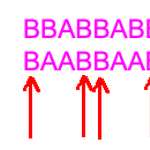
Choose a sequence of two Bs, one A, and one of two Bs, two As. Repeat each to make two strings of 12. There are then sure to be four alignments of B among the 12 spots. In our example, alignment at positions 1, 4, 5, and 8.
An example with alignment at positions 3, 8, 11, 12?

Choose strings of 3, 4, and 5 As and Bs, each with two Bs, and repeat each to make strings 60 long. Triples of Bs line up exactly 8 times. Why?
Can we say anything if we add a string of four As and two Bs, repeated ten times. Can we predict the number of B quadruples?

Write down three As and two Bs and copy that string four times. Then write down two As and two Bs and copy that string five times underneath.
Why are pairs of As sure to line up exactly six times?

Here's the "line method"--also known by other names--for multiplying two numbers.
What is it doing and why does it work?
Also, how do you compute 4003 x 207 with this method?

The Elizabethan method for long multiplication was developed in England during the 1500s. (Today the method is known as lattice multiplication or the galley method for multiplication.)
What is the Elizabethan method doing and why does it work?

You meet a fellow who announces he has two infant children. He also flips a biased coin. With probability p he chooses his eldest child, the other with probability 1-p. Speaking about the chosen child, he truthfully says: "One of my children is a girl."
What are the chances both children are girls?
What are the max and min values of this probability?
Cuthbert, a new acquaintance, tells you that he is the father of two children and that one of his children is a girl who was born on a Tuesday. What are the chances that his other child is also a girl?
Answer this question under the assumption:
1. Cuthbert flipped a fair coin to decide which child he would mention.
2. Cuthbert lives in a society where you must mention having a female child born on a Tuesday if you legitimately can.