

Regional intergovernmental knowledge centre working across 8 Hindu Kush Himalayan #HKH countries Tweets on #HKH #MountainsMatter #MountainPride #ProtectThePulse
Joined August 2009
- Tweets14K
- Following592
- Followers18K
- Likes8.2K




The Hindu Kush Himalaya spans 3,500 km across eight countries and holds four of the world's 36 global biodiversity hotspots.
From 19 to 30 October,196 parties to the Convention on Biological Diversity (CBD) will gather in Yerevan, Armenia for the first global review of progress on the Global Biodiversity Framework at the Seventeenth Conference of Parties to the Convention on Biological Diversity.

ICIMOD will be there, bringing mountain biodiversity into the conversation.
#COP17 #MountainBiodiversity #ActionsForNature #HinduKushHimalaya


In early October, a team from ICIMOD, the Institute of Mountain Hazards and Environment (IMHE/CAS), Chengdu University of Technology, and Tribhuvan University began a three-part scientific expedition to map geohazards across key Nepal-China transit routes, led by ICIMOD and CNICIMOD.
The first leg covered the Tatopani -Zhangmu corridor, where the team mapped active landslide and debris flow risks threatening local communities and hydropower sites. The researchers inspected structural engineering measures at high-risk glacial lakes like Jialong Co, examining how lake-level drawdown works in practice to reduce glacial lake outburst flood (GLOF) risks.
As an intergovernmental knowledge platform, ICIMOD’s role is to connect frontline science with knowledge management and regional policy. By turning raw field observations into clear hazard assessments and practical warning systems, we work alongside our member states to build genuine climate resilience across mountain communities.
A few glimpses of the team in action on the ground. 👇
#ICIMOD #GLOF #DisasterRiskReduction #ClimateResilience #Himalayas #TransboundaryCooperation


Since 2025, ICIMOD has established the Hindu Kush-Himalayan Futures Forum (H2F2), an informal but influential think-tank of eminent diplomats, academics, and experts drawn from ICIMOD’s member countries to provide high-level strategic advice and thought leadership.
The 2026 edition, its second chapter, has begun today in Pokhara, Nepal (15 to 18 October 2026), exploring pathways to strengthen regional cooperation and advance regional leadership.
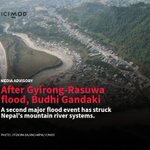
In just the past few weeks, Nepal has witnessed devastating mountain disasters. The catastrophic Bhote Koshi flood in Rasuwa and the recent Budhi Gandaki flood in Gorkha have demonstrated how cascading hazards involving glaciers, rockfalls, landslides, water, and sediment are becoming increasingly destructive in our mountains.


This is happening in a region that is warming faster than the global average and where climate change is amplifying extreme weather events and natural hazards. More than 240 million people living in the Hindu Kush Himalaya, and 1.65 billion downstream, depend on these mountain systems.
Scientists warn that, under current emissions pathways, HKH glaciers could lose up to 80% of their volume by the end of the century, increasing risks from floods, landslides, and glacial hazards across the region.
As climate risks accelerate across the Hindu Kush Himalaya, the need for regional dialogue and collective action has never been greater.
#HKHFUTURESFORUM2026


As the world marks the International Day for Disaster Risk Reduction and Nepal responds to a second major mountain disaster in less than seven weeks, a new scientific synthesis released today has found that the mountain slope responsible for the Gyirong-Rasuwa disaster was deforming by up to 40 centimetres between 7 July and 24 August 2026, Sentinel-1 InSAR satellite observations recorded up to 40 centimetres of line-of-sight deformation between 7 July and 24 August 2026, indicating measurable movement of the slope before failure.
The disaster killed at least 1,451 people and left 5,745 people missing in Nepal, according to the National Disaster Risk Reduction and Management Authority. Chinese authorities reported 43 deaths and 519 people missing.
The report, Understanding the Gyirong–Rasuwa disaster of 26 August 2026 was launched today by Pema Gyamtsho, Director General of ICIMOD, at Nepal’s National Conference on Disaster Risk Reduction, where policymakers, practitioners and researchers gathered to discuss lessons from recent disasters and emerging risks across the Himalaya.
Read the full press release and the report: icimod.org/press-releases/se…

A flash flood swept through Nepal's Budhi Gandaki river system early on 11 October, carrying mud, sediment and debris downstream.
Preliminary accounts indicate that the failure of a temporary landslide blockage near Chumchet, Gorkha, may have triggered the event.
With search, rescue and evacuation efforts are underway, our prayers are with everyone affected. We stand in solidarity with the Government of Nepal providing technical support as required.
Read the full press release: icimod.org/press-releases/la…

Ready to lead a new chapter in mountain resilience?
ICIMOD is hiring a Coordinator, UNU Hub at ICIMOD to drive research, partnerships, fundraising, and regional impact across the Hindu Kush Himalaya.
Shape solutions. Build collaborations. Create impact.
Apply: icimod.org/get-involved/vaca…

What changes when reliable water, renewable energy and women’s agency come together?
Across Bhutan, women make up the majority of the workforce sustaining agriculture and livelihoods. Yet they also carry many of the challenges that make farming harder. For example, Irrigation - one of the fundamentals of crop production, yet it remains out of reach for much of the country.
@IDRCinAsia @ERodDev


The WERELIS (Women’s Empowerment through Renewable Energy-Powered Lift Irrigation Systems) project is exploring a different approach: using Bhutan’s renewable energy potential to bring reliable irrigation water closer to farms, while enabling women to participate in and manage the systems themselves.


Funded by the International Development Research Centre (IDRC) and implemented in collaboration with the Department of Energy, Royal Government of Bhutan, the lessons from WERELIS offer a practical model showing how renewable energy-powered lift irrigation systems can strengthen climate resilience, support women’s empowerment, and enhance energy security as mutually reinforcing goals.
Want to explore the stories behind these changes? Read More Power to Women - the full story of WERELIS and its impact on livelihoods, communities and policy: lib.icimod.org/records/j1pgc…
Read the full press release:icimod.org/press-release/hig…


Beyond GDP. Beyond business as usual.
Bhutan is the first country in the world to adopt Gross Ecosystem Product (GEP) at the national level, recognizing nature as a core contributor to prosperity.
We're proud to have supported Bhutan's Natural Capital Accounting journey.
Guideline: lib.icimod.org/records/s3f96…

1,400+ lives lost. 6,000 people still missing. USD 5 billion in losses.
The Rasuwa-Gyirong flood was more than a disaster. It exposed how mountain hazards can trigger cascading impacts across borders, rivers, infrastructure, and communities.
Now, governments, scientists, and development partners across the Hindu Kush Himalaya have come together around the Kathmandu 10 Action Points, a roadmap to strengthen monitoring, early warning systems, emergency response, and recovery.
As ICIMOD Director General Pema Gyamtsho put it: "This is now a slap in the face and time is running out."
The message is clear, reducing future losses will require stronger regional cooperation, faster information sharing, better science, and greater investment in resilience.
Read the full press release: icimod.org/press-release/ras…
Ahead of the Global Clean Air Dialogue in Istanbul, Türkiye, happening on 23-24 September, ICIMOD’s experience in actionable air quality management offers a practical perspective.
A country’s clean-air priorities are determined by shared science, policy exchange and financing – something that remains a challenge for countries in the Hindu Kush Himalaya.
ICIMOD has worked with governments across the region to drive action on clean air. The Kathmandu Roadmap in 2022 and the Thimphu Outcome in 2024 have been crucial in giving shape and voice to regional air quality management.
While national priorities guide response, regional cooperation helps countries learn from one another.
As the Istanbul dialogue explores strong examples of cooperation worldwide, the experiences of air quality management in the Indo-Gangetic Plain and Himalayan Foothill region highlight how science, policy and finance, including national budgets, can work together to turn evidence into action.
Explore how Nepal is doing this:
thehimalayantimes.com/ampArt…
#CleanAirDialogue2026 #Air #SG1

Protecting biodiversity is not only about what happens on the ground. It is also about ensuring that the realities of mountain regions are reflected at the negotiating table.
Three decades have passed since the Convention on Biological Diversity (CBD) came into effect, yet biodiversity loss has not only persisted but intensified. The Hindu Kush Himalaya (HKH) region represents one of the most biodiverse and environmentally significant mountain regions in the world. The region consists of major ecoregions and four global biodiversity hotspots. Despite this, the specific vulnerabilities of mountain regions are not always comprehensively addressed or reflected in CBD negotiations and relevant implementation frameworks.
To address these challenges, the International Centre for Integrated Mountain Development (ICIMOD), in collaboration with Jigme Singye Wangchuck School of Law, UN Environment Programme and CBD Secretariat, has organised the “Regional training workshop for Conventional on Biological Diversity negotiators” from 16-17 September.
Over the two days, the workshop strengthened the strategic and technical capacities of HKH negotiators, with a particular focus on the CBD’s Kunming-Montreal Global Biodiversity Framework and preparations for the 17th meeting of the Conference of the Parties to the CBD (COP-17) in October. Through a blend of practical exercises, and negotiation simulations, participants will enhance their skills to raise the profile of mountain biodiversity issues and the needs of the HKH region within the CBD and its related processes.
Read the full press release: icimod.org/press-release/str…
#Biodiversity #CBD #COP17 #ICIMOD #HKH #MountainBiodiversity #SG3 #GlobalAdvocacy #UNEP @UNEP_AsiaPac @UNBiodiversity


On 26 August 2026, a north-facing slope on the Langtang Lirung mountain in North-Central Nepal failed. Within minutes, bedrock collapse triggered an ice-rock avalanche that swept down the Bhote Koshi–Trishuli valley and across an international border as a tsunami of floodwater.
How can this be avoided? What is needed in order to reduce the destructive scale of these disasters? Where are the next hotspots?
To address these questions and more, ICIMOD and the Government of Nepal - with the support of the Embassy of Switzerland - convened an international meeting consisting of senior disaster-management and cryosphere experts, aid agency representatives, and government officials from Bangladesh, Bhutan, China, India, Pakistan and Nepal, from 15–17 September in Kathmandu, Nepal.
They were joined by a cohort of Swiss experts who managed a similar ice-rock avalanche in Blatten, Switzerland in 2025.
Read the full story: icimod.org/icimod-rasuwa-gyi…


In solidarity with communities affected by the recent floods in Rasuwa, ICIMOD staff came together and collected NPR 5 million among themselves in support of the Government of Nepal's ongoing relief efforts through a contribution to the Prime Minister's Disaster Relief Fund.
On behalf of ICIMOD staff, Dr Pema Gyamtsho, Director General, accompanied by Shekhar Ghimire, Director, Administration, Finance and Operations, and Anu Joshi Shrestha, Rural Enterprise & Value Chain Development Specialist and Country Focal Person for Nepal, handed over this ICIMOD staff contribution to the Honourable Finance Minister Dr Swarnim Wagle at the Ministry of Finance on 14 September 2026.


ICIMOD Director General Dr Pema Gyamtsho led a delegation to meet Ambassador Zhang Maoming of the People's Republic of China to Nepal on 11 September. During the visit, ICIMOD offered heartfelt condolences for the lives lost and the destruction caused by the Rasuwa-Gyirong disaster, and thanked China for its continued support to our work. The meeting also focused on strengthening regional cooperation, in particular in managing transboundary disaster risks. Ambassador Zhang offered valuable insights and reaffirmed China's continued support for ICIMOD's mission in the region.
To learn more: np.china-embassy.gov.cn/eng/…
