
We use bacteria and their viruses to study Genome architecture/Antimicrobial resistance. Lab website: https://xitter.cf/t.co/niGI6IAJKr
Austin, TX
Joined June 2020
- Tweets162
- Following37
- Followers196
- Likes20


Pinned Tweet
Knowledge of evolution may not be strictly useful in everyday commerce. You can live some sort of life and die without hearing of Darwin. But if, before you die, you want to understand why you lived in the first place, Darwinism is the one subject you must study - R Dawkins
This week, UT's College of Natural Sciences highlighted our recently published work on antibiotic resistance in a bacterial community. Check out their article here: cns.utexas.edu/news/research…

#RNA is more than genetic material; it can be a community defense factor. Our new publication shows that extracellular RNA released during bacterial cell death can bind and sequester cationic antibiotics, reducing their uptake in neighboring cells.
nature.com/articles/s42003-0…
Check out the Harshey Lab's latest publication on chemoreceptor Aer:
pubmed.ncbi.nlm.nih.gov/4187…
The Aer chemoreceptor in E. coli is best known for mediating aerotaxis by sensing metabolic flux through the electron transport chain via an FAD cofactor bound to its PAS domain. (1/5)

This work suggests that targeting chemotaxis pathways - or Aer signaling specifically - could enhance bacterial susceptibility to ROS-generating antibiotics and limit their ability to evade treatment. (4/5)
The Harshey lab recently published a paper introducing the Texas 2-step model to explain the mechanism behind YcgR function. Check out our story, now with commentary from the journal: journals.asm.org/doi/full/10…

HarsheyLab retweeted

🦠🧪🧬#WelchGrantee @harsheylab at @TexasScience has discovered a novel mechanism in which phage Mu couples late gene expression with DNA replication. They found that phage Mu appropriates host bacteria's β-sliding Clamp, an essential replication factor that interacts with Pol III, to transcribe late phage genes through interaction with the late gene transcription factor MuC. Congrats to 1st-author Khang Ho on this paper! pnas.org/doi/10.1073/pnas.25…

We've uncovered an unexpected role for the E. coli β-sliding clamp: phage Mu C repurposes the Clamp to activate late gene transcription. Conserved clamp-binding motifs in the Mor/MuC family suggest clamp-dependent transcription is widespread.
pnas.org/doi/10.1073/pnas.25…
Check out our newest publication on the flagella brake protein YcgR: doi.org/10.1128/jb.00353-25
Here, we introduce the Texas 2-step model and provide evidence for the first step to explain the previously unresolved mechanism by which YcgR imposes counterclockwise bias at the motor.

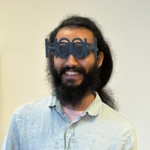
This week the Harshey Lab celebrated Dr. Nabin Bhattarai's fantastic thesis defense. He is shown here wearing fashionable hydrogen peroxide glasses and holding a model of E. coli's flagella motor, both representative of his PhD work. Congrats Dr. Nabin!


The Harshey lab has a new publication on swarming: journals.asm.org/doi/10.1128…
c-di-GMP has been thought to signal only one thing, transition to a biofilm. Our work shows that the choice is not binary, and that threshold amounts of c-di-GMP signal a habitat conducive to swarming.

The choice of DgcO could reflect the fact that it has an autoinhibitory site (I-site), which helps regulate c-di-GMP levels, keeping them low enough to not inhibit motility.