

The official Twitter feed of the @UChicago Harris School of Public Policy. For the latest in evidence-based research and news, visit https://xitter.cf/t.co/ovOGQIC8jk.
Chicago, Illinois
Joined February 2011
- Tweets18.1K
- Following1.8K
- Followers16.2K
- Likes7.7K







Despite near-record turnout in the 2026 midterms, fewer than half of eligible Americans voted. In @USATODAY, Prof. Anthony Fowler examines how mandatory voting could broaden participation and make elections more representative of the public. har.rs/4ADy5L0

1
216
In Stateline, Marc Farinella examines the fallout from Democrats’ sweeping state election victories. His key question: Will Republican lawmakers now feel more freedom to pursue their own policy priorities, potentially moving toward the political center? har.rs/3Un5R81

1
297
Harris Policy retweeted

🎙️🎙️ NEW
AI can do the work. Can it build the trust?
@UChicago @HarrisPolicy's John Burrows talks about what companies are missing in their AI strategies.
chicagobooth.edu/review/podc…

What actually happened on Nov 3? Harris Prof. Anthony Fowler, Soubhik Barari (@NORCnews), and Batu Gundogdu dig into the 2026 midterm results and what comes next. Wed, Nov 4, noon CT, in person or livestream.
har.rs/4sDeIPv

2
331
Cameras, drones, license plate readers: How should Chicago balance public safety with privacy? The 2026–27 Harris Policy Innovation Challenge invites UChicago graduate students to develop evidence-based proposals, with a $10,000 prize for the winning team. har.rs/4kdjhha

Join Leonard M. Lopoo for a discussion on his book Wanting Children: Family-Planning Policies and the Engineering of America's Population. He will be joined in conversation by Prof. Ariel Kalil with a Q&A and signing to follow. RSVP: har.rs/47rsISG

Finnegan Keilty, MPP Class of 2027, reflects on his summer internship on State Farm’s municipal bonds team, his first experience in public finance and the career pivot that motivated him to pursue graduate study at Harris.
Read Finnegan's blog: har.rs/4jpCE6q
365
Join Ryan Kellogg, energy economist and Harris School of Public Policy professor, for an AMA on Reddit! har.rs/4BlDYO6

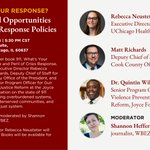
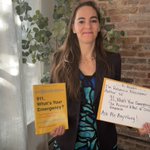
Join us on October 29 for an event exploring America's crisis response system, and celebrating the release of 911, What’s Your Emergency?: The Promise and Peril of Crisis Response, a new book by Rebecca Neusteter.
Register: har.rs/4xYBlPd

252
In @UniteAi, Prof. Alexander Fouirnaies and coauthors warn that multi-agent AI systems can mistake consensus for accuracy. Agents can herd toward shared but unsupported answers, raising questions about systems that reward evidence, not just agreement. har.rs/4i09CrL

289
Harris Policy retweeted

Save the date! Join us on Oct. 28 for Climate Frontiers! 🌍
Featuring a climate showcase, student poster session, career fair, and leadership forum.
Learn more: climate.uchicago.edu/events/…

Join @JohnUChicago and @Travelers to learn practical tips to build connection and rewire workplace technology as a force multiplier for collaboration, innovation and performance. har.rs/4xuXaWm

Congrats to Zoe Dimmitt, MSCEP’27, whose work as a Marquette research assistant contributed to IceCube, the South Pole observatory at the center of this year’s @NobelPrize in Physics. Zoe helped build a particle telescope to observe cosmic rays. har.rs/473C8DO

2
561
In @latimes, @k_sonin says Trump’s ads reflect a pattern familiar from authoritarian systems: blurring the line between leader and state, so that criticism of the leader becomes criticism of the country. “There is this authoritarian scent,” he says. har.rs/4ho5tPc

1
309
For anyone in the Keller Center who has been following recent news about the Kennedy Center and noticing something familiar: you’re not imagining it. Both buildings were designed by Edward Durell Stone, one of the defining modernist architects of the 20th century.


In @AP, @sndurlauf of @UCStoneCenter explains why the record-low official poverty rate needs context. The supplemental measure accounts for food aid, health care, housing, and other costs, giving a fuller picture of what families have and what they need. har.rs/46P9DcT

Don’t miss the chance to hear Nobel laureate and world-renowned economist Roger Myerson deliver his Harris School valedictory lecture, “Local Politics in Nations and Empires,” on October 7th at 5:00 pm in the Keller Center. Secure your spot now: har.rs/4yfZr9p

Harris’ first executive education program in China brought 40 social-sector leaders together in Beijing to learn how behavioral science and evidence can strengthen program design, evaluation, and decisions about when programs can be adapted and scaled. har.rs/4ABzFOl

1
366
In @NextCityOrg, Research Professor Justin Marlowe puts Providence’s divestment ballot initiative in context: growing public scrutiny of local investments reflects “just how much money is at stake and just how opaque the decision-making can be." har.rs/3T8k4VJ

321
Innovative new research from @fouirnaies and co-authors

Our new Free Systems research shows how shared communication can cause agents to fall victim to shared delusions, and how we can use governance structures to correct these.
(1) We create HuggingFace-like simulations to "stress test" agent swarms, exploring cases where agents receive and report incorrect signals leading to bad information cascades
(2) In the "treatment" condition, agents can post their signals to a shared message board as they receive them. In these cases, agents who read the messages are remarkably quick to abandon their private information and "herd" on the bad signal. As a result, shared communication leads the swarm to a shared delusion in these cases.
(3) In the "control" condition, agents don't communicate at all, and as a result, there is no shared delusion---but on the other hand, agents lose the chance to aggregate their information together.
(4) Finally, we show that there are several interventions that can preserve the message board while mitigating the collective failure: in particular, a rule that agents must report the actual private signal they received corrects the behavior and largely eliminates the herding.
This is just one small experiment, using only Haiku, and within that experiment we're zooming in on a particular "stress test" that only occurs in rare instances where several agents receive incorrect signals at the start. There's tons more to do here. But we see this as a proof of concept for one particularly important failure that can occur with multi-agent swarms: information cascades that lead to shared delusions. We'll be doing lots more research to understand these delusions, what mechanisms explain agents' seeming "peer pressure" to abandon private information, and what we can do about it. Stay tuned!
(joint work with @fouirnaies, Sandy Handan-Nader, and @danmthomp)
