

Find your place in space. Become a member today at https://xitter.cf/t.co/DNYphy7mtd
Pasadena, CA
Joined September 2010
- Tweets21.6K
- Following852
- Followers239K
- Likes9K




Congratulations to @JAXA_en and partners @NASA, @esa, @CNES, and @DLR_en on the launch of MMX! 🚀
MMX is currently headed to Phobos, the larger of Mars’s two moons. It’ll be the first mission to land on a moon of Mars and the first to bring back samples from Phobos. The spacecraft will collect at least 10 grams of surface material and bring it home in 2031. It’s also dropping off a rover named Idefix to explore.
And Planetary Society members helped make one of its sample collectors possible!
Our supporters funded PlanetVac’s first full prototype and its rocket test flight. It’s a Honeybee Robotics sampler that blasts the surface with nitrogen gas and catches what flies up. A version called P-Sampler is now mounted on one of the spacecraft’s landing legs, ready to grab a piece of Phobos.
Good luck on your journey MMX! 🔴


The 2026 Orionid meteor shower peaks on the night between October 21 and October 22! Here's how to watch ☄️
planetary.org/articles/your-…

Very cool! @USAToday special space edition is out, and it’s all about Artemis II and the lunar program. Check out the digital version here⬇️
usatodayspecial-va.newsmemor…

Planetary Society members helped fund space technology that’s about to launch on the first mission to land on a moon of Mars!
JAXA’s Martian Moons eXploration (MMX) mission is scheduled to launch no earlier than Oct. 19.
On board is P-sampler, a version of the PlanetVac sample collection system developed by Honeybee Robotics. Our members funded PlanetVac’s first full prototype in 2013 and its rocket flight test in 2018, helping move it from concept to flight-ready hardware.
If all goes well, MMX will land on Phobos, collect samples, and return them to Earth in 2031.
Learn more about MMX and how citizen support helped make P-sampler possible ⬇️
planetary.org/articles/mars-…

What would it take to reach interstellar space within a human lifetime? Or keep astronauts breathing on a years-long trip to Mars?
At the 2026 @NASA Innovative Advanced Concepts (NIAC) Symposium at Wichita State University, Planetary Radio host Sarah Al-Ahmed sat down with the researchers tackling those questions. Part 2 of our NIAC coverage is live:
☀️ Artur Davoyan (@UCLA) on Coilable Stacked Solar Sails, a new architecture that stacks multiple smaller sails instead of deploying one enormous membrane. The goal: fast missions to the outer planets and interstellar space.
☢️ James Bickford (@draper_u) on TFINER, the Thin Film Isotope Nuclear Engine Rocket, which generates thrust from the natural decay of radioactive thin films. Possible destinations include interstellar objects and the solar gravitational focus, more than 500 times farther from the Sun than Earth.
🫁 Alvaro Romero-Calvo and Theo St. Francis (@GeorgiaTech) on Breathing Beyond Earth, a pump-free oxygen production system for long-duration missions to Mars.
🎧Listen now: planetary.org/planetary-radi…

It's International Podcast Day, so here's what we're listening to 🎧
Planetary Radio's latest episode is all about missions that sound like sci-fi: a laser-powered drone that could be the first to explore a cave on another world, tiny nuclear-powered probes built to survive the Moon's darkest craters, and flying robots for the caves of Titan.
Sarah Al-Ahmed talks with the teams behind these bold NASA-funded concepts for reaching places we've never been. Listen now ⬇️
planetary.org/planetary-radi…

Got downtime? Why not marvel at the beauty of our Universe? Check out the best space images of the month. ⬇️ planetary.org/space-images/t…

SpaceX Starship successfully completed its first orbital test flight! Our Chief of Space Advocacy @JackKiraly joined @ABC to explain why this marks a significant moment for the future of spaceflight and the @NASA Artemis program.
Watch the full interview here: abcnews.com/video/136824936/
JAXA's Hayabusa2 flew within 400 meters (1,300 feet) of asteroid Torifune on July 5 and confirmed that it's a contact binary, two lobes stuck together. Tune in to Planetary Radio to hear what this extended mission flyby revealed about this rare contact binary and what it means for planetary defense. planetary.org/planetary-radi…

Three new projects just got funded thanks to our members and donors — from asteroid-defense tech to mapping the far reaches of the Solar System. Meet this year's STEP Grant winners 🎉
Thank you to our review panel:
Jim Bell, planetary scientist at Arizona State University and former president of The Planetary Society
Bruce Betts, chief scientist at The Planetary Society
John Grunsfeld, planetary scientist and former NASA astronaut
Heidi Hammel, vice president of science for the Association of Universities for Research in Astronomy and interdisciplinary scientist for JWST
Dipak Srinivasan, member of the Principal Staff at The Johns Hopkins University Applied Physics Laboratory
Bell, Grunsfeld, Hammel, and Srinivasan are also members of The Planetary Society’s board of directors.
planetary.org/articles/2026-…

NASA's New Horizons is poised to make discoveries about the farthest reaches of our Solar System, but two of its key instruments are in danger of being shut down prematurely.
Starting Oct. 1, SWAP and PEPSSI will go dark. The spacecraft itself is healthy, with enough power and fuel to keep functioning until around 2050.
Here's what's happening and how you can help save them. ⬇️
planetary.org/articles/swap-…

Did you miss it? The replay is up now 🥳
Jonathan Lunine, chief scientist @NASAJPL, joined The Planetary Society's Sarah Al-Ahmed for a fireside chat live from NASA JPL mission control, and the full conversation is now available to watch on demand.
Lunine has spent his career chasing one of science's biggest questions: is there life beyond Earth? After earning both of his graduate degrees at Caltech, he went on to help shape mission after mission, Cassini at Saturn, Juno at Jupiter, and now Europa Clipper, where he's a co-investigator on the spacecraft flying toward one of the most promising places to find life in our solar system. In 2024 he returned to Caltech as professor of planetary science and became chief scientist at JPL.
Over 75 minutes, Lunine and Sarah dug into the missions defining the hunt for habitable worlds: Perseverance's Sapphire Canyon sample (the strongest potential sign of ancient life yet found on another planet), Curiosity's organic molecules in Gale Crater, and Europa Clipper's voyage to Jupiter's ocean moon. Mission imagery, video, and live audience questions included.
🎥 Watch now ⬇️youtube.com/watch?v=tj3HpiM1…

The September Planetary Report is here! This issue covers the Roman Space Telescope's road to launch, the next wave of Mars missions, and how each mission's discoveries build on the last.
Download the magazine and read it for free: planetary.org/planetary-repo…

Today is Star Trek's 60th anniversary! Star Trek changed so much for so many, including us. Read on for a fun fact about our connection to Star Trek. ⬇
Did you know: Gene Roddenberry never publicly endorsed anything to his fans, until The Planetary Society.
In late 1979 or early 1980, he broke that rule and wrote to the Star Trek mailing list about a brand new organization founded by Carl Sagan, Bruce Murray, and Louis Friedman to explore the Solar System and search for life beyond Earth.
He told them Star Trek was fiction, but its idea was "very real and very important," and that it was this idea The Planetary Society was devoted to.
Today, we still strive to support and advocate for a future that allows us to explore the stars and protect space science. We will do everything in our power to "make it so."
You can download this image and read the transcript from our website: planetary.org/space-images/2…

Your advocacy works! Congress just passed a bill that delays a rule that would've fundamentally changed how science is done in the United States.
This effort was pushed by OMB and would have radically changed how the U.S. funds science. It would've directed political appointees — not scientists — to only approve scientific research in line with the President’s political views.
It was set to kick in on October 1. This bill pushes that back to December 11. The rule isn't dead, just delayed. So we have more work to do.
Learn more and save this page for updates: planetary.org/save-nasa-scie…

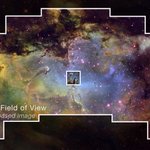
Nancy Grace Roman Space Telescope is set to launch no earlier than this Sunday, August 30. Its field of view will be 100x bigger than Hubble's!
Below is a composite image comparing how much of the sky NASA's Nancy Grace Roman Space Telescope covers with how much the NASA/ESA Hubble Space Telescope covers. The white central square is an image of the Pillars of Creation from Hubble, while the surrounding image of the wider Eagle Nebula simulates how much Roman would image in a single observation. The actual wider image is from a ground-based telescope.
Composite credit: L. Hustak (STScI)

A SpaceX Falcon 9 upper stage launched in January 2025 just crashed into the Moon. How did it end up there a year and a half later? Find out in today's episode of Planetary Radio. planetary.org/planetary-radi…

Live from JPL Mission Control, a fireside chat that walks through the missions defining the hunt for habitable worlds. ‼️This event is limited to 1,000 participants, register early to save your spot.‼️
In 2025, Perseverance drilled a Mars sample called Sapphire Canyon and found the strongest potential sign of ancient life yet. Was it microbes, or just chemistry? We're closer than ever to knowing.
JPL chief scientist Jonathan Lunine has spent his career chasing that question, from Cassini to Juno to Europa Clipper. Join him for a live fireside chat with our own Sarah Al-Ahmed.
📍 Zoom
🗓️ Tuesday, August 25, 12 pm PT
🎟️ Free and open to the public
Register: alumni.caltech.edu/event/tec…