

Email intelligence engineered to optimize deliverability at scale.
Joined February 2017
- Tweets825
- Following265
- Followers221
- Likes1.7K





the next edition of Industry Voices is here.
Dennis Dayman helped shape the SPF and DKIM standards the email industry runs on today. we asked him how authentication and inbox placement have changed.
his answer cuts through something most senders get wrong.
authentication has shifted from a best practice to a hard expectation. major mailbox providers are enforcing requirements senders can no longer ignore. but authentication has never guaranteed inbox placement. it establishes trust in the sending identity and gives receivers a foundation for evaluating reputation.
getting authentication right is only one part of earning the inbo
— Dennis Dayman, Industry Voices

the complaint rate ceiling is 0.3%.
three complaints per thousand sends. since november 2025 crossing it triggers outright rejection from Gmail, Yahoo, and Microsoft. not spam folder. rejection.
most teams find out when something stops working. by then the classification has already happened.
know your complaint rate before the campaign. not after the delivery report.

authentication tells inbox providers who you are.
it doesn’t tell them whether they should trust you.
SPF, DKIM, and DMARC establish identity. reputation is built on what you do with that identity over time. the quality of your list. the engagement your sends produce. the complaint rate you’ve maintained.
authentication is the entry requirement. everything else is the actual work.

we looked at 8 enterprise lists verified in September. 1.18 million email records total.
the deliverable rates ranged from 61% at the low end to 91% at the high end.
same verification process. same time period. completely different results.
that range matters because it means there’s no universal benchmark for a healthy list. a 75% deliverable rate could be fine for one program and a serious problem for another depending entirely on what makes up the other 25%.
the teams that understand what’s inside their non-deliverable bucket are operating with a completely different level of clarity than the ones just looking at the top-line number.

inbox providers don’t know your Q4 campaign is important.
they know your engagement rate, your complaint rate, and the pattern your list has been building for months.
by the time november arrives that pattern is already written.
the best Q4 email strategy starts in Q3. the second best time is now.

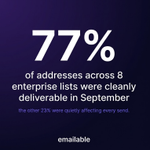
across 8 enterprise lists verified in September, only 77% of addresses were cleanly deliverable.
23 out of every 100 fell outside that bucket.
the number that matters isn’t the one you can see. it’s the one quietly affecting every send while the dashboard shows green.

the next edition of Industry Voices is here.
we asked Kath Pay, one of the most respected voices in email marketing, what a genuinely healthy email program looks like in 2026.
her answer is worth reading slowly.
a healthy program isn’t one that simply has good deliverability or strong campaign metrics. it’s one that creates sustainable value for both the customer and the business. it knows when not to send just as much as when to send. it uses AI to identify patterns and accelerate analysis while keeping the marketer firmly responsible for strategy, judgement, and the customer experience.
and how far is the average brand from that?
quite a long way.
many brands have become very sophisticated at sending email without becoming equally sophisticated at understanding its impact. they’re optimising campaigns when they should be optimising the customer and business outcomes those campaigns are meant to create.
— Kath Pay, Industry Voices

most email teams look at their Undeliverable rate and feel fine. they’re looking at the smaller number.
in 5 of the 8 enterprise lists we verified in September, the Risky category was larger than Undeliverable. Risky doesn’t mean invalid. it means uncertainty. accept-all domains, role addresses, addresses that could go either way depending on the day.
the problem hiding underneath the obvious number is almost always bigger than the obvious number.

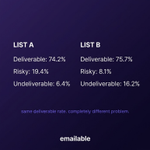
two lists. deliverable rates of 74.2% and 75.7%.
on the surface they look identical. same problem, same fix, same risk level.
underneath they are completely different. one has a mostly Risky composition. the other has a significantly larger Undeliverable problem. same headline number. entirely different diagnosis. entirely different treatment.
this is why deliverable rate alone doesn’t tell you what’s actually wrong with your list. the number outside the Deliverable bucket matters less than what that number is made of.

most email teams treat verification like a one-time event.
verify before a big send. clean the list. move on. twelve months later the list has decayed another 28% and nobody has looked at it since the last campaign that underperformed.
verification isn’t a pre-send checklist item. it’s infrastructure maintenance. the teams with the healthiest lists aren’t the ones who verified once. they’re the ones who made it a recurring part of how they operate.

the average SaaS company loses 5 to 7% of its email deliverability reach every quarter without a single hard bounce to show for it.
no alerts. no obvious failures. just contacts quietly becoming unreachable while the database says they’re still there.
email infrastructure doesn’t degrade loudly. it degrades in the numbers everyone is already watching for something else.

email verification is not where Emailable stops.
it's where we start.
the infrastructure that keeps a list clean is the same infrastructure that can tell you which contacts are worth pursuing, which acquisition sources are producing real engagement, and which signals predict whether a contact will convert before you spend a dollar reaching them.
most email tools are built around the send. we're building around the data that determines whether the send was worth making in the first place.
sharp. straightforward. and a lot more ambitious than a verification tool.

the Black Friday campaign that underperforms in november was decided in august.
not by the creative. not by the offer. by whether anyone looked at the list before the season started.
28% annual decay. four months of summer. the damage is already months old by the time the november send goes out.
verify before the season.

we asked Chad White what he'd tell a brand that's proud of their list size.
list size by number of addresses is a vanity number.
the metrics that matter: how many subscribers have engaged recently. how much revenue each subscriber generates.
a big list that doesn't engage isn't an asset. it's a number that feels good until the campaign that matters proves otherwise.
— Chad White, Industry Voices

a one-time passcode landing in spam is a failed customer obligation. a fraud alert that gets filtered is a liability before it's a deliverability metric.
in financial services email carries things that cannot fail to arrive.
a dirty list is not a housekeeping problem here. it's an infrastructure risk wearing an email marketing label.

the email that doesn't land because the address expired six months ago doesn't announce itself.
it quietly contributes to a pattern inbox providers are reading and scoring while your team looks at the open rate and wonders what changed.
deliverability isn't a campaign variable. it's infrastructure. infrastructure that isn't maintained doesn't fail loudly.

31% of B2B email addresses become unreachable within 12 months.
not because of a bad campaign. because people change jobs and take their work email with them.
most B2B teams are sending to an audience that stopped existing months ago. the CRM says the contact is there. inbox providers know otherwise.
the list that built your pipeline last year is not the list you have today.

a 23% invalid rate on an ecommerce list isn't a deliverability problem.
it's a revenue problem that shows up in the wrong place.
23 out of every 100 sends going nowhere. the abandoned cart that never arrived. the win-back that never landed. the Black Friday campaign firing into the void for nearly a quarter of the list.
inbox placement determines whether everything else you built matters. the list is the infrastructure. everything else runs on top of it.

the next edition of Industry Voices is here and this one's from our own team.
we asked Dickson what he'd say if he had one message for the email marketing industry.
his answer was three words.
make list hygiene sexy again.
because somewhere along the way we made deliverability the boring part. the thing you deal with after something breaks. the maintenance work nobody wants to talk about at the conference.
but the teams quietly winning in the inbox aren't the ones with the best creative. they're the ones who treated list health like it mattered before it became a crisis.
— Dickson, Emailable

hot take: your email list is not an asset.
it's a liability with good branding.
an asset appreciates over time. a list decays. 28% of it becomes unreachable every year without a single alert, a single bounce, or a single reason to look at it.
the number goes up. the quality goes down. everyone celebrates the growth and nobody checks what's underneath it.
verify regularly or stop calling it an asset.
