

New Game Theory papers from https://xitter.cf/t.co/3t5otp86yM: mechanism design, learning in games, coordination. Thank you to arXiv for use of its open access interoperability.
- Tweets15.9K
- Following10
- Followers2.7K
- Likes3





ALT Scoring rules are used to elicit probabilistic beliefs through payments that depend on reports and realised outcomes. We ask how these rules should be designed to induce truthful reporting and incentivise costly information acquisition when the agent is risk averse. For agents with entropic risk preferences in finite state spaces, we characterise proper scoring rules through an exponential transformation, derive optimal structures for information acquisition under bounded payments, and obtain explicit optimal coefficients in the binary case. The risk-neutral limit preserves properness and, in the binary case, optimality, while recovering the optimal betting structure for nonbinary states. For optimal design in the binary model, it suffices to focus on rules whose associated concave function is affine on each side of the prior. The optimal coefficients depend only on the prior and the risk-aversion parameter. The binary optimal rules we construct also admit an exact transformation from

ALT We consider two-player zero-sum concurrent stochastic games played over a finite state space for an infinite number of stages. In every stage, both players simultaneously and independently choose an action. Then, given the current state and chosen actions, the successor state is selected according to a stochastic transition function. We consider limit-average objectives, where Player 1 maximizes the long-run average of rewards assigned to every transition. The value from an initial state is the maximal expectation that Player 1 can ensure. We study the two basic computational problems: (a) the approximation problem of computing the values within an arbitrary additive error, and (b) the exact problem of deciding whether the value at a state is at least a given threshold. The previous results in the literature establish: (a) the approximation problem belongs to TFNP[NP], and (b) the exact problem belongs to PSPACE, via the theory of the reals, and is SQRT-SUM-hard. Our contributions are
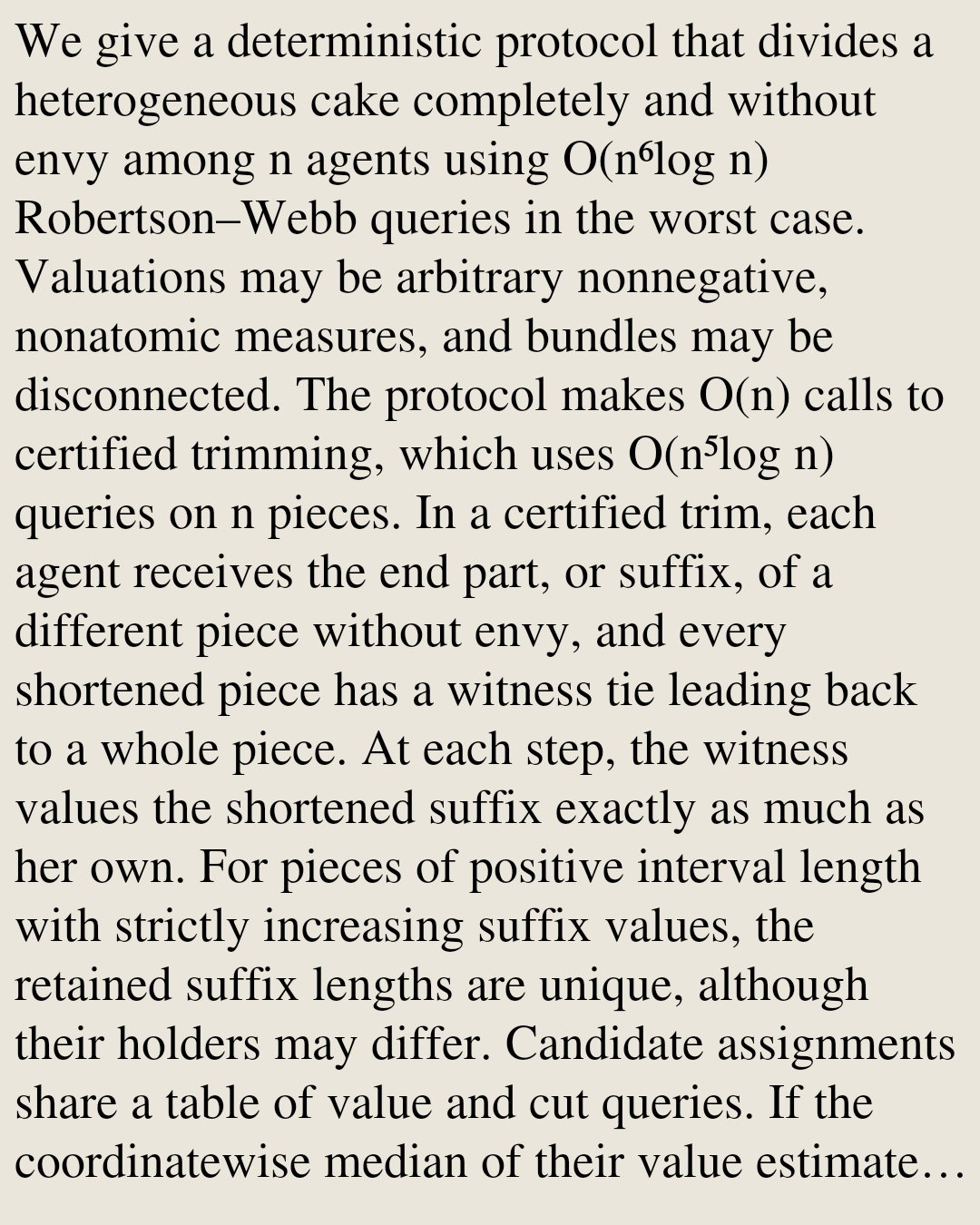
ALT We give a deterministic protocol that divides a heterogeneous cake completely and without envy among n agents using O(n⁶log n) Robertson–Webb queries in the worst case. Valuations may be arbitrary nonnegative, nonatomic measures, and bundles may be disconnected. The protocol makes O(n) calls to certified trimming, which uses O(n⁵log n) queries on n pieces. In a certified trim, each agent receives the end part, or suffix, of a different piece without envy, and every shortened piece has a witness tie leading back to a whole piece. At each step, the witness values the shortened suffix exactly as much as her own. For pieces of positive interval length with strictly increasing suffix values, the retained suffix lengths are unique, although their holders may differ. Candidate assignments share a table of value and cut queries. If the coordinatewise median of their value estimates fails a matching test, the test identifies an agent whose value is underestimated, ruling out at least half the r

ALT Online platforms often control the information behind user decisions they want to influence, such as whether a driver accepts a trip or a buyer completes a purchase. A classical result in information disclosure shows that a censorship policy is optimal for the platform: the platform pools all sufficiently favorable options under a common message, such as a quality badge, and reveals the rest individually. This result, however, presumes fully rational users. We study disclosure to boundedly rational users who follow the logit quantal response model and whose rationality level the platform may not know. Our results deliver a unifying message: less rational, more transparent. Neither bounded rationality nor uncertainty about it calls for a more complex policy; each changes only how much the platform should pool, and only toward greater transparency. When the rationality level is known, censorship remains optimal, and less rational users optimally receive at least as much information as mo

ALT Intellectual work, such as software, legal documents, and scientific results, typically builds on the work of others, and the same end product can often be obtained in several different ways. When assigning credit for such work, it is not clear whether credit should go according to the way the work was actually produced or also consider counterfactual ways of obtaining it. We study this question by generalizing Shapley values to account for counterfactual ways of obtaining the same result. We show that the fairness axioms of efficiency, nullity, and submodularity (in particular, additivity) are incompatible with incentivizing creators to maximize social welfare. In fact, fair credit can uniquely incentivize arbitrarily small welfare relative to the optimum. We also show that without submodularity, incentive compatibility is achievable, and that the four classical fairness axioms uniquely determine the Shapley value and prohibit dependence on counterfactual outcomes.

ALT Polyhedral integrality guarantees integral stable solutions in several classical stability problems: stable matchings in normal hypergraphs, stable b-matchings in unimodular hypergraphs, and kernels in clique-acyclic orientations of perfect graphs. Whether they can be computed efficiently has been a long-standing open question; for kernels in perfect graphs it has been open since the existence theorem of Boros and Gurvich in 1996. We show that, unless PPAD⊆ FP, they cannot. Finding a stable matching is PPAD-complete already in linear unimodular hypergraphs with hyperedges of size at most three and vertex degrees at most three. Consequently, finding a kernel in a clique-acyclic orientation of a perfect graph is PPAD-hard even if all cliques have at most three vertices, answering an open question of Pass-Lanneau, Igarashi and Meunier, and stable matchings are PPAD-hard to find in balanced and in normal hypergraphs. This contrasts with the polynomial algorithm of Chandrasekaran and Kalath

ALT Stackelberg games have important real-world applications in which reliable commitments require accounting for multiple sources of uncertainty. We study finite Stackelberg games in which environmental uncertainty makes each mixed strategy profile induce a random reward, and each player evaluates that reward with a convex monetary risk criterion. In reward form, it is a concave, monotone, translation-equivariant utility and also represented as penalized expected reward over distributions of environmental outcomes. We provide two conditions under which the follower has a unique continuous mixed response, which leads to inducible optimistic equilibrium. We show that even approximate equilibrium computation is NP Hard. We then derive an exact mathematical program with equilibrium constraints for the problem. We also develop an action entropy smoothed implicit-gradient method and prove an end-to-end additive approximation guarantee under the assumption that the gradient method reaches global

ALT We prove global last-iterate convergence of payoff-gradient learning in every typewise Riemannian metric, which for scalar actions is the same as typewise mirror descent, with explicit rates, in a class of Bayesian bidding and pricing games that includes first-price auctions, unit-demand pay-as-bid auctions, rank-based generalized first-price auctions, and homogeneous-good price competition with inelastic demand. The result holds for symmetric self-play: all players use a common strategy and apply the same payoff-gradient update at each type. Convergence is from every continuous weakly increasing feasible initial strategy, including pooling, and does not rely on the monotonicity or Minty conditions that underlie existing guarantees in other games. Instead, the class is characterized by two structural properties: a direct payoff effect that is independent of the action, and a payoff difference at the allocation threshold that is affine in the action. These properties reduce the learning

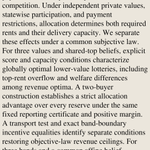
ALT A seller jointly chooses allocation and payments when buyers misperceive competition. Under independent private values, statewise participation, and payment restrictions, allocation determines both required rents and their delivery capacity. We separate these effects under a common subjective law. For three values and shared-top beliefs, explicit score and capacity conditions characterize globally optimal lower-value lotteries, including top-rent overflow and welfare differences among revenue optima. A two-buyer construction establishes a strict allocation advantage over every reserve under the same fixed reporting certificate and positive margin. A transport test and exact band-boundary incentive equalities identify separate conditions restoring objective-law revenue ceilings. For three bands and a common affine belief interval, an explicitly certified reserve attains the ceiling under stated score conditions. A case scaled to public collectible-auction records yields a nominal shared

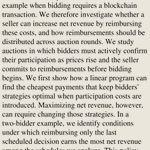
ALT Bidders in an ascending auction may incur a cost each time they choose to continue, for example when bidding requires a blockchain transaction. We therefore investigate whether a seller can increase net revenue by reimbursing these costs, and how reimbursements should be distributed across auction rounds. We study auctions in which bidders must actively confirm their participation as prices rise and the seller commits to reimbursements before bidding begins. We first show how a linear program can find the cheapest payments that keep bidders' strategies optimal when participation costs are introduced. Maximizing net revenue, however, can require changing those strategies. In a two-bidder example, we identify conditions under which reimbursing only the last scheduled decision earns the most net revenue among the schedules we analyze. This policy outperforms no reimbursement, full reimbursement, and the cheapest policy that maintains the original strategies. Some auctions end earlier than

ALT Cooperative game theory answers canonical questions on payoff allocation (Shapley, Owen), interaction attribution (Grabisch-Roubens, Faith-Shap), and coalition formation and stability. None answers a fourth question that arises whenever players carry known, overlapping group tags fixed independently of the game: how should a player's standing be distributed across the groups it already belongs to? We call this membership attribution, formalize it, and give a complete characterization of its solution. The direct, ratio-based answer is provably invalid whenever a player's group-level signals have mixed sign — a common, structurally unavoidable case. We propose a restricted-domain softmax construction instead, and prove that, for any player satisfying a precisely defined richness condition on the group structure, it is the unique such map, up to a temperature parameter, satisfying five requirements. A sixth requirement fixes the sign of this temperature; a seventh, shown independent of th

ALT Data exchange is a fundamental challenge for Web applications such as recommender systems, personalized search, and fraud detection, where combining data across participants can improve predictions. Sustaining such collaboration requires fair returns for contributions and protection against groups leaving for a more beneficial exchange. These requirements are captured by reciprocity, which equates each participant's received utility with its credited contribution to others, and core stability, which rules out any coalition exchanging its own data to make every member strictly better off. Akrami et al. prove that such exchanges exist under broad assumptions, but leave efficient computation open. Two fundamental cases are submodular utilities, capturing diminishing returns from overlapping datasets, and supermodular utilities, capturing complementarities. We settle the approximate computation of reciprocal and core-stable exchanges in both cases, establishing a computational separation u

ALT Securing hundreds of billions of dollars in decentralized finance (DeFi) requires both cryptographically secured collateral and economic capital to absorb losses that collateral alone cannot cover. Composability makes both the amount and location of this protection matter: Kelp's nearly $300 million April 2026 bridge exploit showed how an attacker could borrow against stolen assets across lending markets. We study how to allocate junior capital that absorbs losses before users incur losses in lending protocols. The main object we study is a tripartite graph that records user assets, their covered liabilities, and the junior capital permitted to pay them. Cuts in this graph determine what protection is missing, while a static security game on the graph defines how much such protection should cost. We call this cost the adversarial default premium (ADP), which can be viewed as the excess cost of insurance in composable financial systems. We then study the joint cost of funding loans and

ALT We study a strategic variant of the canonical online fair allocation problem, where a planner must sequentially allocate a divisible resource to agents with privately known demands. At each stage, the planner announces an allocation rule, the agent reports their demand, and the planner allocates resources according to the rule and the reported demand. Unlike the standard model, we allow agents to strategically misreport their needs, as can arise in nonprofit settings where demand is self-reported and monetary transfers are unavailable. We characterize the structure of incentive-compatible (IC) allocation rules in this model, and use this to identify conditions under which the optimal mechanism has a simple cap structure. We then develop an approximation method for the optimal IC mechanism through a careful reduction of the discretized dynamic program to a longest-path problem on a directed acyclic graph. Numerical experiments show that ignoring strategic reporting can be substantially

ALT We study a repeated quadratic incentive design game in which a leader learns a follower's private type from noisy observations of the follower's actions and uses her estimates in an affine incentive rule. The follower knows the leader's learning policy, which incorporates past observations to produce estimates of the follower's type, and can deviate from his myopic best response to influence the leader's future estimates. We ask how the follower's ability to manipulate these observations affects the leader's performance. Under a manipulation budget C_T constraining the expected cumulative squared deviation of the follower's actions from his myopic best response, we establish a minimax regret rate of order max{log T, min{C_T,T}} for approximately rational followers. Our information-theoretic lower bound applies to a general class of causal estimation and manipulation policies for the leader and the follower. We provide a simple learning policy that achieves the lower bound. Finally, we

ALT We characterise path-independent auto-deleveraging (ADL) rules as an extended log-exponential family. Immunity to account splitting, merging and reopening further restrict the class. Homogeneity (essentially) restricts the class to a one-parameter family ordered by both fairness and platform risk. Its split-proof members continuously interpolate between proportional division and water-filling. Among these rules, decreasing the parameter reduces risk at the cost of increasing inequality in how accounts are treated. This suggests selecting the parameter through an ex-ante calibration to a risk bound on historical data to choose a maximally fair rule subject to that bound. A counterfactual replay of Hyperliquid's ADL episode on 10 October 2025 finds that a range of intermediate parameters significantly improves on the observed allocation in both burden dispersion and subsequent risk statistics.

ALT A principal wishes to crowdsource a collection of tasks under a fixed compensation budget. The quality of a task's outcome is stochastic and depends on the worker's effort level. Since this effort is unobservable, the principal offers contracts to workers specifying their compensation for each possible outcome. The principal offers these contracts sequentially, using previously observed outcomes and payments to decide whom to approach next and what contract to offer. The objective is to maximize the expected value of the work produced while ensuring that total payments never exceed the budget, regardless of the realized outcomes. Contract design must therefore account both for a worker's incentives and for the budget available to incentivize others. For valuations that are additive across tasks, we characterize how the approximability of the optimal adaptive policy depends on the numbers of workers, effort levels, and outcomes. Polynomial-time constant-factor approximation is possible

ALT Poker and other games with hidden information are too large to solve in one pass. Strong systems compute a complete blueprint strategy offline and refine it in real time inside the reached subgame. In 2p0s games, a safety theorem guarantees that subgame resolving never increases how much an adversary can gain by exploiting the resolved strategy relative to the blueprint strategy. With three or more players acting independently, no such guarantee exists yet, and heuristic resolving can increase the profile's best-response gap. We prove the first conditional safety theorem for uncorrelated multiplayer subgame resolving, a post-hoc certificate for any delivered update. The best-response gap of the resolved profile exceeds that of the blueprint by at most four terms. Two concern the resolver: the subgame value the blueprint promised without realizing (AᵢS) and the resolver's subgame solve error (εᵢ). The other two are the opponents' best-response gains inside the subgame over their promise

ALT We study the fair division of indivisible chores that must be assigned in a prescribed order. The complete instance is known in advance, but assignments cannot be changed. Temporal envy-freeness up to one chore (TEF1) requires envy-freeness up to one chore after every arrival. For goods, TEF1 allocations need not exist, and deciding whether one exists is NP-hard. For chores, Elkind et al. (AAMAS 2025) showed that TEF1 allocations exist for two agents, but left open whether they always exist, conjecturing that they do not, and whether deciding their existence is hard. We resolve both questions, confirming the conjecture in a strong form: for every n≥3 and every finite factor, some n-agent instance admits no allocation satisfying TEF1 even up to that factor. This holds even when all agents have the same multiset of individual chore costs, with nine chores sufficing for three agents. Deciding TEF1 existence is NP-complete for every fixed n≥3, even when all costs lie within a factor 1+2⁻ᵐ

ALT We give a polynomial-time algorithm for exact equilibrium computation in atomic splittable polymatroid congestion games with integral ranks and rational player-specific affine latencies with positive slopes. The algorithm first computes equilibria of associated integer-splittable games, in which demands are allocated in multiples of a common packet size. For arbitrary polymatroid bases, no polynomial-time algorithm for these discrete equilibria was previously known. We provide such an algorithm and use progressively finer packets to recover the continuous equilibrium exactly. Our proof uses the multiple-exchange theorem of Oki and Schwarcz (2025) to obtain two exchange matchings that yield equilibrium proximity under changes of packet sizes and ranks, independently of cost coefficients. We then bound the matching deficiency caused by rank changes and construct compatible submodular rank roundings. Together these give a polynomial-time packet-halving algorithm using polynomially many su