

Empowering the @Cardano ecosystem and providing blockchain solutions for enterprises. Not-for-profit Swiss foundation.
Zug, Switzerland
Joined November 2015
- Tweets8.9K
- Following770
- Followers824K
- Likes11.5K






Pinned Tweet
Team Cardano.
Thanks to all who stopped by our booth at @TOKEN2049. You look even better offline.

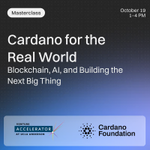
Yesterday, we kicked off our multi-year partnership with UCLA.
In the first Cardano masterclass at @UCLAAnderson, students designed and pitched Web3 businesses with AI-assisted smart contract development.
The next generation of builders starts with education like this.


How do you know that bottle of wine is from where it says it is? Right now, you don’t.
Counterfeiting costs European wine and spirits producers an estimated €2.8B a year.
With Cardano, you don’t have to trust the claims. You can check for yourself, on-chain.

How it works:
• Producer gets a certificate of origin, same as today.
• A digital fingerprint of it is written to Cardano. Nobody can alter it.
• Scan the bottle, compare fingerprint to paper. Match or no match, in seconds.
No new system. The origin just becomes provable.
For producers and certifiers, this runs alongside what you already use. We work with food and beverage companies on exactly this kind of verification.
Here's what it looks like in practice: cardanofoundation.org/soluti…

We are here to bridge Cardano and the world.
The Cardano Foundation works to scale the diversity, quality, and quantity of on-chain activities, with three core focus areas:
Adoption.
Technology.
Governance.
Learn more about the work that we do: cardanofoundation.org/about

Coding with AI on Cardano just got easier.
Cardano Academy’s latest course teaches the full loop: tell an AI agent what you want, audit what it writes, prove it works with a real transaction on preprod.
Build with agents. Ship on Cardano.
cardanofoundation.org/en/aca…

Cardano Foundation retweeted

Developer Office Hours, Friday 14:00 UTC.
Adam Cazes from A.D. Labs walks through Nexus: the data and transaction API behind @GeroWallet, from Yaci Store 3.0 in production to live on-chain events over WebSocket.
Register: addevent.com/event/s6nztc56c…

Introducing the Cardano Foundation Research Exchange.
A new series where the researchers behind Cardano Foundation research walk through their work and take your questions.
The first session is next Monday, 19 October. Add it to your calendar: addevent.com/event/32lwv110r…

Reeve writes financial records onto the Cardano blockchain as signed, permanent entries.
Once they’re on Cardano, nobody can edit them. Every record is tamper-proof and independently verifiable.
With Reeve, we aim to make finance transparent for all.
cardanofoundation.org/reeve

Reeve is fully open source.
We publish our own financial reports through it. The code that writes, reads, and verifies records on Cardano is on GitHub, built for others to integrate.
Explore the code, put your financials on-chain.
github.com/cardano-foundatio…

Cardano's design rests on peer-reviewed research.
Staking rewards, native tokens, the on-chain treasury, the Ouroboros consensus protocol itself: each started as an academic paper you can still read today.
A blockchain backed by science: reviewed, published, tested.


A large reserve doesn’t guarantee a secure network. New research shows why.
Manvir Schneider (CF) and Paolo Penna (@IOGroup) built a framework to determine how much reserve a PoS network needs to stay secure as token price and demand shift, presented at AFT 2026 last week.

Explore the research yourself: cardano.org/research

One night in Singapore. Over 90 investors in the room, up to $500K on the line.
From AI agents and DeFi to digital identity, nine startups building across Cardano, Bitcoin and the wider UTXO ecosystem made their case.
Co-presented with @DraperDragon alongside @TOKEN2049.
