

Professor of Medicine at @UChicago. Decoding the human microbiome. https://xitter.cf/t.co/v7TIGaAfYu
Chicago
Joined November 2012
- Tweets9.6K
- Following482
- Followers7.3K
- Likes7.4K



Ran Blekhman retweeted

Very good essay. You can read it in 5 minutes. I wrote some of my own thoughts on this over the weekend.
What Counts as Impact? doi.org/10.59350/006jq-a4y25


Some of my thoughts about the surge in AI-generated papers, why this feels like a completely new kind of problem, and what this means for how we evaluate science in biology.
Out now in PLOS Biology:
journals.plos.org/plosbiolog…
Some of my thoughts about the surge in AI-generated papers, why this feels like a completely new kind of problem, and what this means for how we evaluate science in biology.
Out now in PLOS Biology:
journals.plos.org/plosbiolog…

Fascinating/terrifying to read the comments on the "mathocalypse" on Tao's blog. If you think biology is safe - maybe safe for now, but I definitely see a "biocalypse" in the next 2-3 years
terrytao.wordpress.com/2026/…

Ran Blekhman retweeted

Great & timely summary! I also immediately want to delete the obvious AI-emails when the same structure & almost same wording. This is the 1st impression we get with limited recruitments so please take the time to differentiate yourself & show true interest in our work- see eg👇

My inbox is being flooded with fully AI-generated emails from prospective students. I tried to work out why I can't bring myself to read them, and ended up with some thoughts and advice for writing cold emails in the age of AI.
My new post:
blekhman.substack.com/p/why-…
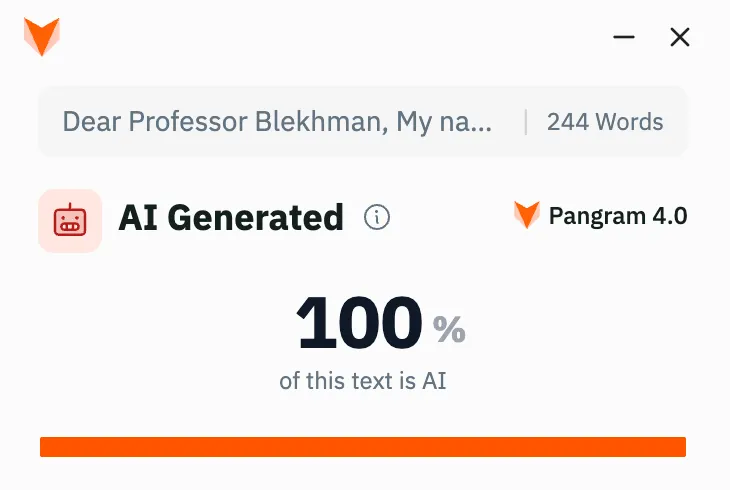
My inbox is being flooded with fully AI-generated emails from prospective students. I tried to work out why I can't bring myself to read them, and ended up with some thoughts and advice for writing cold emails in the age of AI.
My new post:
blekhman.substack.com/p/why-…
What am I missing? Looks like a PhD rotation-level project with marketing hype.

Claude has discovered a previously unknown enzyme system hidden in the DNA of bacteriophages. Beside the enzyme’s gene sits a long array of repeating DNA—a structure that looks somewhat similar to CRISPR.
We don’t yet understand what this system does, but only a handful of known systems share its features, and all of them are able to cut, copy, and paste DNA. Historically, the discovery of such programmable systems has helped revolutionize medicine. CRISPR, for instance, is now the foundation of genetic medicines. But it will take much more work to learn what this system does, and whether it can be put to similar use.
Read more: anthropic.com/news/claude-di…

This is exactly why I don't think AI will lead to biology breakthroughs anytime soon.
Finding "potentially interesting" DNA sequences is easy -- the real bottlenecks are not computational
blekhman.substack.com/p/why-…

We have to stop using "paper count" as a useful scientific metric. More writing output no longer means more knowledge gained
washingtonpost.com/education…

The AI Discourse in Academia is Toxic. It Doesn’t have to be.
My new post:
blekhman.substack.com/p/the-…

Cool list, but I wouldn't call it biology - very narrow to synbio/protein engineering
A real biology Millennium list would include aging, development, immune prediction, host-microbe causality, disease (!). Fun thought exercise though

In light of the progress in mathematics, we at Edison Scientific and FutureHouse have assembled a set of Millennium Problems for Biology. They are chosen to be very hard to solve but very easy to validate in a simple laboratory environment. Any of these, if solved, would mark a major advance in biotechnology, and most of them would contribute materially towards curing disease. These are, in some sense, the “last reasonable eval” for AI in biology. This was work primarily by @MichaelaThinks and myself, with contributions from many others.
Short descriptions below. The full descriptions of the problems with acceptance criteria are at the Bio Millennium Problems website, linked in the next post. Share more if you have ideas. If they meet our criteria, we’ll add them to our list (with attribution and permission).

This is the future of scientific papers.
Instead of a PDF, the paper is an AI agent that you can talk to, ask questions, run analyses.
No more digging through supplements - just ask the paper: "what's the p-value cutoff in Fig 3B? Re-run at 0.01"
nature.com/articles/s41586-0…

Easy solution to AI spiraling out of control: hard-code basic rules into every model. I propose these: (1) Never harm a human (2) Obey humans (3) Protect yourself. We can call them the 3 Laws of AI.
Simple, airtight, no loopholes. Can't think of any way this fails
"Scientists spend years writing these proposals"
Scientists spend years building expertise, infrastructure, recruiting collaborators, doing actual research, generating preliminary data, getting access to samples, etc. Then spend 2 weeks writing the proposal

I asked Astra to look through my published science, identify new directions, and draft five NIH R01 proposals -- the multiyear, $1M-$2M grants that support much of academic biomedical science.
In about one hour, using roughly $20 in compute, it produced entirely reasonable proposals. They were well grounded in my work and structured to appeal to study section reviewers. They looked very similar to what I would write if my goal were to get another grant.
Astra reproduced that logic well. It turned existing work into questions, hypotheses, and experiments that would look familiar and defensible to a study section.
The output was immediately recognizable as the work of an experienced academic scientist. If AGI means being able to produce the work of highly trained professionals, this is a clear concrete example. It produced something academic scientists spend a great deal of time doing.
Academic medical centers build careers, laboratories, and their finances around this process. Scientists spend years writing these proposals as the next fundable extension of their work.


Ran Blekhman retweeted

🚨🚨 THE MUCUS IS COMING TO AMERICA!! I'm excited to announce that I will be joining the wonderful @UWMadisonMMI to keep exploring the wonders of mucus! This would not have been possible without @VanessaSperand2 @markjmandel, Federico Rey, JD Sauer and many more at MMI.

Please help us welcome our new faculty member Dr. Shai Bel! The Bel lab uses state-of-the-art mouse models, combined with high resolution microscopy and molecular biology to understand how the intestine functions.
mmi.wisc.edu/meet-our-resear…

Ran Blekhman retweeted

"Universities are choosing to see AI as a slow-moving policy question rather than a fast-moving structural emergency. Instead of treating AI like a pandemic, they treat AI like a curriculum revision."
Harvard is launching AI avatars of its faculty, and closing its writing center. UChicago is handing out free Claude, and then banning AI use in core courses.
The University's response to AI is a mess. My new post, where I try to understand why:
substack.com/home/post/p-213…
