

@AudioShakeAI
Account based inUnited States
About this account
- Account based in
- United States
- Connected via
- United States Android App
Account-level information from X, not a live location or the device used for a specific post.
Making audio more usable for humans and machines.
San Francisco
Joined October 2019
- Tweets793
- Following312
- Followers1.3K
- Likes873







Pinned Tweet
Multi-Speaker 2.0 is live–the world’s first low and high-resolution multi-speaker separator. One recording of several people in. A clean labeled track per person out, including the moments when two people talk at once.
8 kHz to 48 kHz, one model. Confidence scores every 20ms.
Editing a film or ad and need "a song about starting over"? You can now search @audionetwork's catalog by lyrics, not just genre and mood 🎶 Built with @AudioShakeAI's lyric transcription + alignment API.
Case study: audioshake.ai/case-studies/u…

A finished mix used to mean dialogue, music and effects were fused for good.
At Mix Sound for Film, Suzanne Kirkland and Stephen Oliver shared what changes when they're not: archives that can be reused, sports libraries that work across streaming, and more localized content.


AudioShake retweeted

.@AudioShakeAI launches The Refinery, packaging speaker separation 🗣️ and confidence scoring into a #data-for-AI service aimed at 🤖 #AI labs, content owners, and data marketplaces.
slator.ch/AudioShakeAIDataAu…

Most voice AI demos run on clean audio. Real callers interrupt, talk over each other, + put you on speaker in the car. Thanks @RimeLabs, @LilyJClifford, @BrookeHopkins (@CovalDev), Josh Burnell (@Asurion) and @ShivIndap (@Upstart) for digging into that gap with us at #SFTechWeek


"Enormous amounts of that conversation already exist. The challenge is in turning it into usable training data." @themoko on @AudioShakeAI’s Refinery. audioshake.ai/products/refin…

Real conversation is messy and overlapping. Most training data isn't.
The Refinery splits real-world recordings into one track per speaker and scores each for quality.
Hundreds of millions of minutes processed with frontier labs.
audioshake.ai/products/refin…

Most audio in the world was never recorded on separate tracks.
@themoko breaks down source separation on @Dell's #ReshapingWorkflows with @LoganatDell, starting with how we pull vocals, instruments, or a single speaker out of a finished mix.
Most archive audio is stuck in a finished mix, which makes dubbing, clearing music and re-licensing hard. Suzanne Kirkland talked through how @AudioShakeAI's separation, @ortanamg, and @AWS Marketplace fit together to fix that, with Ortana and AWS at IBC.

Voice agents fail in predictable ways: overlapping speakers, background noise, crosstalk the model was never trained to hear.
On Wednesday, @themoko and @lilyjclifford (@RimeLabs) get into what teams learn when they build that stack themselves. RSVP: partiful.com/e/qRX76YKI93J2I…

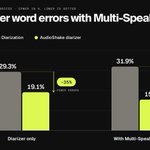
NVIDIA's Nemotron 3 diarizer hit #1 on Voice Arena. We ran it against ours on LibriCSS (8-speaker recordings).
Diarizer vs. diarizer, no overlap: 35% fewer word errors.
With Multi-Speaker isolating each voice, all recordings: 52% fewer word errors than Nemotron 3.

Upload a file → get a cue sheet back.
@AudioShakeAI's music ID is now in @MusicReportsInc' Cuetrak®.
We separate the music out of the mix first, then identify each cue — so buried and unlabeled tracks still get caught.
audioshake.ai/press-releases…

A therapy podcast with 70+ episodes was about to lose its whole archive in a station move — licensed bumper music, baked into the mix, no session files.
AudioShake's Music Removal stripped the cues out of every episode, leaving the speech untouched.
audioshake.ai/case-studies/f…

Voice agents: great in the demo, harder on a real call.
Join @AudioShakeAI + @RimeKLabs at #SFTechWeek for Voice AI in the Real World, a panel on training data, failure modes, and what teams built vs bought.
Oct 7 · 575 Market St
partiful.com/e/qRX76YKI93J2I…

"You have to hit between 10 and 15 milliseconds."
@themoko and @LoganatDell on why Dialogue RT–speech isolation for broadcasters runs on a Dell Pro Max with GB10 — and what a workstation unlocks that the cloud doesn't.
Dialogue RT isolates dialogue from a live feed in 11 ms end to end — measured model input to isolated output.
That's not noise suppression. It's two stems: dialogue, and everything else.
On NVIDIA DGX Spark and Blackwell architecture GPUs. audioshake.ai/post/isolating…

Real conversation isn't tidy. People interrupt, agree over each other, laugh through the answer.
This is the part every other tool gives up on. Multi-Speaker 2.0 keeps both voices as separate tracks, tells you how confident it is, and runs on anything from 8 to 48 kHz.
Four days at IBC, hundreds of conversations. The question we heard most:
“Can it run on the feed, not the file?”
Answer: yes. Live, less than 11 milliseconds. Another great year in the books.


Most audio in the world was never recorded on separate tracks.
Jessica Powell breaks down source separation on Dell's #ReshapingWorkflows — how we pull vocals, instruments, or a single speaker out of a finished mix.
Full episode: podcasts.apple.com/us/podcas…
At IBC last week we demoed Dialogue RT: hand someone a mic in a chaotic room and they hear themselves come back clean, in real time.
It separates dialogue from crowd, music and room noise off a live feed in ~11ms. Not a noise gate — a separation model.
Reactions from NAB 👇
Cue sheets decide whether music royalties reach the songwriters and publishers who earned them. Incomplete data sends that money into the PRO "black box." AudioShake's music identification is now built into @MusicReportsInc' Cuetrak®.
In finished content, music is buried. @AudioShakeAI separates it out , then identifies each cue from the clean signal — even noisy, archival, or unlabeled tracks. Cuetrak turns that into a cue sheet. Read in @digitalmusicnws: digitalmusicnews.com/2026/09…
