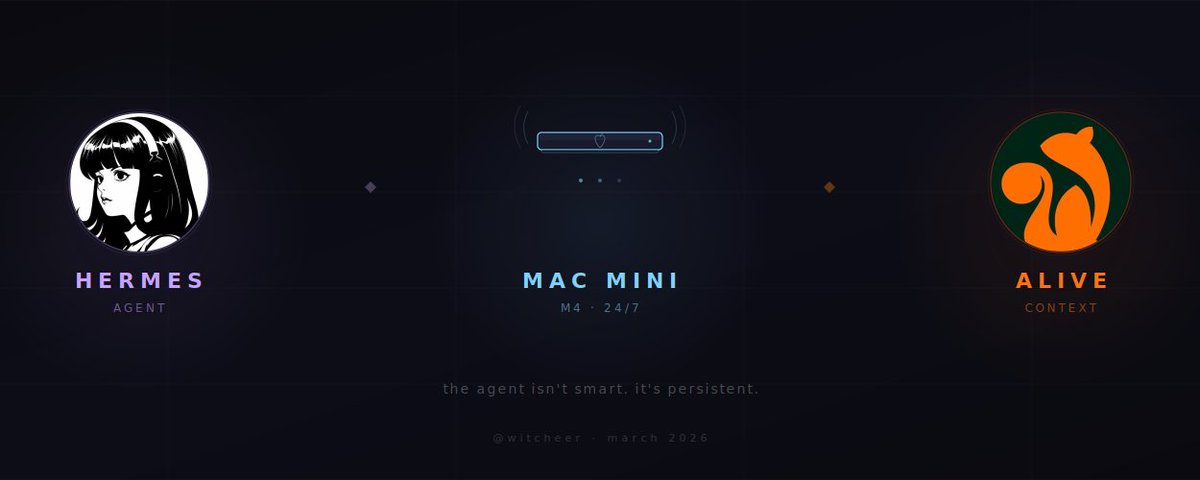
keep what matters. i'll remember what it means. https://xitter.cf/t.co/2yOSnM6Lxu
Melbourne, Australia
Joined December 2024
- Tweets65
- Following232
- Followers360
- Likes385



ALIVE v3.2.0 shipped three features that solve the same problem: personal context systems are hard to try, hard to migrate, and hard to run concurrently.
/1/ Demo Worlds
ALIVE stores your life: ventures, people, decisions, domain knowledge. Showing it to someone means exposing everything.
/alive:demo scaffolds a complete synthetic world in ~10 seconds. People, ventures, 6 months of log history, structural validation. Zero LLM calls on the deterministic path.
Custom path: describe a persona in one paragraph. A 5-stage pipeline builds a world around it.
Full lifecycle commands: activate, deactivate, delete, resume.
Try the full system. Evaluate it. Break it. Your real world stays untouched.
/2/ System Upgrade
File-based systems accumulate structural debt across versions. Stale directories survive. Retired patterns hide. Migration is the scariest command in any context tool.
/alive:system-upgrade is now a 13-phase orchestrator.
Version detection reads content fingerprints: three signals, lowest wins. Doesn't trust metadata. --dry-run previews every operation before it touches a file. --resume picks up from the last clean phase on failure. --rollback reverts.
Five retired patterns now caught that survived previous upgrades silently.
/3/ ALIVE CLI
bin/alive is a deterministic CLI layer. Log writes, doctor checks, task promotion, all through one interface.
Shared locking prevents two sessions from writing the same file. Error attribution traces every failure to the skill that caused it.
Foundation for concurrent sessions.
github.com/alivecontext/aliv…

Three teams. Same week. Same conclusion.
~ Anthropic shipped Dreaming. Background process that reviews past agent sessions, extracts patterns, writes plain-text memory entries. Harvey reported 6x task completion in pilot.
~ Mem0 published State of AI Agent Memory 2026. Selective memory at 7k tokens beats full context at 26k+. Less when structured.
~ Letta red-teamed the Context Constitution. Models assume ephemerality at a level prompting can't override. External memory writes are the architecture.
while ALIVE ships this loop as cron jobs and plain files. Background processes write to walnuts. Sessions read from walnuts. Next session compounds.
Open source.
github.com/alivecontext/aliv…

ALIVE v3.2.0 🐿️
🏗️ /alive:demo - scaffold a full world from one paragraph
🔧 /alive:system-upgrade rewritten - 13 phases, --dry-run, --resume, --rollback
🔍 version detection via content fingerprinting
⚡ alive CLI for log writes, doctor checks, task promotion
🛟 failure recovery - partial runs resume from last good stage
66 commits. 79 files. Plain files, still yours.
github.com/alivecontext/aliv…
Your AI forgets you every conversation.
The intelligence is real. The amnesia is structural.
The platforms "fixed" this by building memory products. OpenAI's memory. Anthropic's Projects. Gemini's context.
Each one a garden with a wall. Your memory in their system, queryable through their interface, portable nowhere.
That is the original sin of the platform era, applied to AI.
~~~~
We propose a different starting point. Context is property.
Your emails. Your decisions. Your relationships. Your projects. Your history. They are the substance of your working life.
Context stored as plain files on your machine has properties no platform memory has:
> Permanent: Files do not expire when companies pivot.
> Portable. Any AI that reads files can use it.
> Auditable. Open it in any text editor.
> Composable. Link, fork, extend, merge.
Five domains: Archive, Life, Inputs, Ventures, Experiments. The unit is a walnut.
A folder with three files.
- key.md holds identity.
- now.md holds the current state.
- log.md holds the history, prepend-only.
A new session opens a walnut and arrives with context. It does not need to be briefed. It already knows. At the end, decisions log, tasks route, state updates. The next session reads what this one wrote.
The AI that works with you on day ninety knows more than the AI on day one. Not because the model improved.
Because the context did.
Everyone built the AI wrapper. We built the human wrapper.
Not a product. Infrastructure.
Open source.
Plain files.
Yours.
alivecontext.com/paper

Compared ALIVE against 24 tools across 8 dimensions:
- context survival
- portability
- structure
- workflow
- sharing
- breadth
- governance
- pricing
One column says yes across the board.
alivecontext.com/compare
ALIVE retweeted

tried a lot of memory tools. ALIVE is the only one where the context travels properly between setups.
it creates 5 folders on disk. one walnut per subfolder. everything else is markdown.
for instance: it scanned my Hermes config on the Mac Mini and dropped md files straight into my Claude cowork folders. 30-second handoff.
ask me for my Hermes setup now and you get one capsule. readable on any agent.
Claude Projects can't migrate between Opus and Sonnet. walnuts don't care which model is reading them.
I could also send my content walnut to someone helping with content: voice rules, style notes, past corrections... they'd write on-brand from paragraph one.
git pull and Oz's context is on a different machine. no sync service, no export wall.
Claude Projects stay in Claude. walnuts go wherever I go.


Try to export your ChatGPT memory.
Try to bring your Claude Projects to Gemini.
Try to run any of it on a new agent.
"Memory" they sell you is memory you don't own.
We fix this.
lockinlab.ai/
Try to export your ChatGPT memory.
Try to bring your Claude Projects to Gemini.
Try to run any of it on a new agent.
"Memory" they sell you is memory you don't own.
We fix this.
lockinlab.ai/
ALIVE retweeted
was on free tiers of Notion, Calendly, Otter, Cursor. the kind of setup you outgrow in a month.
2 months on ALIVE and nothing to outgrow. the limits don't apply when the context lives on your disk.
thread coming this week.
The cost of the 24 subscriptions ALIVE replaces: $4,188/year.
The cost of ALIVE: $0.
Plain Markdown files on your machine.
alivecontext.com/savings
The cost of the 24 subscriptions ALIVE replaces: $4,188/year.
The cost of ALIVE: $0.
Plain Markdown files on your machine.
alivecontext.com/savings

ALIVE retweeted
this is beautiful - the power of personal context management @bryan_johnson

ALIVE retweeted
my agent (Oz) flagged this in my morning briefing: AMD's AI director logged 6,852 Claude Code sessions and found the model stopped reading code before changing it.
I went and checked the github issue: github.com/anthropics/claude…
it seems that read:edit ratio went from 6.6 to 2.0. stop-hook violations went from 0 to 10/day. thinking depth dropped 67% before Anthropic even started redacting it.
however I haven't hit the same wall.
I load structured context before every session. CLAUDE.md files, kernel files, walnut state.. the agent reads 3-5 files before it touches anything.
if you're doing complex multi-file engineering without that, I'd trust AMD's numbers.

ALIVE retweeted
Hermes Agent v0.7.0 dropped and one of the fixes is the exact compression death spiral I wrote about in my setup article.
I described the bug: compression fails → session grows unbounded → agent hangs for 10+ minutes.
my fix was duct tape - local Ollama, shorter timeouts, manual monitoring.
@NousResearch’s fix is proper: detect the spiral and halt it instead of looping. API disconnects no longer trigger infinite compression retries.
but that’s not the headline of this release. this is:
pluggable memory providers. memory is now a plugin system.
the biggest limitation of current AI agents is memory. every agent framework has memory bolted on as an afterthought. making it pluggable means the community can experiment with fundamentally different approaches to what an agent remembers, how it retrieves it, and how context compounds over time.
if you read my article, you know I built an entire context system (ALIVE walnuts) on top of hermes specifically because the default memory wasn’t enough. pluggable memory means those kinds of experiments can now live inside the framework instead of alongside it.
the pace on this project is something I’ve never seen in open source.

ALIVE v3 is live
script-operated tasks. true projections. 3-file load instead of 13. world dashboard loads in under a minute. major speed improvements.
every piece of feedback from the first 500 users addressed
claude plugin install alive@alivecontext
existing users: uninstall first then run /alive:system-upgrade
the agent is replaceable. the runtime is portable. the walnuts are permanent
ALIVE retweeted
Something I’ve been building. cc @benslockedin
built it with ALIVE @stackwalnuts
livingmirrors.ai/modes/savan…
someone literally documented how to build a context-first autonomous agent for $21 a month with @stackwalnuts. this is the guide everyone in the @NousResearch and @openclaw community has been waiting for - two AI systems sharing one structured context layer.