

At the Centre for Ageing Better we are pioneering ways to make ageing better a reality for everyone. Supported by @TNLComFund.
- Tweets17K
- Following1.8K
- Followers30.7K
- Likes8.8K




ALT Ten ways we've made ageing better Impact report

ALT Many people do not see themselves as carers, but rather as helping someone they love. Recognising that caring role is often the first step towards understanding your rights and accessing support.


ALT Society Although internet use has increased among older people, many are still excluded from digital services. The proportion of people aged 65 and over who don’t use the internet at home dropped from 29% to 27% between 2023 and 2024. 3.5 million people aged 65 and over don’t use the internet at home. For source see chart 7.13 here: ageing-better.org.uk/society-state-ageing-2025

ALT Our ageing population People aged 50 to 64 who live in the regions with the worst health and highest poverty levels are most likely to provide unpaid care for others. 17% The North East region has the highest percentage of people aged 50 to 64 who provide unpaid care. For source see chart 2.07 here: ageing-better.org.uk/our-ageing-population-state-ageing-2025

ALT Homes People from Black, Asian and Minority Ethnic backgrounds are less likely than White people to be satisfied with their homes. White: 2% Asian: 8% Black: 15% Owner-occupied sector only For source see chart 4.07 here: ageing-better.org.uk/homes-state-ageing-2025

ALT Health Bangladeshi and Pakistani people experience poor health younger than those from other ethnic groups. Age at which 10% of people are in bad or very bad health 65 – White British 53 – Pakistani 51 – Bangladeshi Source: Census 2021. Available at: https://www.ons.gov.uk/datasets/create/filter-outputs/454838fa-81fb-4e19-b020-32755d070c39#get-data

ALT Government response to the healthy ageing Inquiry: Welcome steps: prevention recognised as central to good health, role of good homes, work and connected communities recognised, and ambition to halve regional healthy life‑expectancy gaps. To go further: clear leadership, a cross‑government ageing strategy, and a Commissioner for Older People and Ageing in England

ALT What did our evaluation of the Age-friendly Employer Pledge find the wider impact of the Pledge to be for our employers?

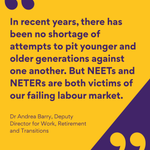
ALT In recent years, there has been no shortage of attempts to pit younger and older generations against one another. But NEETs and NETERs are both victims of our failing labour market.

ALT pledge connections event

ALT pledge connections event

ALT pledge connections event

ALT Did you know 1 in 3 women (aged 40 to 65) have considered leaving work due to menopause symptoms?

ALT IDOP logo

ALT 2.9 million people aged 50 to state pension age are NETERs

ALT Quote says: The question should not be which generation deserves support. It should be how we build a system that protects people from poverty now while giving future generations confidence that they too will have a decent standard of living in retirement. Dr Andrea Barry


ALT 2.9 million people aged 50 to state pension age are not working. they're not retired either. introducing NETER.

ALT NETR is a new labour market measure developed by the Centre for Ageing Better

ALT 1 in 5 older working-age people are NETER. Yet this group is absent from policy debates about work, retirement, economic inactivity. What we measure shapes what we prioritise.

ALT Many in the NETER group want to work. 925,000 people are interested in or actively seeking work.

ALT Who is in this group? More than half are out of work because of ill-health or disability.

ALT Caring responsibilities are the second biggest barrier to being in work.

ALT We are calling on the government to: measure NETER. Make it a national indicator. Build a strategy. Join up employment, health, skills, care and pensions policy. Target support. Use NETER data to identify gaps and inequalities.

ALT For millions of people, the journey from work to retirement isn't straightforward. NETER helps tell their story.