

An Africa where evidence is used consistently to transform lives | L'Afrique où les preuves sont systématiquement utilisées pour transformer les vies
Africa
Joined July 2012
- Tweets10.8K
- Following5.4K
- Followers9.4K
- Likes3.5K

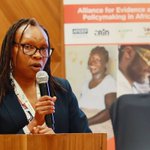


Climate finances should trickle down to everyone to realise the impact. This was one of the issues highlighted from the #PolicyDialogue session at the 3rd Annual Nairobi Health Scientific Conference, led by @Afidep.
The conversation focused on Financing Climate-Resilient Health Systems in Kenya. Challenges securing available financing by health sector actors was identified as one of the main reasons affecting policy implementation.
Patricia Mbogo, the ED, @ACCESSCSOs noted that “Climate finance exists but getting it to the people who need it is the real challenge. Financing must reach underserved populations. Investments should address the needs of marginalised and hard-to-reach communities, rather than concentrating only on large infrastructure projects.“
Ms. Sophie Matu, a Senior Research Scientist at the @KEMRI_Kenya & Chairperson of the Health, Environment and Climate Change Conference shared KEMRI’s perspective and how @Afidep's role in the conceptualisation of the flagship Kenya Climate Change and Health Strategy (KCCHS) 2024-2029 has been a game changer despite the several implementation gaps that still exist.
She urged stakeholders to join together to unlock financing including the Green Climate Fund.
She also highlighted the introduction of Health at the just concluded @turkiyecop31 as a step in the direction towards addressing this gap.


Key action areas emerging from the dialogue include:
↘️ Intergrating health into climate and renewable energy financing mechanisms
↘️ Strengthening multisectoral collaboration and coordination
↘️ Strengthening institutional capacity to secure the Green Climate Fund and other climate financing mechanisms.


The #PolicyDialogue session provided insights and follow up actions to bridge the gaps between policy commitments and actual implementation, driven by inadequate financing.
⤵️ Read the Kenya Climate Change and Health Strategy here: shorturl.at/5YbwG

Climate change is a major threat to human health, both directly and indirectly, making sustainable funding crucial for building health systems that can withstand its impacts. Yet according to the Public Health Operations for Climate Change Action (#PHONIC) governance framework, climate-health action remains underfunded and often project-dependent rather than institutionally resourced.
@Afidep's Research and Policy Analyst @Ibukayo is leading a #PolicyDialogue on Financing Climate-Resilient Health Systems in Kenya at the
3rd @nbohsc.
📍 Other speakers include:
↘️ Dr Joanes Atela, Executive Director, @arin_africa
↘️ Ms. Sophie Matu, Senior Research Scientist,
KEMRI & Chair, Health, Environment and Climate Change Conference
↘️ Dr Naomi Mutie, Head of Environmental Health and Sanitation, State Department of Public Health,
@MOH_Kenya.
↘️ Mr. Odhengo Peter, Senior Policy Advisor on Climate Finance, National Treasury and Planning
↘️ Ms. Patricia Mbogo, Executive Director,
@ACCESSCSOs.
📍 The session will share the #PHONIC assessment’s findings and recommendations, explore practical ways to mobilise climate finance for health, and commit to accountable next steps.
📍 #PolicyDialogues like this showcase #AFIDEP’s role as a trusted convener that turns evidence into policy action, ensuring climate finance decisions are evidence-informed and protect the health of the most vulnerable.
#AfricaLEEPS (Learning together to advance Evidence and Equity in Policymaking to achieve the #SDGs in Africa) supports African governments and regional bodies to institutionalise evidence use in policy, planning, advocacy, and accountability.
Learn more: shorturl.at/fPPXP
#NBOHSC2026 #EIDM #ClimateHealthFinancing

Success in #EIDM capacity development shouldn't be measured by the number of people trained, but by how the skills gained are applied to influence research, policy & practice.
At the @Afidep led panel discussion today at the 3rd @nbohsc drawing on experiences from LEEPS Phase I and reflections on Phase II, speakers @Ibukayo, Belinda Korir, Jim Oduor, Lilian Mayieka, and Dr Akinyi Eurallyah shared perspectives on strengthening capacity in #EIDM through training, mentorship and grant support.
The session highlighted several key takeaways:
📷 Training alone is not enough; sustained mentorship is essential in helping researchers strengthen their skills, improve their work and produce quality research and policy outputs.
📷 Mini-grants provide researchers with opportunities to advance their research ideas, strengthen their research and knowledge translation capacity and nurture champions and future leaders in #EIDM.
📷 Institutional commitment and additional resources are necessary to ensure that trained and mentored early career researchers and practitioners put into practice the knowledge and skills gained and drive efforts to embed #EIDM in institutional and public policy processes.
📷 Strengthening the link between research and policy is critical. Evidence generated must be translated into accessible and relevant information that policy actors can use to inform decisions.
📷 Knowledge management plays an important role in making research findings accessible, relevant and useful for decision-making.
📷 Lessons from programme implementation, including feedback from fellows and mini-grant awardees, are valuable in informing subsequent phases and strengthening capacity development approaches.
For @Afidep, the session reinforced the importance of investing in capacity development approaches that go beyond training to support the application of research and knowledge translation skills and strengthen the connection between evidence, policy and practice.
Learn more about the #LEEPS Project here: shorturl.at/fPPXP


Evidence-informed decision-making (#EIDM) is crucial to solving societal problems because it grounds decisions in data, research, and practical and lived experience rather than guesswork or bias.
@Afidep's Research & Policy Analyst @Ibukayo & Research and Policy Associate’s Belinda Korir are part of a panel discussion on Training, mentorship and grant schemes: pathways to institutionalising #EIDM at the 3rd Nairobi Health Scientific Conference.
The discussion will draw from the Africa LEEPS, AEEPA Hub #EIDM capacity development with @arin_africa Fellows (training, mentorship & mini grants). Whether and how the interventions have led to changes in individual processional practices, organisational structures and processes and ultimately public policy impact and drivers will be interrogated.
📍Other panelists include:
➡️ Jim Oduor - Research and Evaluation Consultant at Instream Consulting Group; PhD Candidate, Climate Change and Adaptation, University of Nairobi, Institute of Climate Change and Adaptation.
➡️ Dr Akinyi J. Eurallyah - Research Associate & Programme Manager - Africa Science-Policy Fellowship, ARIN.
➡️ Lilian Mayieka - Ag. Deputy Director, Resource Development & Knowledge Management, Senior Research Scientist, Knowledge Translation, #EIDM & Research Uptake - Kenya Medical Research Institute (KEMRI)
Africa LEEPS (Learning together to advance Evidence and Equity in Policymaking to achieve the #SDGs in Africa) is a partnership that supports African governments and regional bodies in strengthening and institutionalising the use of evidence in policy, planning, advocacy, and accountability processes.
Learn more about LEEPs work here: shorturl.at/fPPXP
#NBOHSC2026 #AFIDEP #ClimateFinance

Over the next three days, @Afidep will be taking part in the 3rd Nairobi City Council Annual Scientific Conference @nbohsc .
The event organised by the Nairobi City County seeks to examine critical issues at the intersection of health systems strengthening climate resilience, pandemic preparedness, universal health coverage, and digital innovation.
Event details
🗓️ November 18-20, 2026
🪧 Emara Ole Sereni – Nairobi
Are you at the Conference? Look out for our sessions.
For #AFIDEP this event offers an opportunity to advance critical discussions on how data can be used to foster measurable and scalable solutions that promote equitable access to quality healthcare.
For more information, click the link below: shorturl.at/FG6W7
#NBOHSC2026
#EIDM
#LEEPs
#PolicyDialogue
@EliyaZulu @roseoronje @Ibukayo @EdelSakwa @arin_africa

Transparency and accountability are about whether citizens can see how their governments work and hold those in power answerable for their actions. In practice, this means people can access public information, senior officials and public servants declare their assets, face consequences for misconduct, and the judiciary and oversight bodies like national anti-corruption authorities and supreme audit institutions can work independently and effectively.
Africa’s average score for transparency and accountability in Round 13 of the Africa Integrity Indicators stands at 29.8 out of 100, a marginal improvement from 28.2 in 2014.
More than a decade later, the continental average remains far below the moderate benchmark of 50.
Only 6 of 55 African countries have reached this benchmark; they include:
1. South Africa
2. Seychelles
3. Mauritius
4. Morocco
5. Namibia
6. Senegal
This suggests that across most of the institutions meant to promote integrity are not yet working as they should.
#AFIDEP works to ensure that transparent and accountable institutions are the foundation for evidence-informed decision-making. When governments are open and answerable to citizens, evidence is more likely to shape policies that improve people’s lives.
Explore the latest Africa Integrity Indicators findings about the state of governance across Africa here: bit.ly/48nYaSm

WE ARE HIRING | Research and Policy Associate
#AFIDEP is seeking a Research and Policy Associate, based in Lilongwe, Malawi, or Nairobi, Kenya.
The successful candidate will support research, policy engagement, evidence synthesis, and capacity development to advance evidence-informed decision-making in Africa.
Requirements:
✓A relevant Master’s degree
✓At least 3 years of research experience
✓Strong skills in policy analysis, scientific writing, project management, and evidence synthesis.
How to apply:
Submit your motivation letter and detailed CV, including three referees, to Recruitment@afidep.org. Use the subject line: Research and Policy Associate – LEEPS.
Visit bit.ly/4zUg23k for the full job description and application details.
Deadline: 30 November 2026

The African Union Development Agency–NEPAD (AUDA-NEPAD), in collaboration with the Science for Africa Foundation, invites stakeholders across Africa and beyond to contribute to the Vision for Open Research in Africa: Towards a Sustainable and Equitable Open Knowledge Ecosystem.
The Vision aims for an African-led, globally influential open research ecosystem by 2034, where knowledge is openly created, discoverable, accessible, shareable and reusable to drive equitable development.
Researchers, policymakers, universities, research institutions, science granting councils, the private sector and development partners are invited to share evidence-informed recommendations on the priorities, opportunities and requirements for achieving this ambition.
Your voice matters in shaping Africa’s open research future.
📍 Review the draft Vision and submit your contributions through the stakeholder consultation form by November 30, 2026.
🪧 Submit your input: forms.cloud.microsoft/r/AmkW…
The contributions will inform the final Vision and preparations for its proposed launch during STI Week 2027, on the margins of the @_AfricanUnion Summit in Addis Ababa, Ethiopia.
#AFIDEP works alongside AUDA-NEPAD to strengthen the generation and use of African evidence in policymaking, a partnership that matters because an open, African-led research ecosystem is essential for ensuring that development decisions across the continent are informed by evidence produced in and for Africa.

Stronger institutions are essential for accountable governance and democratic development in Africa.
On 28 October 2026, stakeholders from across the governance landscape convened in Nairobi, Kenya, for AFIDEP's High-Level Policy Dialogue on Public Institutions and Oversight in Africa. The dialogue brought together diverse perspectives on institutional performance, accountability, and the role of oversight mechanisms in strengthening democratic governance. It also marked the launch of the findings from Africa Integrity Indicators (AII) Round 13 and the Integrity Narratives 2026 Report.
Here are some highlights from the conversation:
1. Africa needs institutions that effectively implement their mandates and deliver for citizens
2. Weak accountability and poor service delivery are eroding public trust in democracy
3. Oversight institutions need independence, adequate resources and protection from political interference
4. Transparency in political financing is essential for credible democratic processes
5. Young people, women and persons with disabilities must meaningfully influence governance decisions
Watch highlights from this important engagement and explore the evidence shaping conversations on governance and accountability across Africa.
Read the report here: bit.ly/4zadflj
A Heartfelt Thank You!
African Institute for Development Policy (AFIDEP) sincerely appreciates everyone who participated in the High-Level Dialogue on Public Institutions and Oversight in Africa and the launch of the Integrity Narratives 2026 Report in Nairobi.
Your contributions, insights, and engagement enriched the discussions on strengthening public institutions, enhancing accountability, and advancing democratic governance across Africa.
As we reflect on the dialogue, we invite you to continue the conversation and explore the evidence, insights, and stories shaping Africa’s governance landscape.
Explore the Integrity Narratives 2026 Report here: bit.ly/4zadflj
Discover the revamped Africa Integrity Indicators website: bit.ly/4zuNrBj
The journey toward accountable, transparent, and resilient public institutions requires sustained collaboration, evidence, and collective action.
Thank you for being part of the conversation and the change!

"Mozambique is rich in minerals, but its greatest resource is its people.”
At the Conference on Population and Development in Maputo, opened by His Excellency Daniel Francisco Chapo, President of the #Mozambique, African Institute for Development Policy (AFIDEP)’s Dr. Rose N. Oronje delivered the inaugural keynote.
Every year about 500,000 young Mozambicans enter the labour market, while the formal economy creates about 25,000 jobs.
📍 Her message: accelerating fertility decline through voluntary family planning, and investing in education, skills and productive jobs, will decide the size of #Mozambique’s demographic dividend.
Read more: lnkd.in/dsEzhfRt
#DemographicDividend #Mozambique #PopulationAndDevelopment #YouthEmployment #HumanCapitalDevelopment #FamilyPlanning #SustainableDevelopment #AFIDEP

Did you know? Approximately 80% of Malawi's population is below the age of 35.
This presents Malawi with a significant opportunity to harness its youthful population as a driver of productivity, innovation and economic growth. However, this potential will not be realised automatically.
It requires deliberate investments in:
📚 quality education,
🏥 healthcare,
🧑🧑🧒🧒 family planning
🍳 development and
👨🏾💻 decent job opportunities.
By equipping young people with the health, knowledge and skills they need to participate productively in the economy, Malawi can turn its youthful population into a powerful engine for economic transformation. Without these investments, this potential risks remaining untapped.
Read the study: afidep.org/publication/harne…
#DidYouKnow #DemographicDividend #PopulationAndDevelopment #AFIDEP

5
251
Mozambique’s changing population presents an important opportunity for economic transformation. But turning this opportunity into a demographic dividend will require deliberate policy choices and sustained investment in people.
AFIDEP is participating at the Conference on Population and Development.
Date: November 4-5, 2026
Venue: Mozambique-China Cultural Centre in Maputo
Theme: Population, Economic Transformation and Well-being: Policies to Harness the Demographic Dividend in Mozambique.
Organised by Mozambique’s Ministry of Planning and Development, the conference brings together stakeholders to explore how population policies and investments can drive economic transformation and improve people’s well-being.
AFIDEP’s Deputy Executive Director and Head of Programmes, Dr Rose N. Oronje, will deliver a keynote presentation titled “How can Mozambique harness its demographic transition for accelerated development for its people?” Her presentation will explore the policy choices and investments needed to harness the demographic dividend, with a focus on fertility decline, human capital development and productive employment.
Read more: afidep.org/event/afidep-at-c…
#PopulationAndDevelopment #DemographicDividend #EvidenceInformedPolicy #AFIDEP

Population dynamics shape nearly every development challenge Africa faces, making them a cross-cutting factor in achieving most of the Sustainable Development Goals, and nowhere is this clearer than in the task of creating decent jobs for the continent’s fast-growing, youthful workforce.
AFIDEP’s Executive Director, Dr Eliya Msiyaphazi Zulu, will deliver a kick-off presentation for the panel on Jobs and the Demographic Dividend at the Demographic Futures Dialogue in Abidjan, Côte d’Ivoire, on 4 November 2026.
The session will explore how African countries can harness demographic change to drive productive employment, with a focus on human capital development, job creation and the conditions needed to realise the demographic dividend.
Co-hosted by UNFPA, the African Union Commission and the Government of Côte d’Ivoire, the Dialogue brings together policymakers, researchers, development partners and other stakeholders to explore how demographic change can be turned into opportunities for prosperity, resilience and inclusion through informed policies, planning and investment.
Dr Zulu’s presentation draws on AFIDEP’s long-standing work in this field. By strengthening the use of evidence in policymaking and planning, AFIDEP supports African countries to harness the demographic dividend through strategic investments in human capital, job creation and inclusive economic development, work that has helped spark unprecedented interest in tackling population and development issues across the continent.
Learn more on our #DemographicDividend work: bit.ly/3Us2z3i
#PopulationDynamics #DemographicDividend #SDGs

Prioritising reforms for Malawi’s economic recovery and transformation requires more than policies. It requires a change in mindset, action and accountability.
Speaking at the Economics Association of Malawi (ECAMA) Annual Economic Conference 2026 in Mangochi, AFIDEP Executive Director, Dr Eliya Msiyaphazi Zulu, highlighted the importance of addressing behaviours and practices that continue to undermine the country’s progress.
“It’s the mindset shift. Continuing to engage in behaviours that we know are undermining the country’s progress, because we feel we cannot be held to account.”
Dr Zulu emphasised that Malawi’s challenge is not a lack of policies or ideas, but the need to prioritise reforms, strengthen implementation and sustain progress. He highlighted the importance of stabilising the economy, improving economic management and investing in agriculture, mining, businesses and human capital to support long-term transformation.
“These efforts must align with Malawi 2063, create opportunities for young people, deliver practical results, remain fiscally affordable and strengthen the country’s ability to earn and save foreign exchange.”
With approximately 270,000 young people entering the labour market annually, while the economy creates around 40,000 formal jobs, effective reforms are essential to expanding employment opportunities, improving livelihoods and building a more productive economy.
Achieving this requires sustained commitment, effective coordination, public accountability and consistent monitoring to ensure that reform priorities translate into tangible results for Malawians.
Malawi’s economic transformation depends on turning policy commitments into action, strengthening institutions and sustaining reforms that deliver lasting improvements in people’s lives.
#ECAMA2026 #EconomicTransformation #Malawi #AFIDEP #EconomicReforms #Accountability #Malawi2063


