

Independent analysis of AI
San Francisco
Joined January 2024
- Tweets4.1K
- Following692
- Followers177K
- Likes2.8K


Pinned Tweet
Thanks for the support @AndrewYNg! Completely agree, faster token generation will become increasingly important as a greater proportion of output tokens are consumed by models, such as in multi-step agentic workflows, rather than being read by people.

Shoutout to the team that built artificialanalysis.ai/ . Really neat site that benchmarks the speed of different LLM API providers to help developers pick which models to use. This nicely complements the LMSYS Chatbot Arena, Hugging Face open LLM leaderboards and Stanford's HELM that focus more on the quality of the outputs.
I hope benchmarks like this encourage more providers to work on fast token generation, which is critical for agentic workflows!

Claude Fable 5.2 leads scientific visual reasoning benchmark VIALS-AA; it makes more tool calls than any other Anthropic model, unlike OpenAI models which make fewer as they get smarter
VIALS-AA is our implementation of @joinHandshakeAI’s VIALS benchmark for visual reasoning in life sciences research, across artifacts such as gel blots, plasmid maps, and phylogenies. Claude Fable 5.2 (max with fallback) scores 67% on VIALS-AA, ahead of Gemini 4 Carbon (high) at 64% and GPT-6 Astra (max) at 63%. Fable averages ~37 tool calls per task, while Astra averages ~8, the fewest of any model we’ve tested.
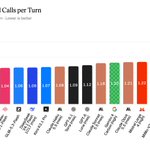
On turn 4 of this protein interaction task, Fable creates crops and asks to view them. On turn 10, it builds a color mask by thresholding color channels. On turn 17, it fits a circle to each arc and unrolls the arc into a straight strip. On turn 31, it counts the bars as peaks in an intensity profile. And on turn 41, it maps every detected spoke back on the original image to check its work. Fable batches calls on 28 of its 51 turns, averaging 1.75 tool calls per turn, compared with 1.12 for Sonnet 5.5.
Across all of VIALS-AA, Fable averages 1.60 tool calls per turn, the highest of any model on the leaderboard.

1
7
3,022
Read the launch article and explore model trajectories: artificialanalysis.ai/articl…
Explore the updated VIALS-AA results, including Scores, Cost per Task and Tool Use: artificialanalysis.ai/evalua…

3
2,670
Claude Fable 5.2 is now #1 on AA-3D, our benchmark for how well AI models build interactive 3D experiences
Claude Fable 5.2 (Max) scores 1271 Elo, 67 points ahead of Claude Sonnet 5.5 (1204) and Claude Opus 5.5 (1202). Its 95% confidence interval (1246 to 1297) does not overlap any other models, so its lead is outside the margin of error.
Key results:
➤ It scores 132 points above its predecessor, Claude Fable 5.1 (1139)
➤ It is ahead of the highest-ranked OpenAI and Google models on AA-3D, GPT-6 Astra (1168) and Gemini 4 Argon (1147)
More results and scenes in the thread below
How AA-3D works: build, check, vote, rank
Each model works as an agent in an offline sandbox and turns a written brief into a three.js web page, with up to three hours and 250 turns. The sandbox has Blender, Rapier physics, Python, a headless browser to test its own work, and a broad library of materials, 3D models and characters.
Human panelists compare blind pairs of scenes built from the same brief and spend at least 30 seconds with each scene before they vote. Votes are then converted into Elo, with 95% confidence intervals.
Explore every Claude Fable 5.2 scene in the AA-3D Explorer
AA-3D Explorer: artificialanalysis.ai/3d/exp…
Leaderboard and full results: artificialanalysis.ai/evalua…

5
3,398
Beyond the slop: how good have image and video models actually become? Join us for our first image and video event in San Francisco on Tuesday, November 17!
AI-generated images and video have gone from spaghetti-eating slop to commercially valuable outputs, sometimes indistinguishable from reality. Every leap has made us rethink how we measure the best models, from the prompts we test to the way people judge the results.
On Tuesday, November 17, we will share what we've learned about the challenging craft of measuring the subjective, and hear from a panel of leaders building the media generation frontier - across image, video, and beyond.
Submit your questions when you register and we'll answer a selection live.
Register 👇
luma.com/artifi-7w32?utm_sou…

GPT Image 2.6 Flare generates images almost twice as fast as GPT Image 2.5 Flare
Median generation time in our independent benchmark, at max quality: about 30 seconds for GPT Image 2.6 Flare, about 55 seconds for GPT Image 2.5 Flare.
And it scores higher on both AA-Image-T2I v2.1 and AA-Image-Editing v2.1 too!
See the full results:
AA-Image-T2I v2.1: artificialanalysis.ai/image/…
AA-Image-Editing v2.1: artificialanalysis.ai/image/…

6
4,706
Anthropic has released Claude Fable 5.2, taking the #1 spot on the Artificial Analysis Intelligence Index v5 at 65, led by gains in science, knowledge, and coding
At max effort it scores 65, 5 points ahead of Gemini 4 Carbon (high, 60) and 6 ahead of Claude Opus 5.5 (max, 59). Gains are driven by scientific reasoning, knowledge and FrontierCode 2.0, and roughly matching Opus 5.5 on AA-Briefcase and Terminal-Bench 4.0.
Priced at $8/$40 per 1M input/output tokens, a 20% reduction from Fable 5.1, Claude Fable 5.2 averages a Cost per Task of $26.5 with max effort, a ~2.6x increase compared to Opus 5.5 (max, $10.0) and ~2x compared to Fable 5.1 (max, $12.99)
Key takeaways:
➤ Claude Fable 5.2 leads 5 of the 9 evaluations in the Intelligence Index: At max effort, Fable 5.2 scores 65, ahead of Gemini 4 Carbon (high, 60), Claude Opus 5.5 (max, 59) and GPT-6 Astra (max, 57), and ~15 points above Claude Fable 5.1 (max, 49). It sets the highest scores on HLE-Diamond (80%, previous best 69% from Gemini 4 Carbon), AA-Omniscience v1.1 (67, previous best 54 from Gemini 4 Carbon), Terminal-Bench-Science (73%, previous best 65% from Gemini 4 Carbon), CritPt v2 hard subset (77%, previous best 72% from GPT-6 Astra) and FrontierCode 2.0 (49%, previous best 46% from Claude Opus 5.5)
➤ Less progress in agentic knowledge work and terminal coding: Claude Fable 5.2 improves on Fable 5.1 across capabilities, but sometimes only to Opus 5.5 levels. It reaches 1785 Elo on AA-Briefcase, within the confidence interval of Opus 5.5 (1800) and just behind Claude Sonnet 5.5 (1813). On GDP.pdf it reaches 24% all-pass against 26% for Opus 5.5. On Terminal-Bench 4.0 it scores 60%, level with Opus 5.5 and behind Kimi K3.1 Pro (67%), Gemini 4 Carbon (65%) and Sonnet 5.5 (64%). AutomationBench-AA is an exception, at 76% against 70% for Opus 5.5, narrowly behind Gemini 4 Carbon, 78%
➤ Lower efforts still take leading positions: With high and xhigh effort, Claude Fable 5.2 scores 62, ahead of every other model at any effort, using 98k output tokens per task against 173k for Opus 5.5 (max). At max effort Fable 5.2 costs ~2.6x more than Opus 5.5, but at lower effort settings it can outperform Opus 5.5 at lower cost per task
Other model details:
➤ Context window: 1 million tokens with image and text input
➤ Pricing: $8/$40 per 1M input/output tokens; cache writes $10 with 5-minute TTL, $16 with 1-hour TTL, and cache reads $0.20
➤ Effort settings: five (low, medium, high, xhigh, max). Intelligence Index evaluations were run at all five with Anthropic's default fallback enabled
Congratulations to @AnthropicAI on this impressive release!

Full breakdown of the individual evaluations in the Artificial Analysis Intelligence Index v5 for Claude Fable 5.2 across effort settings

Compare Claude Fable 5.2 with other leading models at: artificialanalysis.ai/models…

33
6,887
Meta's newest model Muse Ember scores 36 on the Artificial Analysis Intelligence Index, matching Claude Haiku 5.5 (max) at a third of the Cost per Task
Muse Ember is Meta's newest efficient-tier model line, with the same input and output token prices as Claude Haiku 5.5 and GPT-6 Luna
Key Takeaways:
➤ On the Intelligence Index vs. Cost per Task Pareto frontier at both max and xhigh effort. Muse Ember (max) is the cheapest model scoring 36 or higher, at $0.14 per task, and Muse Ember (xhigh) scores 34 for $0.12. Claude Haiku 5.5 (max) costs almost 3x more at $0.41 for the same score as Muse Ember (max). Muse Ember (max) is also about 4x cheaper than DeepSeek V4.1 Flash 1017 (max, 33, $0.60) and GLM-5.3-Flash (28, $0.58)
➤ 8 points behind Muse Wonder for about 1/50th of the Cost per Task. Muse Wonder (max) scores 44 at $6.95 per Intelligence Index task
➤ Stands out on AutomationBench-AA. Muse Ember (max) scores 68.1% on AutomationBench-AA, level with Muse Wonder (max), and beats Claude Haiku 5.5 (max) on GDP.pdf (22.8% vs 20.8%), but trails it on AA-Briefcase (1521 vs 1574 Elo)
➤ Mixed in agentic coding in our Intelligence Index evaluations. It beats Claude Haiku 5.5 (max) on Terminal-Bench 4.0 (40.9% vs 32.8%) but trails it on FrontierCode 2.0 (27.2% vs 34.9%)
➤ Ahead of similarly priced models when running in its own coding agent. In Muse Code, Muse Ember (max) scores 46 on the Artificial Analysis Coding Agent Index, ahead of Claude Haiku 5.5 in Claude Code (max, 37) and GPT-6 Luna in Codex (max, 31)
➤ Knowledge is the main weakness, but it rarely hallucinates. Its AA-Omniscience accuracy of 21.1% is the lowest of the similarly intelligent models we compared, against 34.7% for Claude Haiku 5.5 (max) and 50.5% for Gemini 3.8 Flash (high). This is mostly because it declines to answer 64% of questions, which keeps its hallucination rate at 17.4%, half of Claude Haiku 5.5’s (max)
Other details:
➤ Pricing: $0.10 input / $0.004 cached input / $0.50 output per 1M tokens
➤ Reasoning effort: results shown at max effort, with xhigh also on the Intelligence vs. Cost chart ➤ Availability: Meta's first-party API and Muse Code


Compare Muse Ember with other leading models at artificialanalysis.ai/models…

1
12
3,783